
Basic Information
Scientific classification
- Chinese name: Philippine jade
- Scientific name: Reddish-brown spotted kingfisher, Todirhamphus winchelli, Halcyon winchelli, Rufous-lored Kingfisher, Wincell's Kingfisher
- Classification: Climbing birds
- Genus and species: Order Coraciiformes, Family Kingfisher, Genus Aldebaran
Vital signs data
- Body length: Approximately 25 centimeters
- Weight: 60-80g
- Lifespan: No verification data available.
Significant features
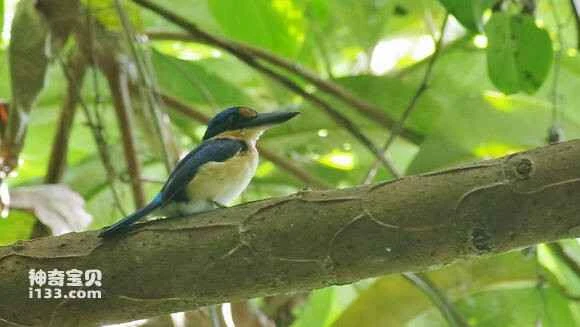
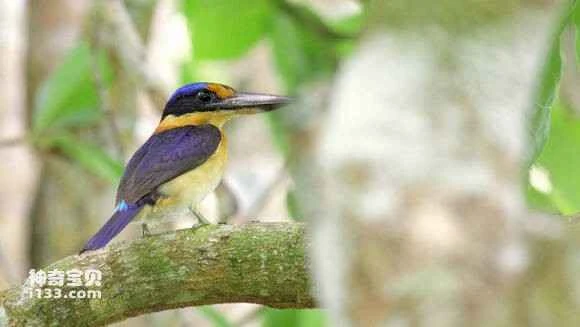
It has large reddish-brown spots in front of the eye, hence the name "reddish-brown spotted jadeite".
Distribution and Habitat
Philippine jade is distributed across the islands of the Pacific Ocean (including Taiwan, the Dongsha Islands, Xisha Islands, Zhongsha Islands, and Nansha Islands of China, as well as the Philippines, Brunei, Malaysia, Singapore, Sumatra and Java of Indonesia, and Papua New Guinea).
The Philippine kingfisher has been recorded at altitudes of up to 1,000 meters on some islands. It typically inhabits dense forests and waterfront areas.
Appearance
The Philippine Kingfisher is 25 cm long, with males weighing 60-64 grams and females 67-80 grams. It has a large reddish-brown spot in front of its eyes, hence its other name, the Reddish-Brown Spotted Kingfisher. Its plumage is dazzling, slightly blackish with an iridescent blue sheen, especially bright on the head and rump. The female has a pale yellowish-orange forehead, while the male has a white belly. Juveniles have darker plumage than adults, with an orange breast and collar. There are five subspecies of the Philippine Kingfisher, each differing in the intensity of the blue on its upperparts and the color of the female's belly.
The beak is thick and long, resembling a chisel, with a relatively wide base, a straight beak peak, a rounded ridge, and no nasal grooves on either side; the wings are rounded, with the first primary flight feather being the same length as or slightly shorter than the seventh primary flight feather, and the second, third, and fourth primary flight feathers being nearly the same length; the base of the primary flight feathers has white spots; the tail is rounded.
Detailed introduction
The Philippine jadeite, scientifically known as *Todirhamphus winchelli* or *Halcyon winchelli*, and commonly called Rufous-lored Kingfisher or Wincell's Kingfisher, has five subspecies: (1. *Todirhamphus winchelli nesydrionetes*, distributed in Tasmania, Philippines; 2. *Todirhamphus winchelli nigrorum*, distributed in Samar, Bililan, Leyte, Negros, Cebu, Siquijor, and Boho; 3. *Todirhamphus winchelli mindanensis*, distributed in Mindanao; 4. *Todirhamphus winchelli winchelli*, distributed in Basilan; 5. *Todirhamphus winchelli alfredi*, distributed in the Sulu Archipelago (Bounao, Saya Saya, Tawi-Tawi, Jolo).)

The Philippine kingfisher typically hunts alone or in pairs. Like most forest kingfishers, it is entirely carnivorous, often searching for prey in leaves or soil. Its main diet consists of invertebrates such as crickets, spiders, scorpions, and snails. It also eats small vertebrates such as small fish, small snakes, and lizards.
The breeding season for the Philippine Emerald is from April to May each year. Chicks leave the nest between April and August, building their nests on earthen cliffs or riverbanks. They dig tunnel-like burrows with their beaks, about 60 cm deep, 20 cm wide, and 10 cm high, with an oval shape. These burrows are generally unlined. Eggs are laid directly on the ground inside the nest. Some also burrow into tree trunks to make nests. The eggs are nearly round, pure white, and approximately 29.4 × 26.2 mm in size.

Listed in the IUCN Red List of Birds, ver 3.1: 2008.
Protect wild animals and ban the consumption of wild game.
Maintaining ecological balance is everyone's responsibility!


