Basic Information
Scientific classification
- Chinese name: Muscovy duck
- Scientific name: Muscovy Duck, also known as the Red-faced Duck, American Duck, Cairina moschata.
- Classification: Waterfowl
- Family and genus: Anseriformes, Anatidae, Diaper
Vital signs data
- Body length: 66-84 cm
- Weight: 1250-3000g
- Lifespan: Approximately 20 years
Significant features
It has red or dark reddish-black tubercles at the base of its beak and around its eyes. It flaps its wings and floats in the water, but is not good at swimming for long periods of time.
Distribution and Habitat
It is distributed in Argentina, Belize, Bolivia, Brazil, Colombia, Costa Rica, Ecuador, El Salvador, French Guiana, Guatemala, Guyana, Honduras, Mexico, Nicaragua, Panama, Paraguay, Peru, Suriname, the United States, Uruguay, Venezuela, the Bolivarian Republic, Trinidad and Tobago, Chile, and Puerto Rico.
The mute duck is native to Central America, South America, and the eastern Andes Mountains. It inhabits the trees along slow-moving rivers in lakes and tropical lowland forests, and appears in brackish water swamps and coastal lagoons during the dry season.
Appearance
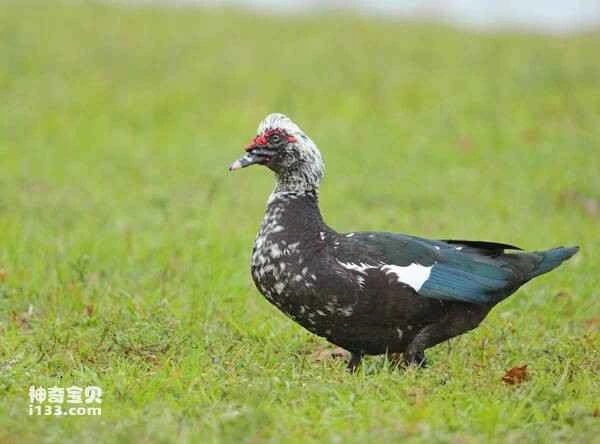
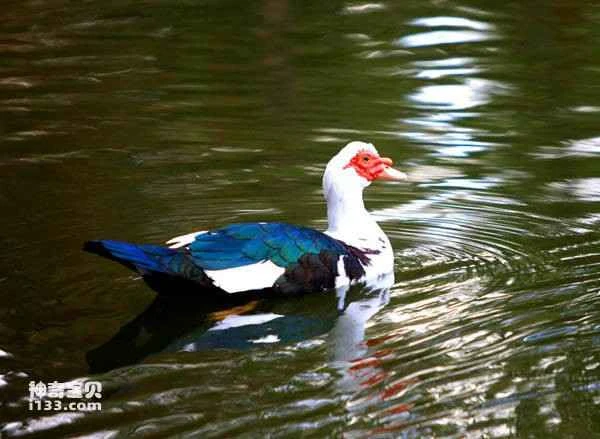
The Muscovy duck is 66-84 cm long with a wingspan of 120 cm. Females weigh 1250 g, and males weigh 3000 g. It has a robust and stout body, slightly flattened, tapering from front to back, and is elongated oval in shape. The head is large and short, with a relatively short and narrow beak, bright red or dark red. The base of the beak and around the eyes have red or reddish-black tubercles that extend wide and thickly on both sides of the head. There are no feathers around the eyes and beak. The eyes are bright red. The chest is broad and flat, and the wings are large, long, and powerful. The legs are short and stout, red, orange-red, or black. The toes are hard and sharp, with large and thick webbed feet. The plumage comes in various colors, including pure black, pure white, black and white, or white mixed with blue-green.
Detailed introduction
The Muscovy Duck (scientific name: *Cairina moschata*) has no subspecies. Captive Muscovy Ducks are mostly pure white, often called "white ducks," but there are also variegated types with black and white plumage, similar in color to wild Muscovy Ducks.
Mute ducks congregate in small groups of about 30, even during molting. They are cautious and timid; males lack territoriality, and pair bonds are relatively loose and short-lived. They prefer warm waters, playing and flapping their wings, but are not adept at prolonged swimming. They live in flocks, are docile, and move clumsily with a steady gait. When resting, they tuck their heads under their wings, assuming a "one-legged" posture. Males often emit a low, hoarse "li li" call, while females emit a soft "na na" call.
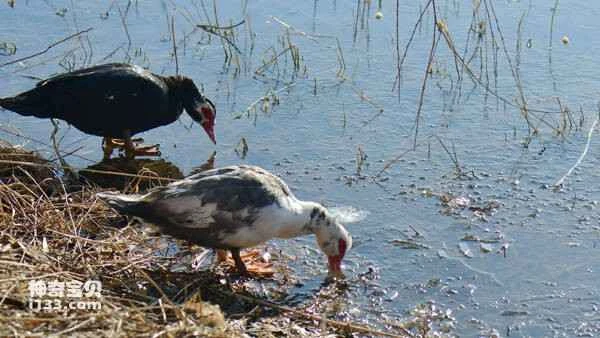
The mute duck is mainly active at night and in the early morning. It lives and forages in shallow water, and sometimes also roams grasslands and shorelines. It is a herbivore, feeding mainly on the roots, seeds, stems, and leaves of aquatic plants, but also eats insects, mollusks, crustaceans, and small vertebrates such as small fish and reptiles.
The breeding season for the Mute Duck varies by region. In Guyana, nesting occurs from February to March; in Venezuela, from June to November; in Panama, from July to November; and in Bolivia and Peru, from March. Nests are built in various locations depending on the environment, with palm trees, huts, old nests of birds of prey being preferred. Various types of nests are even constructed on the ground or in large crevices in thick vegetation along riverbanks. The female lines the bottom of the nest with her breast feathers and lays a clutch of eggs, up to 21, within 9 to 15 days. The incubation period varies from 30 to 35 days. Although highly productive, the survival rate is low, with only 2 or 3 ducklings surviving.
The Muscovy duck is an excellent lean-meat duck. Its meat is delicious, tender, and not greasy, with a unique aroma, making it a popular winter tonic. Internationally, Muscovy duck production has gained attention, and the number raised is constantly increasing, with France having the largest population. The French company Grimaud has developed four specialized high-yield strains (R31, B41, R51, and B61). Muscovy duck farming in China is developing rapidly, with significant numbers raised in Fujian, Hainan, Guangdong, Guangxi, Zhejiang, Jiangsu, Jiangxi, Hunan, and Anhui provinces. Hubei, Shanghai, and Sichuan provinces have also begun introducing and breeding Muscovy ducks, gradually replacing some other wild duck breeds.
The Muscovy duck is characterized by its strong disease resistance, tolerance to extensive farming, low subcutaneous fat content, high lean meat percentage, delicious meat, rapid growth, large size, tolerance to coarse feed, easy fattening, low carcass fat content, and good growth and fattening performance. Under normal conditions, at 1.0 week old, males reach a weight of 3000-3500 grams, and females reach 1800-2200 grams. The carcass fat content is 15%-18%, which is 10 percentage points lower than that of the Beijing duck. It has a high lean meat percentage, with breast and leg muscles accounting for 27%-30% of the carcass, and the meat is delicious and has a rich gamey flavor.
Muscovy ducks are highly efficient at utilizing feeds rich in crude fiber. Under the same conditions, Muscovy ducks have a higher feed conversion ratio than Peking ducks. Generally, the feed conversion ratio for Muscovy ducks is 2.7-3.0:1. Breeding ducks, under free-feeding conditions, consume no more than 180-200 grams of feed per day during peak egg production. They exhibit strong compensatory abilities during the rearing period, saving on concentrated feed. Muscovy ducks consume less feed than geese and other duck breeds when producing foie gras, and force-feeding is simple. Each duck produces foie gras weighing 325-444 grams, with a tender, succulent, and delicious texture, and a high pass rate. Additionally, they yield approximately 30% more flavorful and valuable duck meat and high-quality down.
Listed as Least Concern (LC) on the IUCN Red List of Threatened Species 2013 ver 3.1.
Protect wild animals and ban the consumption of wild game.
Maintaining ecological balance is everyone's responsibility!