
Basic Information
Scientific classification
- Chinese name: White-fronted Bee-eater
- Scientific name: Merops bullockoides, White-fronted Bee-eater
- Classification: Climbing birds
- Family and genus: Coraciiformes, Nematodae, Nematodae
Vital signs data
- Body length: 22-24 cm
- Weight: 28-35g
- Lifespan: No verification data available.
Significant features
It has a white forehead, and its head, back, and neck are light yellowish-brown.
Distribution and Habitat
It is distributed in Angola, Botswana, Burundi, Congo, Democratic Republic of Congo, Gabon, Kenya, Malawi, Mozambique, Namibia, Rwanda, South Africa, Swaziland, United Republic of Tanzania, Zambia, and Zimbabwe.
The white-fronted bee-eater is frequently found in dry riverbeds, scrublands, grasslands, woodlands, and seasonal rivers. Its primary habitat is the sub-equatorial grasslands of Africa. Its habitat includes vast rural areas, especially near ditches.
Appearance
The White-fronted Bee-eater measures 22-24 cm in length, with males weighing 28-35 grams and females 31-38 grams. Adult females are larger than males. The White-fronted Bee-eater is brightly colored, with a white forehead, pale yellowish-brown head, back, and neck. Its eyebrows are white, while the eyes, eye stripes, cheeks, and ear coverts are partially covered in black, with a broad white band along the lower side. The chin is white. The upperparts are green, the underparts are cinnamon, and the tail feathers are blue-blue. The primary flight feathers have black edges. The bright red throat contrasts sharply with the red breast and pale yellow belly. The vent and tail are blue. The tail tip is pale yellow with a black covering. The beak is black. The iris is dark brown, and the legs are dark gray.
The beak is relatively long and thin, with exposed nostrils; the body feathers are dense, normal, and without longitudinal stripes; the tail is convex, with the central tail feathers being particularly elongated and narrow or pointed at the tip; the middle and outer toes are often joined together to the last joint; the wings are long and pointed, with the first flight feather being small and the second being the longest.
Detailed introduction
The white-fronted bee-eater, scientifically known as *Merops bullockoides*, has two subspecies.
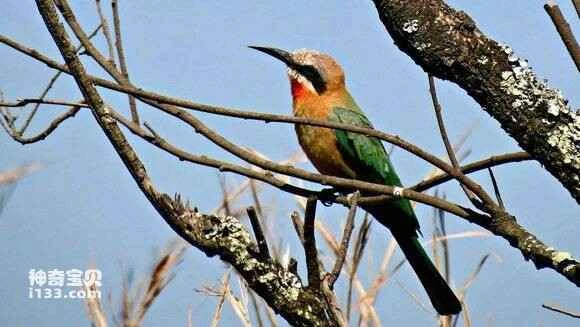
White-fronted bee-eaters often live in groups. They spend most of the day flying, soaring straight and fast with rapid wing flapping, sometimes accompanied by gliding. They are not afraid of people and sometimes enter villages, around houses, and orchards. When resting, they often perch on power lines, dead branches, or bushes. They hunt in flight.
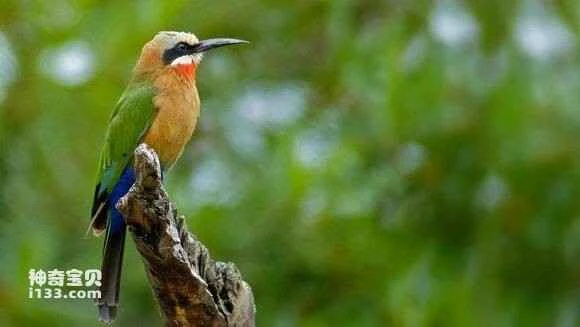
The white-fronted bee-eater primarily feeds on bees, which make up nearly 50% of its diet. It also eats other flying insects such as beetles, bedbugs, flies, crickets, termites, dragonflies, and damselflies, depending on the season and the availability of prey. They hunt from fixed positions on low branches or glide down to catch insects. Their call is a low, grating sound.
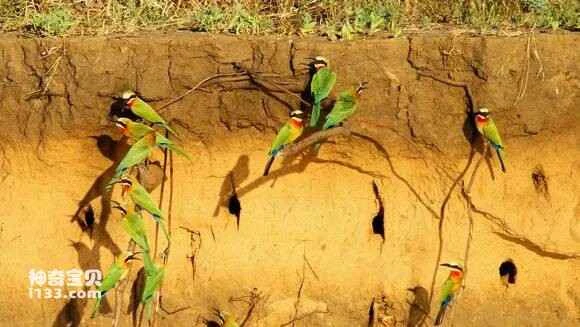
White-fronted bee-eaters typically live in colonies of 200 individuals, nesting in burrows dug into cliffs or along riverbanks. These colonies can span several square kilometers of grassland, but they return to the same location to inhabit, live, and breed. They possess one of the most complex social systems among birds. White-fronted bee-eaters have a monogamous social relationship, and the group engages in cooperative reproduction, with infertile members helping to raise the chicks. They help build more than half of the nest and act as assistants during the breeding process, including digging nests, feeding the female, incubating and feeding the chicks, significantly influencing the number of chicks born. During the breeding season, the female lays an average of 3-8 eggs, with the egg-laying period varying depending on location, rainfall, and temperature: April to June in Kenya, August to September in Zambia and Angola, February and April in Zimbabwe, and September to October in South Africa.
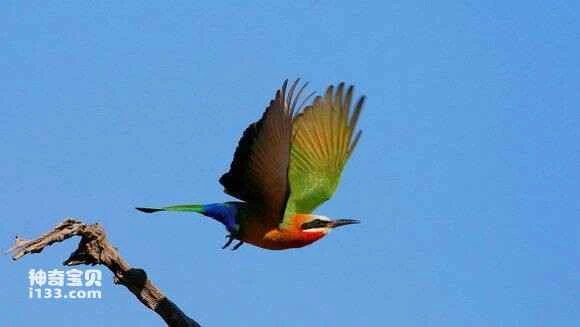
Listed as Least Concern (LC) on the IUCN Red List of Threatened Species 2013 ver 3.1.
Protect wild animals and ban the consumption of wild game.
Maintaining ecological balance is everyone's responsibility!


