
Basic Information
Scientific classification
- Chinese name: Golden-throated Woodpecker
- Scientific name: Psilopogon franklinii, Megalaima franklinii, Golden-throated Barbet
- Classification: Climbing birds
- Family and genus: Entomomorpha, Pterygomorphaceae, Pterygomorpha
Vital signs data
- Body length: 19-24 cm
- Weight: 72-122g
- Lifespan: No verification data available.
Significant features
Distribution and Habitat
Distribution in China: It is distributed in western, southern and southeastern Yunnan Province, including Gongshan, Lushui, Tengchong, Yingjiang, Yongde, Lancang, Xishuangbanna, Lüchun, Maguan, and Pingbian, as well as southern Tibet and southwestern Guangxi.
Global distribution: Found in China, India, Myanmar, Thailand, the Indochina Peninsula, and the Malay Peninsula.
The Golden-throated Barbet mainly inhabits evergreen broad-leaved forests at altitudes of 500-2500 meters, especially in forest valleys and along the banks of streams.
Appearance
The Golden-throated Barbet has a large deep red patch on its forehead and nape, and a golden-yellow crown. Its lores, crown, and sides of the nape are black, and its supercilium is grey or black. Its back, shoulders, inner wings, rump, and tail are grass-green, sometimes tinged with yellow. Partial green is visible on the wing surface, with dark blue or purplish-blue edges on the lesser and outer wing coverts. The inner webs of the flight feathers are blackish-brown with pale yellow edges; except for the first primary, the outer webs of the other primary flight feathers have blue edges. It has an orange patch at the base of its bill, a golden-yellow chin and upper throat, silver-grey sides of its head, ear coverts, and lower throat, and the rest of its underparts are pale yellowish-green.
The iris is brown, the beak is pale blue-black, and the tarsus, toes, and claws are grayish-green.
Size measurements: Weight: ♂ 72-122 g, ♀ 79-96 g; Body length: ♂ 199-240 mm, ♀ 199-230 mm; Bill length: ♂ 22-27 mm, ♀ 23-25 mm; Wing length: ♂ 95-108 mm, ♀ 98-105 mm; Tail length: ♂ 67-88 mm, ♀ 64-71 mm; Tarsus length: ♂ 22-29 mm, ♀ 24-29 mm. (Note: ♂ male; ♀ female)
Detailed introduction
The Golden-throated Barbet, scientifically known as *Psilopogon franklinii* or *Megalaima franklinii*, has three subspecies: 1. the nominate subspecies *Psilopogon franklinii franklinii*; 2. the Burmese subspecies *Psilopogon franklinii ramsayi*; and 3. the Lao subspecies *Psilopogon franklinii auricularis*.
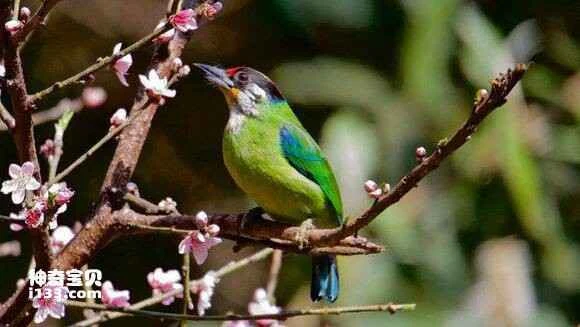
The Golden-throated Barbet is mostly solitary and prefers to perch on densely leafed trees. Its diet consists mainly of plant-based foods such as fruits, seeds, and flowers, but it also sometimes eats insects and insect larvae.
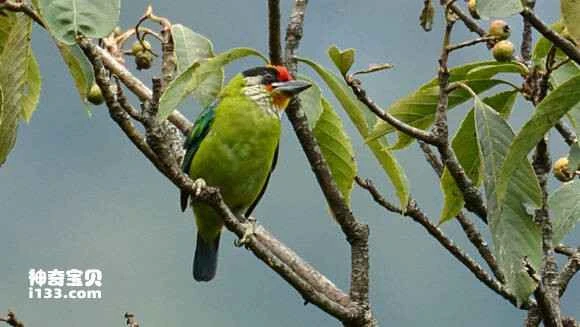
The breeding season for the Golden-throated Barbet is from April to August, with most of the breeding season in May and June. They nest in evergreen broad-leaved forests, pecking holes in decaying tree trunks or scions. The nest holes are empty of any lining and are typically 1.5-6 meters above the ground. Each clutch contains 2-5 eggs, usually 3-4. The eggs are white, oval, and measure 25-29 mm × 19-22 mm. Both parents take turns incubating the eggs; the chicks are altricial.
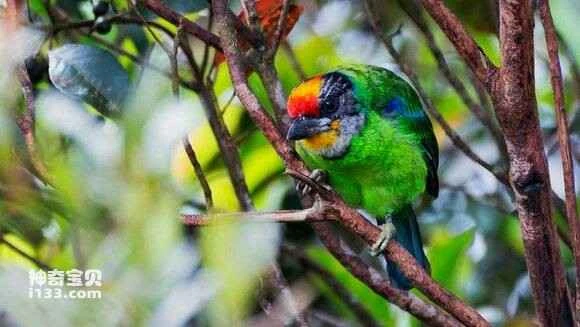
The population of the Golden-throated Barbet is extremely small.
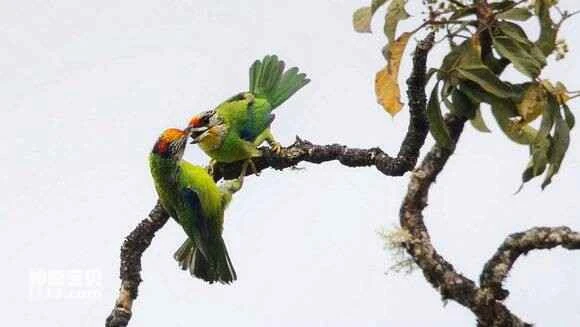
It is listed in the "List of Terrestrial Wild Animals of Beneficial or Important Economic and Scientific Research Value under State Protection" issued by the State Forestry Administration of China on August 1, 2000.
Listed as Least Concern (LC) on the IUCN Red List of Threatened Species (IUCN 2016 ver 3.1).
Protect wild animals and ban the consumption of wild game.
Maintaining ecological balance is everyone's responsibility!


