Basic Information
Scientific classification
- Chinese name: Common Loon
- Scientific name: Northern Loon, Common Loon (Gavia immer, Colymbus immer immer)
- Classification: Waterfowl
- Genus and family: Loons, order Loons, family Loons, genus Loons
Vital signs data
- Body length: 70-90 cm
- Weight: 3.7-4.48kg
- Lifespan: Approximately 9 years
Significant features
They have straight, thick, dagger-like beaks that are black during the breeding season and gray at other times.
Distribution and Habitat
It is most abundant in Canada and the northern United States. Its distribution spans from western Greenland, across the northernmost parts of Canada and the United States, with breeding grounds including around lakes and other waterways in Alaska. They winter along both coasts of North America, extending to Baja California Southern and Texas. Breeding populations also exist in Iceland, and the species is a frequent winterer on the west coast of Europe.
They nest on lakes and large ponds. Climate limits habitat selection, as common loons cannot nest on frozen water. They prefer to nest on offshore islands, islets, or in floating vegetation in shallow waters. In winter, common loons migrate to shallow coastal habitats. They are typically found in coastal waters, sometimes in tidal rivers and estuaries. They are a common species in the Arctic Ocean, especially in Norway and Sweden.
Appearance
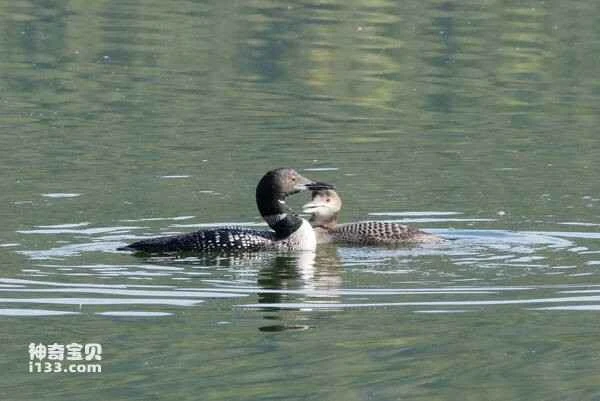
The Common Loon typically weighs 3700-4480 grams, is 70-90 cm long, and has a wingspan of 127-147 cm. It is a large waterfowl. Males are usually larger than females, but their appearance is similar. They have a straight, thick, "dagger-like" beak that is black during the breeding season and grey at other times. They have black, white, and grey plumage. During the breeding season, they have a black head adorned with a white and black pearl-like necklace, and a checkered pattern on their back. In winter, their head and back are uniformly grey, while their neck and underside are white. The Common Loon has distinctive plumage during the breeding season, distinguishing it morphologically from the Black-throated Loon and other loons. In winter, the Common Loon can be distinguished by the indentation in the white section of its neck. Its legs are black and light grey. The iris is wine-red.
Juvenile common loons resemble adults in winter, but have more white on their heads and backs. This juvenile state is maintained throughout the first summer.
Detailed introduction
The Common Loon (scientific name: Gavia immer) has no subspecies.
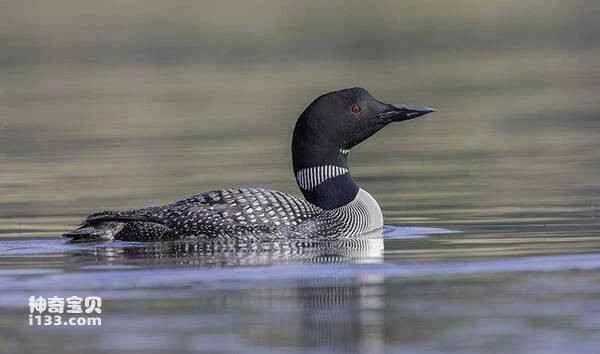
The common loon is a migratory species. Starting in September when they begin breeding, they migrate alone or in small flocks of up to 15 individuals. During migration, common loons may congregate in groups of hundreds on large inland lakes to roost together overnight. When wintering, they guard small feeding areas of 0.04–0.08 square kilometers during the day, but gather together at night.
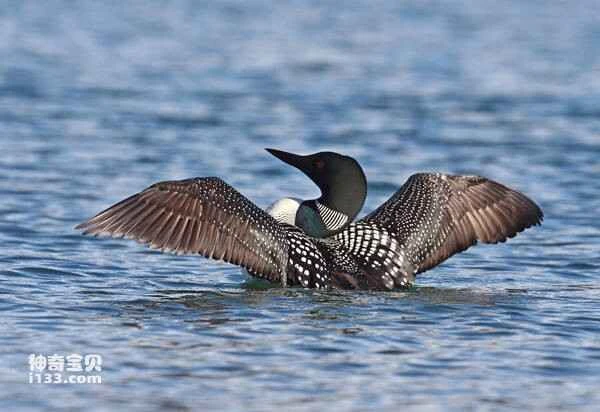
Their weight forces them to exert considerable effort to take off from the water. Once airborne, they can reach speeds of up to 40 km/h. During flight, their necks are slightly extended downwards. Common loons are skilled swimmers. They can extend their legs far from their bodies, making them very powerful underwater swimmers. However, this body structure also makes walking difficult for these birds. They can remain underwater for up to 3 minutes, although their dive time at a depth of approximately 12 meters will not exceed 40-60 seconds.
Common loons communicate using visual displays and vocalizations. They employ six visual displays and five vocalizations. These displays and vocalizations are used for courtship, territorial disputes, communication between pairs and offspring, and among group members, as well as for alarm purposes. They are silent in winter, but become noisy during the breeding season, emitting loud snickers and primal, repetitive complaining sounds. In flight, the female emits short barks.
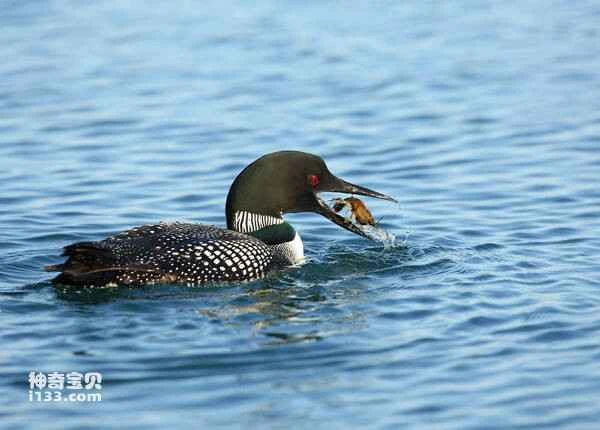
Common loons are predators that locate fish by sight and dive deep to catch them. They typically fish in water 2-4 meters deep. Because of their reliance on sight, clear water is crucial for common loons. Adults catch most of their food underwater. They bring larger prey to the surface before feeding. They also eat other aquatic animals, primarily marine fish up to 28 cm long, including cod, herring, haddock, bass, and eels, as well as small mollusks, crustaceans such as crayfish and shrimp, and some aquatic plants. They drink by scooping water with their lower beak and tilting their head back to swallow.
Common loons may be vulnerable to attacks from large marine mammals (such as sea otters) and large birds of prey (such as bald eagles and ospreys). Seagulls, crows, bald eagles, raccoons, skunks, weasels, alligator snapping turtles, and large fish are natural predators of common loon chicks.
Common loons typically nest on islands to avoid predation, where terrestrial predators are less common. When a predator approaches, they frantically charge at it and attempt to attack and drive it away using their abdomen, head, neck, or back.
Common loons breed annually in spring and summer. They are monogamous, remaining with their partners for life. The male and female arrive together at the breeding area in early spring. They establish territories ranging from 40 to 1200 acres and patrol them regularly. Common loons defend their territory and courtship through physical displays and vocalizations. For example, the male uses loud calls to indicate that its territory has been claimed. After the courtship display, the male and female swim ashore to mate. During mating, the male perches on the female's shoulders, extending his head beyond her body.
They build nests together, typically on unforested riverbanks near lakes. Nests are usually built on islands or peninsulas extending into the water, often near the shore in deeper water, allowing the parents to swim back and forth unnoticed by predators. The nest is placed in the ground near the water, a shallow depression about 0.6 meters in diameter, filled with soil, grass, moss, or other vegetation. During nest building, each pair maintains a distance of at least 400-500 meters from the other.
The female lays eggs between May and June, producing 1-3 eggs per clutch, one egg every other day. The eggs are olive-brown with some black spots. Incubation begins from the first egg laid, with both parents participating and protecting the nest together. The incubation period lasts 26-31 days. The chicks hatch asynchronously, with a maximum interval of one day. After hatching, they stay in the nest for one or two days, after which they leave the nest with their parents and rarely return to the shore. The chick stage lasts 2-3 months, during which the chicks stay with their parents in the surrounding area, sometimes riding on the back of one parent for several weeks. The parents feed the chicks every hour. They also protect the chicks from predators by vocalizing and swimming away from them to distract them. In the first few weeks of the chick stage, the parents often carry the chicks on their backs. If the chicks are cold, the parents may return to the shore with them, sheltering the chicks under their wings. The chicks begin diving into the water at close range two days after hatching, eventually reaching depths of 3 meters. They are able to fly within 2-3 months. Once they can fly, young common loons can become independent of their parents. Common loons are considered to be relatively long-lived birds. Wild common loons are known to live at least 9 years.
Common loons are primarily threatened by habitat loss or degradation. They are highly sensitive to human disturbance from recreational or developmental activities in secluded lakes. They are also threatened by industrial pollutants, such as the accumulation of mercury and other heavy metals, which build up on lobsters, their primary food source, and slowly poison them. Acid rain kills phytoplankton, disrupting the food chain on which lobsters depend. Oil spills are fatal to common loons; when their feathers are soaked in oil, they are unable to fly, dive, or swim. Lead poisoning from ingesting lead weights and becoming entangled in fishing nets is another cause of death.
Listed as Least Concern (LC) in the IUCN Red List of Threatened Species 2018 ver 3.1.
Protect wild animals and ban the consumption of wild game.
Maintaining ecological balance is everyone's responsibility!