
Basic Information
Scientific classification
- Chinese name: White-billed Loon
- Scientific name: Yellow-billed Loon, White-billed Diver (Gavia adamsii)
- Classification: Waterfowl
- Genus and family: Loons, order Loons, family Loons, genus Loons
Vital signs data
- Body length: 75-100 cm
- Weight: No verification information available.
- Lifespan: No verification data available.
Significant features
It is the largest of the loons.
Distribution and Habitat
The White-headed Loon breeds in the northernmost parts of Russia, including the Kola Peninsula, Kolgiev Posad, Novaya Zemlya, Yamal Peninsula, and Taymyr Peninsula. It then travels eastward across northern Siberia, passing the Indigirka and Kolyma Rivers, reaching Magadan on the coast of Okhotsk and the Chukchi Peninsula in eastern Siberia. From there, it crosses the Bering Strait to St. Lawrence Island and northern Alaska in the United States, as well as the northern coast and islands of Canada. It winters in the Kamchatka Peninsula, Sakhalin Island, southern Alaska, and the Norwegian coast, and occasionally in Sweden, the British Isles, the North Sea, the Baltic Sea, Italy, North Korea, Japan, the Liaodong Peninsula in China, and Fujian province.
Distribution in China: Liaodong Peninsula (Liushutun), Fujian (Fu'an).
Native distribution: Belgium, Canada, China, Denmark, Finland, Japan, North Korea, South Korea, Mexico, Norway, Sweden, and the United States.
Migratory birds are distributed in: Austria, Belarus, Bulgaria, Croatia, Czech Republic, Estonia, Faroe Islands, France, Germany, Greenland, Ireland, Italy, Myanmar, Netherlands, Poland, Slovakia, Slovenia, Spain, Svalbard and Jan Mayen, Switzerland, Ukraine, and the United Kingdom.
During the breeding season, the white-billed loon mainly inhabits lakes and estuaries near the Arctic tundra coast, and also appears in mountainous lakes and rivers in northeastern Siberia. During the autumn migration and winter, it mainly inhabits the sea near coastal and near-shore islands, and sometimes appears in estuaries.
White-billed loons prefer deep, clear lakes with stony or sandy bottoms and gentle surface undulations. Their ideal habitat is a lake that is not completely frozen, rich in fish and aquatic plants, with a complex shoreline that provides good conditions for nesting and incubation. They usually avoid forested areas, but sometimes they will fly away from their breeding grounds to find food.
Appearance
The White-billed Loon has a black head and neck with a bluish-green metallic sheen during summer plumage. It has a discontinuous horizontal band of white spots on its throat, and a broad white band from the foreneck to the sides of the neck, which tapers towards the foreneck and is interrupted in the middle of the foreneck. Its upperparts are black, with white spots on its back and wing coverts. Its shoulders have many identical rectangular white patches, and its uppertail coverts have small, paired white spots. Its underparts are white. Its sides of the breast and flanks are black, with paired white streaks and spots. Its undertail coverts have black horizontal bars.
In winter plumage, the upperparts are grayish-brown, the crown and nape are pale grayish-brown, and there is a white ring around the eyes; there is often a dark brown spot on the ear area; the underparts are white, and the white on the chin, throat and foreneck is not clearly separated from the grayish-brown nape; the white spots on the back and wings are not obvious or absent.
The juvenile birds resemble the adult birds in winter plumage. However, their upperparts are paler, with pale grayish-white edges on the back, shoulders, and wing coverts, forming a distinct white spot on the back.
The iris is reddish-brown, the beak is yellowish-white, and the tarsus is brown.
Size measurements: Body length 750-1000 mm; bill length 88-90 mm; wing length 310-405 mm; tail length 60-65 mm; tarsus length approximately 87 mm.
Detailed introduction
The White-headed Loon (scientific name: *Gavia adamsii*) is a large waterfowl belonging to the family Gaviaidae in the order Loons. The White-headed Loon is very similar in appearance to the Great Loon (G. immer), leading some scholars to consider it a subspecies of the Arctic Loon. However, most scholars classify it as a separate species because their breeding grounds overlap in North America, and they differ in size, bill color, and shape (the White-headed Loon is larger and has a paler bill).

White-billed loons are usually found in pairs or small flocks, and occasionally singly in larger lakes and at sea, but not in small ponds. In the water, they sink relatively deep, with their necks straight, heads held high, and bills tilted upwards. In flight, their heads and necks are extended forward, with their legs extended behind their tails. They are fast fliers, but takeoff from the water is difficult and requires a running start. Their calls are high-pitched and harsh. They are usually silent at sea, but emit falsetto screams in their breeding grounds.
The white-billed loon primarily feeds on fish, but also consumes aquatic insects, crustaceans, mollusks, and other invertebrates. It forages by diving, typically in tundra lakes and at sea.
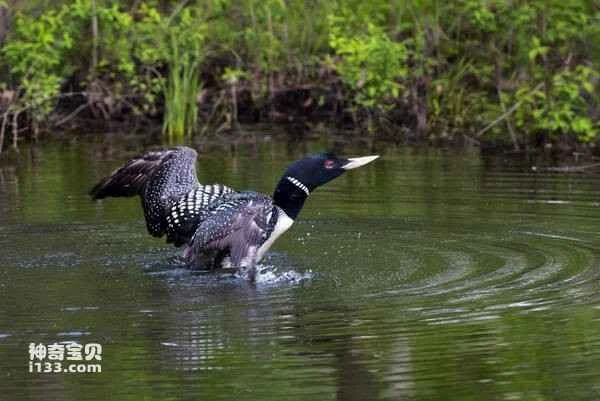
The White-billed Loon migrates in spring from April to May, arriving at its breeding grounds in late May or early June. It migrates again in autumn from September to October, reaching its wintering grounds in October and November. It is a rare winter migratory bird in China.
The White-billed Loon breeds from June to August, in the Arctic and subarctic tundra and tundra forests. They nest on the shores of tundra lakes in very simple nests made of dry grass. Each clutch contains 1-2 eggs, usually 2. The eggs are brown with small dark brown spots, measuring 80-95 mm × 53.5-66 mm, with an average of 89 mm × 56.9 mm.

The population of the white-headed loon is declining rapidly due to unsustainable hunting, and specific data needs further quantification. A 2007 record of approximately 1,000 white-headed loons in the Bering Strait region indicated that hunting is the greatest threat to the species' survival. Both in their breeding and wintering grounds, the white-headed loon is threatened by coastal oil spills. In its breeding grounds on the Alaskan Arctic Coast, 90% of white-headed loon nests are threatened by oil and gas development sites, and 29% are located in vast areas used for oil and gas transportation. Wintering white-headed loons are potentially threatened by heavy metal pollution and entanglement in fishing nets. Climate change may pose a future threat to the species, while its relatively low reproductive rate and specific habitat requirements are also contributing factors to these threats.
In 2006, the Fish and Wildlife Conservation Society of America, together with its partners, proposed an agreement aimed at protecting the white-billed loon in western and northern Alaska and reducing threats to its population. Current needs include obtaining population data, establishing monitoring programs to observe white-billed loon population trends, assessing hunting levels and implementing control measures, and evaluating and comparing the potential impacts of ecological and climate change on the population.
Listed in the China Species Red List (2004), assessment level: not assessed (NA, marginal distribution area in China).
Listed in the IUCN Red List of Threatened Species (ver 3.1: 2010–2018) as Near Threatened (NT).
Protect wild animals and ban the consumption of wild game.
Maintaining ecological balance is everyone's responsibility!


