Basic Information
Scientific classification
- Chinese name: Blue-naped mousebird
- Scientific name: Blue-naped Mousebird, *Urocolius macrourus*
- Classification: Climbing birds
- Genus and family: Order Rodentia, Family Rodentia, Genus *Longtailus*
Vital signs data
- Body length: Approximately 35 centimeters
- Weight: No verification information available.
- Lifespan: No verification data available.
Significant features
The head feathers are soft, the neck feathers are blue, and the tail feathers are slender and long.
Distribution and Habitat
It is widely distributed in Benin, Burkina Faso, Burundi, Cameroon, Chad, Djibouti, Democratic Republic of Eritrea, Chad, Congo, Ethiopia, Guinea-Bissau, Kenya, Mali, Mauritania, Niger, Nigeria, Rwanda, Senegal, Somalia, Sudan, Tanzania, Uganda and other countries, and is also found in Gambia.
Blue-naped mousebirds typically inhabit thorny thickets.
Appearance
The Blue-naped Mousebird is about 35cm long. It has soft head feathers and blue neck feathers. Its tail feathers are thin and long, and its body appears rather plump. It is grayish-white or brown. Its beak and eyes are reddish-black and very small. Unlike other four-toed birds, its toes extend forward to help it grip branches when perching. The outward-curling outer toes make it more agile when walking and jumping.
Detailed introduction
The Blue-naped Mousebird (scientific name: Urocolius macrourus) has three subspecies.
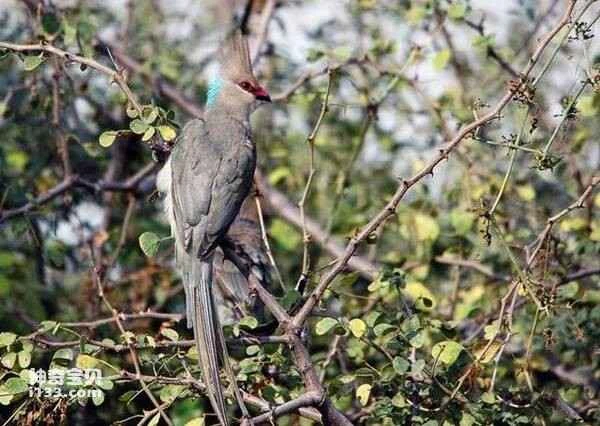
Blue-naped mousebirds typically flap their wings for short, horizontal flights, sometimes gliding. They often climb to high places to survey the surrounding vegetation. Their main diet consists of green leaves, but they also eat nectar, fruits, and seeds. They are very voracious, with large appetites and slow digestion, causing their bellies to swell into a pot-like shape. Therefore, they habitually hang from trees with their legs spread shoulder-width apart. These birds often huddle together tightly to roost, preening each other's feathers and building skirt-like nests. They frequently emit soft, two-syllable calls while flying and roosting.
Listed as Least Concern (LC) in the IUCN Red List of Threatened Species ver 3.1 2009.
Protect wild animals and ban the consumption of wild game.
Maintaining ecological balance is everyone's responsibility!