
Basic Information
Scientific classification
- Chinese name: White-backed Mousebird
- Scientific name: Colius colius, white-backed mousebird
- Classification: Climbing birds
- Genus and family: Order Squirrels, Family Squirrels, Genus Squirrels
Vital signs data
- Body length: 30-34 cm
- Weight: 38-64g
- Lifespan: No verification data available.
Significant features
Their tail feathers have grayish-white stripes and are extremely long.
Distribution and Habitat
White-backed mousebirds prefer to live in sparse woodlands or forests, where natural resources are often abundant.
Appearance
The white-backed mousebird is about 30-34 cm long and weighs 38-64 g. Its tail feathers are grayish-white striped and exceptionally long, twice the length of its body. The beak is bluish-white, while the head, crest, and chest are grayish-brown; the belly is pale yellow with a few spots. The legs and feet are orange-red. Unlike other four-toed birds, its toes extend forward to grip branches when perching; the outward-curving outer toes make it more agile when walking and jumping.
Detailed introduction
The white-backed mousebird (scientific name: Colius colius) has two subspecies.
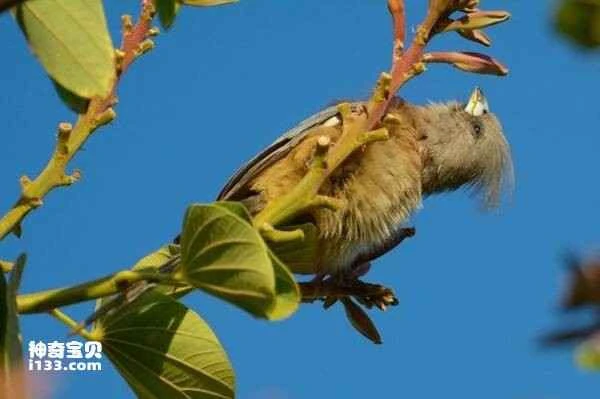
White-backed mousebirds are gregarious and feed mainly on green leaves, but also on nectar, fruits, and seeds. They are very greedy, with a large appetite but slow digestion, so they often swell their abdomens into a bulging pot shape. Therefore, they habitually spread their legs as wide as their shoulders and "hang" on the tree, much like woodpeckers.
After mating each year, a pair of white-backed mousebirds build a nest using old twigs, leaves, and grass. Each female lays 1-6 eggs, which are incubated by both parents in turn. The chicks hatch after 11-13 days. From the time a pair of mousebirds incubates the eggs until they leave the nest, the chicks are continuously hatched. Captive-raised chicks remain in the nest for approximately 11-20 days, becoming independent after 21 days.
This species received little attention from 1988 to 2000, but was listed as a protected animal after 2004. It was listed as an endangered species on the IUCN Red List of Threatened Species in 2010.
Protect wild animals and ban the consumption of wild game.
Maintaining ecological balance is everyone's responsibility!


