
Basic Information
Scientific classification
- Chinese name: Red-backed Mousebird
- Scientific name: Colius castanotus, Red-backed Mousebird
- Classification: Climbing birds
- Genus and family: Order Squirrels, Family Squirrels, Genus Squirrels
Vital signs data
- Body length: 29-38 cm
- Weight: No verification information available.
- Lifespan: No verification data available.
Significant features
The back—especially the part near the tail—has orange-red feathers.
Distribution and Habitat
It is distributed in Angola, the Democratic Republic of Congo, and the Republic of Congo.
Appearance
The Red-backed Mousebird is about 29-38 cm long, with creamy white or brownish-yellow feathers, and orange-red feathers on its back, especially near the tail. Its tail feathers are extremely long, twice the length of its body; it has a full crest; a grayish-brown beak; and orange-red feet. Unlike other four-toed birds, its toes extend forward to grip branches when perching; the outward-curling outer toes make it more agile when walking and jumping.
Redback mousebirds typically inhabit thorny thickets or jungles.
Detailed introduction
The Red-backed Mousebird (scientific name: *Colius castanotus*) is, like all mousebirds, a very gregarious and cooperative species. Its main diet consists of green leaves and buds, but it also eats nectar, fruit, and seeds. It is quite voracious, with a large appetite but slow digestion, which causes its abdomen to swell into a pot-like shape. Therefore, it habitually hangs from trees with its legs spread shoulder-width apart.
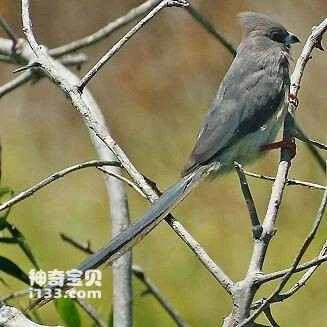
The mousebird's nest is an open, bowl-shaped structure made of twigs, built several meters above the ground in dense thickets of thorns, and is usually quite messy. In Namibia, the nests of the spotted mousebird and the red-faced mousebird are often located near hornet nests. Mousebirds typically lay 2-4 eggs per clutch, and, except for nest parasitic cuckoos, the weight of their clutch of eggs as a percentage of the female's body weight is the smallest among all bird species. Incubation is shared by both parents, sometimes even simultaneously, and occasionally by a helper; the incubation period is 11-15 days. Chicks may leave the nest 10 days after hatching, before they can fly, but for the next 4-6 weeks they are fed regurgitated plant matter by members of the family group. Surviving chicks generally continue to live with family members for some time after they can fly. Females are more likely than males to leave the group.
This species received little attention between 1988 and 2000, but was listed as a protected species after 2004. It is listed as an endangered species on the IUCN Red List of Threatened Species in 2010.
Protect wild animals and ban the consumption of wild game.
Maintaining ecological balance is everyone's responsibility!


