Basic Information
Scientific classification
- Chinese name: Long-nosed Bulbul
- Scientific name: Perameles nasuta
- Classification: Mammals
- Family and genus: Bandicootidae, Genus: Bandicoot
Vital signs data
- Body length: Head and body length is about 31–44.5 cm, and tail length is about 12–16 cm (there are significant differences between different regions and individuals).
- Weight: Common weight is about 0.75–1.10 kg (males are usually larger); the range of individuals can be wider under special conditions.
- Lifespan: Limited data on lifespan in the wild; the longest recorded lifespan in captivity is about 5.6 years.
Significant features
Nocturnal marsupials in eastern Australia often leave cone-shaped digging pits in lawns/forests. They mainly feed on invertebrates, but also consume fungi and plants.
Distribution and Habitat
Eastern Australia (parts of Queensland, New South Wales, and Victoria); inhabits eucalyptus forests, woodlands, rainforest edges, humid valleys, and some suburban gardens, preferring a mosaic environment of "open foraging grounds + concealed shrubs".
Appearance
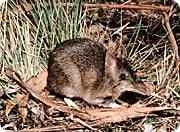
The back is dark grayish-brown, while the belly and feet are lighter in color; the muzzle is long and sharp, and the ears are large and pointed; the back is slightly arched, and the female has a pouch that opens at the rear.
Detailed introduction
The long-nosed bandicoot (scientific name: Perameles nasuta ) is a medium-sized marsupial commonly found in eastern Australia, known for its long snout and ability to dig for food in the ground. They are nocturnal and prefer to inhabit woodlands, rainforest edges, grasslands, and suburban gardens, often leaving small, cone-shaped "digging holes" in lawns or under trees.
Although the species is widely distributed globally, in some large urban areas, populations are declining locally due to road traffic, invasive predators (foxes and cats), and habitat fragmentation. Some urban subpopulations have even been listed as key protected species in local lists.
Classification and nomenclature
The long-nosed bandicoot belongs to the order Peramelemorphia, family Peramelidae, and genus Perameles . It's important to note that some populations in North Queensland were previously considered a subspecies ( P. n. pallescens ), but subsequent research elevated them to a separate species, "Northern Long-nosed Bandicoot" ( Perameles pallescens ). Therefore, P. nasuta now generally corresponds to the concept of long-nosed bandicoots distributed in the "southern/southern" region.
Appearance features
They are about the size of a rabbit, with a dark grayish-brown or sandy-brown back and a creamy-white underside, forefeet, and upper hind feet. They have a long, pointed muzzle, relatively large and pointed ears, and a slightly arched back. Females have a pouch that opens at the rear. Males are usually slightly larger and heavier than females.
Distribution range and habitat
They are mainly distributed in eastern Australia, extending south from the east coast of Queensland through New South Wales and into parts of Victoria. Their habitats are diverse, including eucalyptus forests, woodlands, rainforest edges, scrublands, damp valleys, and some suburban gardens and parks. They typically require a mosaic environment of "open foraging grounds + concealed hiding places": foraging at night in grasslands or leaf litter, and nesting and resting in scrub or thick leaf piles during the day.
Lifestyle Habits and Behaviors
Nocturnal and terrestrial, they are usually solitary or loosely distributed within overlapping ranges. They use their forelegs to quickly dig through the soil and leaf litter in search of food, leaving characteristic cone-shaped pits. When threatened, they can quickly burrow into bushes or use their nests for cover.
feeding habits
Omnivorous but primarily feeding on animal matter, they commonly consume beetles and larvae, earthworms, spiders, and other invertebrates. They also eat fungi (such as terrestrial fungi), seeds, tender roots, and other plant matter. Their digging behavior plays an ecological role in soil turning and leaf litter renewal.
Reproduction and life cycle
Breeding season is related to regional climate. Gestation is extremely short (approximately 12.5 days), and the young continue to develop in the pouch for about 50–54 days before weaning. Multiple offspring are typically produced per litter, but the final number of successfully raised offspring is affected by resources and the environment. Wild lifespan data is limited; the longest recorded lifespan in captivity is approximately 5.6 years.
Relationship with humans
In some suburban communities, bandicoots enter gardens to feed on insects and larvae, and are considered "natural gardening helpers"; however, they can also leave digging holes in lawns, causing "human-wildlife conflict." Road injuries and deaths, as well as predation by domestic/stray cats and foxes, are significant risks in urban and suburban areas.
Protecting the status quo and threats
On a global scale, the IUCN assesses the long-nosed bandicoot as Least Concern (LC). Key threats include habitat loss and fragmentation, invasive predators (foxes and cats), road traffic fatalities, dog attacks, and the impact of extreme events such as localized fires and droughts on habitat and food resources. Even though it is not generally endangered, maintaining greenway connectivity, reducing vehicle speeds, and managing pets effectively remain crucial measures for the conservation of this species in urban areas.
Frequently Asked Questions
Q1: Is the long-nosed bilby a mouse?
No. It is a marsupial endemic to Australia, belonging to the order Thylacoleos, and is a marsupial like wombats and kangaroos.
Q2: Why do they dig so many small holes in the lawn?
Those are traces left by nighttime foraging, as they search for food such as beetle larvae, earthworms, and fungi in the soil and leaf litter.
Q3: Where are long-nosed bandicoots mainly distributed?
Primarily in eastern Australia, from the east coast of Queensland to New South Wales, and extending into parts of Victoria.
Q4: Is the long-nosed bandicoot an endangered animal?
The global IUCN assessment is Least Concern (LC), but local populations in urban areas may decline due to roads and predation by foxes/cats.