
Basic Information
Scientific classification
- Chinese name: Bora Jade
- Scientific name: Todirhamphus tuta, Chattering kingfisher
- Classification: Climbing birds
- Family and Genus: Coraciiformes, Kingfisher Family, Kingfisher Genus
Vital signs data
- Body length: Approximately 22 centimeters
- Weight: No verification information available.
- Lifespan: No verification data available.
Significant features
Distribution and Habitat
This species lives in primary forests, and is particularly distributed in the islands of the Pacific Ocean (including Taiwan, the Dongsha Islands, Xisha Islands, Zhongsha Islands, and Nansha Islands of China, as well as the Philippines, Brunei, Malaysia, Singapore, Sumatra and Java in Indonesia, and Papua New Guinea). It is found in valleys, streams, secondary forests, gardens, woodlands, coconut groves, farmland and vegetable gardens near villages.
Appearance
The Bora jadeite is 22cm long and is identical in both sexes.
The top of the head is a deep blue-green, with two large white eyebrows extending down to the neck from the white forehead. The lores are black, and the cheeks are greenish-black. The chin, throat, collar, and underparts are a beautiful white. There is a narrow black line on the neck. The wattles and scapulae are deep blue-green. The wings, tail, and tail are dark blue-green. The upper jaw is black. The irises are dark brown, and the eyes are black. The legs are gray or black.
The juvenile's plumage is dark green with a pale yellow-white and green stripe at the top. The eyebrows have thin green and white stripes. The throat and chin are white with fine black streaks on either side; the neck is black with a hidden black stripe on the white collar. The outer coat is black or dark green, darker than the adult's. The breast has strong black and white stripes. The belly is dark white. The rest of the plumage is the same as the adult.
The beak is thick and long, resembling a chisel, with a relatively wide base, a straight beak peak, a rounded ridge, and no nasal grooves on either side; the wings are rounded, with the first primary flight feather being the same length as or slightly shorter than the seventh primary flight feather, and the second, third, and fourth primary flight feathers being nearly the same length; the base of the primary flight feathers has white spots; the tail is rounded.
Detailed introduction
The Bora kingfisher, scientifically known as *Todirhamphus tuta*, also called Chattering kingfisher, has three subspecies: (1. *Todirhamphus tuta tutus*, found on Tahiti in the Society Islands; 2. *Todirhamphus tuta atiu*, found on Raiatia, Huahine, and Tahiti in the Society Islands; 3. *Todirhamphus tuta mauke*, found in the southeastern Cook Islands.)
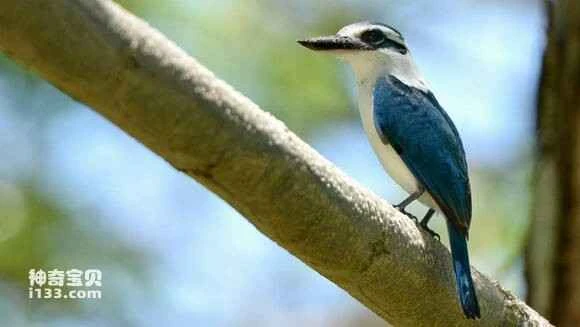
Bora kingfishers are noisy birds. Despite inhabiting marine environments, they utilize almost all resources, including the ocean and surrounding forests. They typically hunt alone or in pairs. Like most forest kingfishers, they are entirely carnivorous. Their main diet consists of invertebrates such as shrimp, crickets, spiders, scorpions, snails, and freshwater crustaceans. They also eat small vertebrates such as small fish, snakes, and lizards.
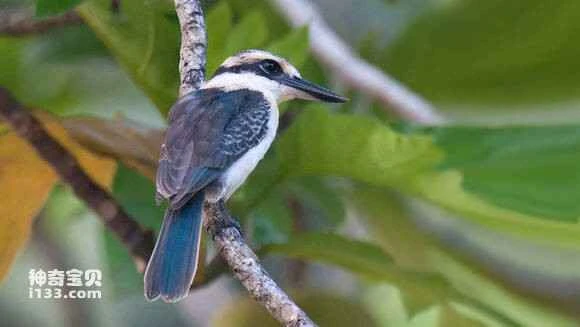
The Bora kingfisher nests in burrows in decaying tree trunks. Egg-laying occurs in December and January. The female lays two eggs at a time. The eggs are nearly round, pure white, and approximately 29.4 × 26.2 mm in size.
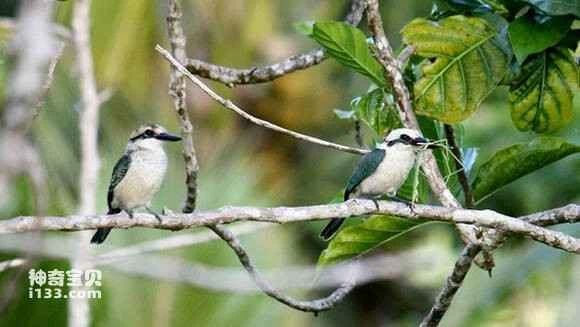
Listed in the IUCN Red List of Birds, ver 3.1: 2008.
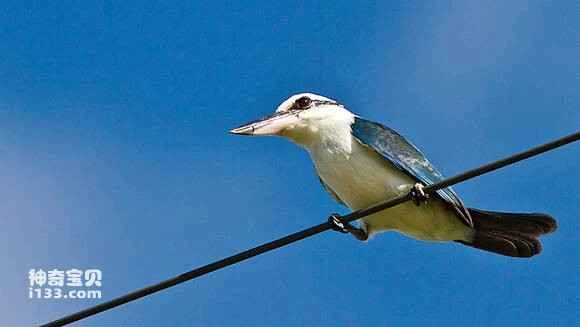
Protect wild animals and ban the consumption of wild game.
Maintaining ecological balance is everyone's responsibility!


