Basic Information
Scientific classification
- Chinese name: Crown Jade
- Scientific name: Australian jade, *Todirhamphus australasia*, *Halcyon australasia*, *australasia*, *Timor Kingfisher*
- Classification: Climbing birds
- Family and Genus: Order Coraciiformes, Family Kingfisher, Genus *Hypericum*
Vital signs data
- Body length: Approximately 21 centimeters
- Weight: 28-58g
- Lifespan: No verification data available.
Significant features
Distribution and Habitat
It is distributed in Indonesia and East Timor.
Crowned kingfishers inhabit woodland environments, ranging from sea level to 700 meters above sea level. They live on forest edges, in monsoon forests, densely wooded areas, plantations, and in shady spots near villages or farms. They seem to particularly prefer dense foliage as their habitat.
Appearance
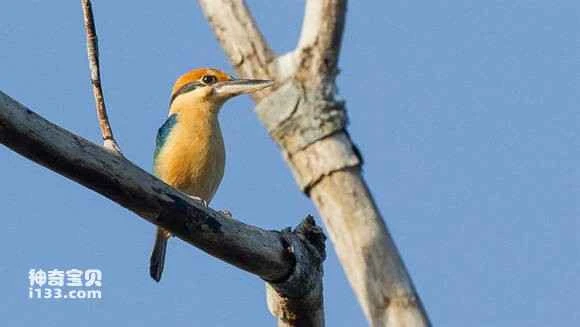
The Crested Kingfisher is 21 cm in length, with males weighing 28-58 grams and females 39-55 grams. Males and females are similar in appearance. Adults have an orange-red cap on their heads extending to their eyebrows. The lores are pale yellow or orange. This species has a black mask covering its cheeks down to its neck. The chin is white. The throat, sides of the neck, and other parts are pale orange. The upper neck is cinnamon orange; the back and shoulder blades are oily green; the breast is white, the underparts are brownish-yellow; the rump is bluish-green; the tail tip is bright blue; the wings are green; the tail is bluish-green; there is a small blackish-green patch under the wingtips on each wing, below which are red wings. The upper jaw is brownish-black, and the lower jaw is pale yellow with black feather edges. The iris is brown, surrounded by a ring of small feathers. The legs are black. Juveniles resemble adult females, but the breast feathers are edged with black. The beak is pale white.
The beak is thick and long, resembling a chisel, with a relatively wide base, a straight beak peak, a rounded ridge, and no nasal grooves on either side; the wings are rounded, with the first primary flight feather being the same length as or slightly shorter than the seventh primary flight feather, and the second, third, and fourth primary flight feathers being nearly the same length; the base of the primary flight feathers has white spots; the tail is rounded.
Detailed introduction
The crown-necked kingfisher, scientifically known as *Todirhamphus australasia*, also called *Halcyon australasia*, *australasia*, or *Timor Kingfisher*, has five subspecies.
1. The nominate subspecies *Todirhamphus australasia* is distributed in the Lesser Sunda Islands (Lombok, Sumbaveta, and East Timor). 2. The subspecies *Todirhamphus australasia dammerianus* is distributed in the eastern Lesser Sunda Islands (Dama and Babar). 3. The inland subspecies *Todirhamphus australasia interpositus* is distributed in the eastern Lesser Sunda Islands (Leti and Moa). 4. The Tanimbar subspecies *Todirhamphus australasia odites* is distributed in the Tanimbar Islands. 5. The Roman Island subspecies *Todirhamphus australasia tringorum* is distributed on Roman Island in the eastern Lesser Sunda Islands.
).
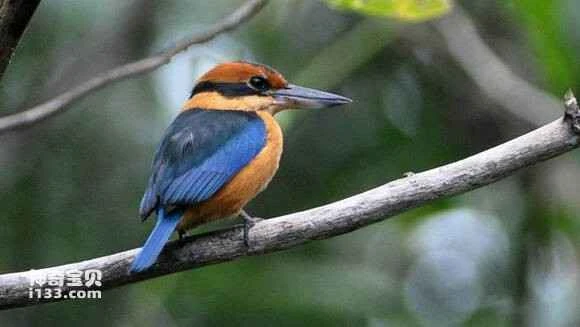
The crested kingfisher is usually solitary, generally perching on tree stumps and rocks along the riverbank, and sometimes on the low branches of small trees near the river. It often gazes motionless at the water's surface for long periods, and upon spotting fish or shrimp, it dives in with extreme speed and ferocity to catch them with its beak. Sometimes it also hovers in the air, flapping its wings and looking down at the water's surface; upon spotting prey, it plunges in and quickly captures it. It usually carries its prey back to its roost, beats it on branches or rocks until it dies, and then swallows it whole. Sometimes it also flies low and straight along the water's surface at great speed, often calling out as it flies.
Crowned eagles can produce rapid trills: "'ch'w'hee - ch'w'hee" lasting 5 to 12 seconds. They also often produce noise.

The crested kingfisher breeds only one brood per year, nesting in earthen cliffs or river embankments. It digs tunnel-like burrows with its beak, laying eggs in May and June. Some also burrow into tree trunks. The eggs are nearly round, pure white, smooth, and without spots, measuring approximately 29.4 × 26.2 mm. Both parents take turns incubating the eggs, with an incubation period of 19-21 days. The chicks are altricial, and after hatching, they are cared for by their parents for 23-30 days before leaving the nest to fly.
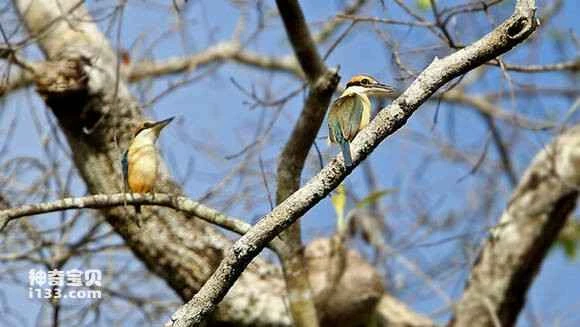
The crowned kingfisher has a wide but scattered distribution and is generally uncommon. Due to changes in its forest habitat, human development, and habitat loss, monitoring within its range has revealed a declining population. Ecological studies have indicated that the species is now classified as near threatened.
Listed as Near Threatened (NT) on the IUCN Red List of Threatened Species 2013 ver 3.1.
Protect wild animals and ban the consumption of wild game.
Maintaining ecological balance is everyone's responsibility!