Basic Information
Scientific classification
- Chinese name: Southern Gorgeous Frog
- Scientific name: Cophixalus australis
- Order: Anura
- Family and genus: Rana davidae, Rana nymphaeus
Vital signs data
- Body length: Adults are generally about 2–3 cm in length. They are small but intricately patterned rainforest terrestrial frogs.
- Weight: Individual weight is usually only a few grams, but varies depending on the size, sex and nutritional status of the individual.
- Lifespan: It is estimated that it can survive for several years in the wild, and can participate in the breeding season multiple times in rainforests with stable habitats and suitable humidity.
Significant features
These tiny, intricately patterned tadpoles, found in the rainforests of eastern Australia, are adept at hiding in leaf litter and moss, employing terrestrial reproduction and, if possible, direct development to minimize their dependence on open water.
Distribution and Habitat
It is mainly distributed in the mountainous rainforests and damp woodlands of eastern Queensland to northern New South Wales in Australia. It prefers shady and damp ground environments with thick leaf litter, moss and rock crevices, and is often found around mountain stream valleys.
Appearance
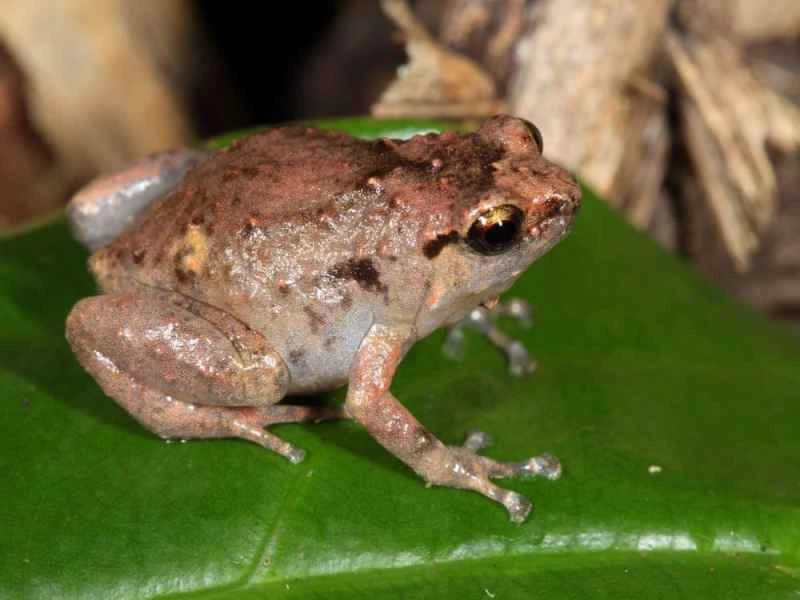
The body is short and oval, with a brown or grayish-brown back with symmetrical or irregular patterns. Some individuals have light-colored dorsal stripes or shoulder spots. The abdomen is light-colored, the limbs are slender, and the toes are slightly enlarged at the ends, giving an overall impression of "luxury and refinement".
Detailed introduction
The Southern Ornate Nursery Frog is a small, brightly colored, and uniquely nursed species native to Australia, typically categorized as a rainforest "nursery frog." They mostly inhabit damp forest floors and leaf litter, and while adults are small, they possess intricate patterns, making them a highly representative group of small amphibians in the Australian rainforest.
Classification and Naming (Summary)
The English name "Southern Ornate Nursery Frog" may correspond to slightly different closely related species or subgroups in different literature, but it is generally considered to be part of the Southern Ornate Nursery Frog complex in eastern Australia. Here, we will use "Southern Ornate Nursery Frog" as a popular name for a general overview:
Chinese reference name: Southern Gorgeous Frog (general translation);
English name: Southern Ornate Nursery Frog;
Scientific name: Cophixalus australis
Possible family and genus: Microhylidae → juvenile frog / rainforest frog ( Cophixalus type);
Note: As taxonomic research is still ongoing, this page does not mandate a single scientific name and is more suitable for general introductions to morphology and ecology.
Appearance and Identification Features
The Southern Ornate Frog is a typical "small rainforest terrestrial frog," short in length but possessing rather gorgeous body coloration and patterns:
Size: Adults are usually about 2-3 cm long. They are small in size, with females being slightly larger than males.
Body shape: The body is slightly oval or short oval, the head is relatively short, the snout is slightly blunt, and the limbs are slender;
Back color: Common base colors include brown, grayish brown, and olive brown, with dark spots, fine lines, or symmetrical patterns; some individuals have more prominent light-colored stripes or patches on the back midline or shoulders.
Ventral side: The abdomen is mostly milky white, light gray or pale yellow, with some individuals having small spots;
Skin texture: The back is slightly rough or has small granules, and the texture is not as smooth as that of a tree frog;
Limbs and toes: The limbs are relatively slender, the toes are slightly enlarged at the ends, and the webbing is not well developed, making them more suitable for walking and short jumps among the leaf litter and moss.
The surface pattern gives an overall feeling of "exquisite" and "luxurious", which is also the origin of the name "ornate".
Distribution range and habitat
The Southern Ornate Frog is believed to primarily inhabit the tropical and subtropical rainforests of eastern Australia , particularly the mountainous and hilly areas near the coast.
It is mainly distributed in the rainforest mountains and surrounding woodlands from eastern Queensland to parts of northern New South Wales;
They are often found in humid forests and rainforest mosaic landscapes at low to medium altitudes.
Typical habitat characteristics include:
Closed or semi-closed rainforests and mountain forests, with a thick layer of fallen leaves and moss under the trees.
Near streams, seepage slopes, rock crevices, and damp valleys;
They often hide among fallen leaves, fallen logs, crevices between rocks, and tree roots, making them a typical terrestrial "rainforest ground frog".
Lifestyle
The Southern Elegant Frog is a nocturnal, terrestrial rainforest frog .
During the day, they mostly hide in damp and dark layers of fallen leaves and crevices in rocks to avoid dehydration and predators;
They are most active at night when the temperature is relatively humid, and there is dew or light rain.
Their range is usually small, and they forage and breed mostly in familiar micro-habitats.
vocal characteristics
Frogs that raise their young are often identified by their calls. Male Southern Ornate Frogs emit short, rhythmic calls on rainy nights:
The call is often described as a series of monosyllabic "chirp" or "drip" sounds with a clear rhythm;
When multiple male frogs sing together near a stream or a damp slope, their calls intertwine to create a cheerful "rainforest background sound."
There are subtle differences in pitch, rhythm and repetition patterns in the calls of different juvenile frog species.
feeding habits
Southern gorgeous tadpole larvae are mainly composed of tiny invertebrates:
Small insects on the forest floor, such as ants, small beetles, small crickets, and springtails;
Small arachnids and their larvae inhabiting leaf litter and moss;
They hunt passing prey at night by moving slowly or ambushing.
Reproduction and raising young (characteristics of "young frogs")
What makes juvenile frogs most unique is that many species do not rely on large open bodies of water for reproduction, but instead adopt a relatively "terrestrial" approach:
Male frogs often call to attract mates in damp leaf litter, moss mats, or under rocks, rather than near large ponds.
The female frog lays her eggs in damp, secluded places, such as deep in the leaf litter or in burrows.
Some frog eggs develop directly on land, hatching into small frogs instead of aquatic tadpoles (i.e., "direct development").
In some species, male frogs will guard the egg cluster near the spawning site, demonstrating a certain degree of "parental care".
The Southern Elegant Frog is also believed to have similar characteristics of "terrestrial reproduction + direct development", which greatly reduces its dependence on open water bodies.
Protecting the status quo and threats
Based on currently available information, most Australian brood frog populations are classified as having a conservation status close to Least Concern (e.g., Least Concern or near Least Concern) . However, the status may vary between different populations, and specific IUCN classifications should be referenced from the latest authoritative databases.
Potential threats include:
Rainforestation and habitat fragmentation have led to a reduction in the area of humid understory environments;
Road construction and tourism development have damaged mountain valleys and mossy valleys.
Changes in rainfall patterns caused by climate change affect the long-term stability of humid microhabitats;
The pressure on native small amphibians from invasive species (such as invasive vegetation or predators).
Protecting primary rainforests and mountain valley ecosystems, reducing habitat fragmentation, and controlling the spread of alien species are important measures to safeguard the populations of the Southern Elegant Frog and its closely related species.
Frequently Asked Questions
Q1: Why is it called "Nursery Frog"?
The name "brooding frog" comes from their unique reproductive method: many species do not rely on large ponds, but instead lay their eggs in secluded, damp places on land.
The eggs develop directly into small frogs on land, skipping the typical "tadpole living in water" stage, which is equivalent to moving the "nursery" to the forest floor.
Q2: Are Southern Elegant Frogs easy to spot in the wild?
Because of their small size, color similar to fallen leaves, and nocturnal activity, they are difficult to see during the day.
On a damp, rainy night, it is often more effective to identify calls by ear than by eye, following mountain streams, mossy slopes, and leaf litter.
Q3: What are their environmental requirements?
It requires high air humidity and ground moisture, and is usually only found stably in rainforests or humid woodlands.
If forests are cut down, the leaf litter layer decreases, or the environment becomes too dry, the population may decline significantly.
Q4: Is this type of frog dangerous to humans?
They are generally considered to pose no direct danger to humans; they will not attack people unless they secrete a small amount of skin mucus.
If there is brief contact, follow standard amphibian observation guidelines and wash your hands afterwards.