Basic Information
Scientific classification
- Chinese name: Smooth toad
- Scientific name: Uperoleia laevigata
- Order: Anura
- Family and genus: Rhizophoraceae (Ground Frog Family), Rhizophora (Ground Frog Genus)
Vital signs data
- Body length: Adults are generally about 2–3 cm in length, belonging to small but slightly stocky terrestrial frogs.
- Weight: Individual weight is usually only a few grams, and varies slightly depending on the size, sex and nutritional status of the individual.
- Lifespan: It is estimated that it can survive for several years in the wild and can participate in the breeding season multiple times in areas with stable habitats and water bodies.
Significant features
A small, terrestrial frog common in eastern Australia, it is short and stout with a delicate back. It is active in small wetlands and around temporary waterholes, and preys on small invertebrates at night.
Distribution and Habitat
Native to the eastern coastal and inland regions of Australia, it is commonly found in open woodlands, grasslands, thickets, farmland, roadside ditches, and small wetland environments near cities, relying on temporary waterholes and small ponds for reproduction.
Appearance
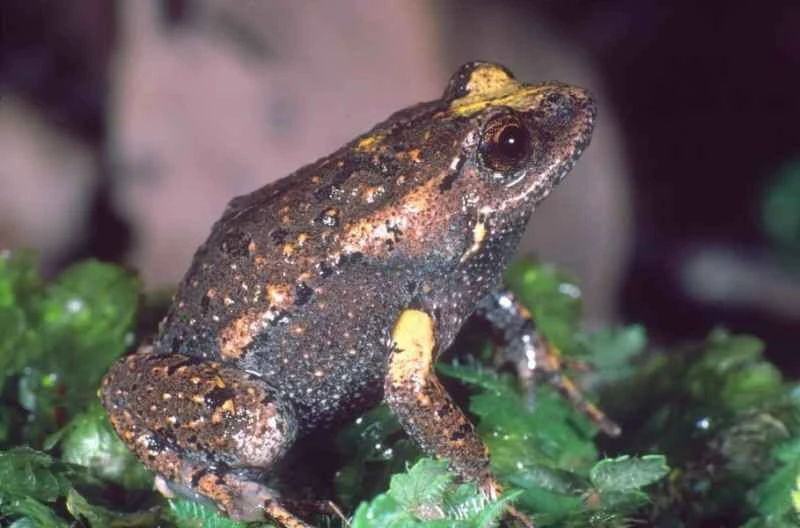
It has a short and wide body, a short head with a blunt snout, a grayish-brown or brownish-gray back with fine spots, and relatively smooth skin with fine granules. Its ventral side is light in color, and its limbs are short and powerful, making it suitable for short jumps on the ground and traversing through leaf litter.
Detailed introduction
The smooth toadlet ( Uperoleia laevigata ) is a small, ground-dwelling frog native to Australia. Often called a "toad-like frog" due to its resemblance to a miniature toad, it is actually a true frog relative within the order Anura and is one of the most common small amphibians in eastern Australia.
Classification and nomenclature
Chinese reference name: Smooth Ground Toad (general translation);
English name: Smooth Toadlet;
Scientific name: Uperoleia laevigata ;
Family: Myobatrachidae → Genus: Uperoleia
Appearance and Identification Features
The smooth-skinned ground frog is a typical "small terrestrial frog," with a small size and a slightly stocky body.
Size: Adults are typically about 2–3 cm in length, with females being slightly larger than males;
Body shape: The body is short and wide, giving an overall impression of being "short and stout". The head is relatively short and the snout is blunt and rounded.
Back color: The back is mostly grayish brown, brownish brown or olive brown, and may have small spots or cloud-like patterns of varying shades;
Skin texture: Compared to some ground toads with more obvious warts, the back of the smooth ground toad is generally more delicate and has smaller granules, hence the name "Smooth".
Abdomen: The abdomen is lighter in color, mostly milky white, grayish white or light yellow, and may have a few spots;
Limbs: The limbs are short and powerful, with the hind limbs suitable for short-distance jumping. The webs in the toes are not well-developed, making them more adapted to life on land than to long-distance swimming.
Spirals/Glands: Some individuals have glandular bulges or spots on both sides of the body, which is one of the important details for identifying species of the genus *Phallus*.
Distribution range and habitat
The smooth ground toad is a species endemic to the eastern coastal and near-inland regions of Australia .
It is mainly distributed in eastern New South Wales and surrounding areas, and is commonly found in some woodlands, shrublands and farmland landscapes;
It is commonly found in temperate and subtropical regions at low to medium altitudes.
Typical habitats include:
Open woodlands, shrublands, grasslands, and forest edges;
Surface environments near small ponds, temporary waterholes, drainage ditches, and seasonal wetlands;
They often hide in leaf litter, under rocks, near fallen trees, or at the roots of weeds, which is a typical terrestrial lifestyle.
Lifestyle
The smooth-skinned ground frog is a nocturnal, terrestrial frog .
During the day, they rest in sheltered places, such as deep in the leaf litter, in soil crevices, under rocks and fallen trees, to avoid dehydration and predators;
They are most active from dusk to night, especially on damp and rainy nights;
Their activity range is usually concentrated around water bodies and on damp ground, and their movement methods are mostly short jumps and slow crawling.
vocal characteristics
The calls of species in the genus *Gnaphalium* are very important for species identification. Male *Gnaphalium sclerophyllum* frogs emit short, rhythmic calls during the breeding season:
The calls are usually a series of short, monosyllabic "chirp" or "tsk" sounds, with regular intervals;
On rainy nights or during the humid season when breeding is possible, multiple male frogs often gather around a puddle and call out, forming a chorus.
The frequency, rhythm, and timbre of their calls differ slightly from those of closely related species of ground toads, which is an important basis for herpetologists to identify species.
feeding habits
Like many small terrestrial frogs, the smooth-skinned frog primarily feeds on tiny invertebrates:
Insects such as ants, small beetles, small flies, and mosquitoes;
Small arthropods and larvae that inhabit the leaf litter layer;
They capture palatable prey by moving slowly on the ground at night or by ambush.
Reproduction and Development
The reproductive activities of the smooth ground toad are closely related to rainfall:
The breeding season usually occurs during warmer and rainier periods, when male frogs call out to attract female frogs near temporary puddles, ditches, and small ponds.
Female frogs lay their eggs in still or slow-moving shallow water; the egg masses may attach to aquatic plants or sink to the bottom.
Tadpoles develop in these small bodies of water, and after metamorphosis, they become small frogs, leave the water, and enter the surrounding terrestrial habitat.
Protecting the status quo and threats
In the current global assessment, the smooth ground toad is listed as Least Concern (LC) on the IUCN Red List, indicating that its overall population is not currently showing a significant downward trend.
Potential threats include:
Small wetlands and temporary waterholes are filled in, drained, or polluted;
The effects of pesticides and chemicals on tadpoles and adult frogs;
Urban expansion and infrastructure development have led to habitat fragmentation.
Protecting remaining wetlands, preserving leaf litter and surface cover, and reducing pesticide and pollutant emissions help maintain healthy populations of the smooth-skinned frog and other small terrestrial frogs.
Frequently Asked Questions
Q1: Is the smooth-skinned toad really a "toad"?
Although its English name is "toadlet" and its appearance is somewhat similar to a miniature toad, taxonomically it belongs to the frog group of the family Ranidae.
It's not a real toad; it's just named for its short, stout, and sturdy appearance.
Q2: In what season are you most likely to hear the smooth ground toad?
Male frogs are most easily heard croaking near small puddles and ditches during the local warm rainy season or periods of heavy rainfall.
Rainy nights and damp evenings are good times to observe and listen to them.
Q3: Is this small frog harmful to humans?
They are generally considered to pose no direct threat to humans, as they mainly feed on small insects and, to some extent, help control pests.
If contact is necessary, follow the general advice for amphibians: handle with care, wash hands afterward, and avoid rubbing eyes and ingestion.
Q4: What is the role of the smooth-skinned toad in the ecosystem?
As a small predator, it regulates the population of small invertebrates on the ground, and is also an important food source for snakes, birds, and medium-sized invertebrates.
It plays a connecting role in the food web.