Basic Information
Scientific classification
- Chinese name: Southern Sand Dune Frog
- Scientific name: Arenophryne rotunda
- Order: Anura
- Family and genus: Rana squarrosa (Family: Rana squarrosa)
Vital signs data
- Body length: Adults are generally about 3–4 cm long, with short, round and stout bodies, belonging to small but relatively "spherical" burrowing frogs.
- Weight: Individual weight is usually only a few grams, but varies depending on the size of the individual and nutritional status.
- Lifespan: It is estimated that it can survive for several years in the wild, and can participate in the breeding season multiple times in sand dune areas with regular rainfall and stable habitats.
Significant features
A small burrowing frog highly adapted to the sand dune environment of Western Australia, it has a plump body and is good at "diving backwards" into the fine sand, and copes with the arid climate by breeding and developing under the sand.
Distribution and Habitat
It is mainly distributed in the coastal dune belt and sandy shrubland of the southern part of western Australia, relying on deep, loose fine sand and sparse vegetation. Its habitat is generally arid with relatively little rainfall.
Appearance
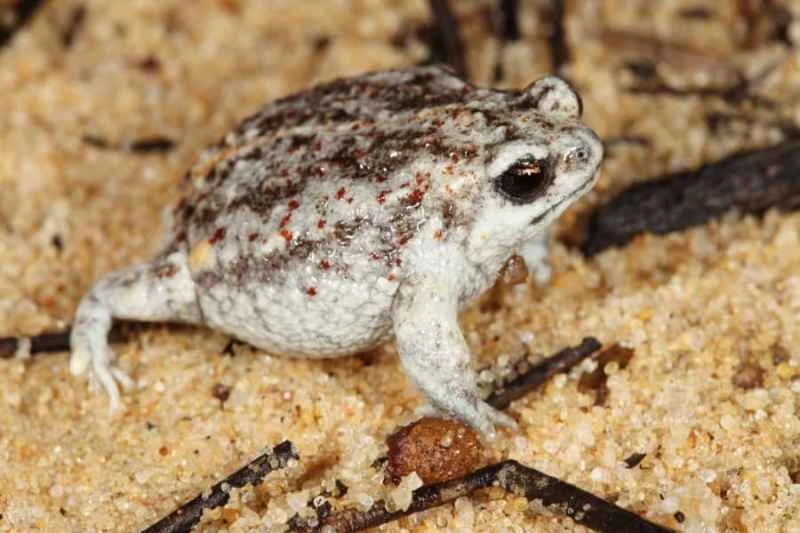
Its body is short and round, with an indistinct boundary between the head and torso. Its back is sandy yellow or grayish brown with fine spots, similar to the color of the sand. Its limbs are short and powerful, especially its hind limbs, which are well-suited for digging and diving in loose sand.
Detailed introduction
The Southern Sandhill Frog ( Arenophryne rotunda) is a small, round-bodied, native Australian frog native to the sand dunes, specifically adapted to sand dune environments. Belonging to the genus Arenophryne in the family Arenophryneidae, it is a typical "burrowing frog," living year-round in deep sand near the sea and considered one of the representative amphibians adapted to arid sandy environments.
Classification and nomenclature
Chinese reference name: Southern Sand Dune Frog (general translation);
English name: Southern Sandhill Frog;
Scientific name: Arenophryne rotunda (Sandhill Frog, often considered the "southern" sandhill frog, relative to the northern population);
Family: Myobatrachidae → Genus: Arenophryne
Appearance and Identification Features
The southern sand dune frog has a very unique appearance, looking like a small, round frog:
Body shape: Adults are usually about 3-4 cm long, with short, round and stout bodies, giving them a "short and fat" appearance;
Body shape: The body is almost round or short oval, the head is not clearly distinguishable from the body, and the snout is short and blunt;
Back color: mostly sandy yellow, grayish brown or brown, often with small spots or cloud-like patterns, which are very similar to the surrounding sandy environment and have a very good camouflage effect;
Abdomen: The abdomen is lighter in color, usually milky white or light gray;
Skin texture: The skin on the back is slightly rough or has small particles, which helps it adhere to the sand.
Limbs: The limbs are relatively short but very powerful, especially the hind limbs and hind feet, which are suitable for digging and "drilling backwards" in loose sand.
Head and eyes: The head is flat and the eyes are not as prominent as those of the tree frog, making it more suitable for hiding in the sand;
Overall impression: Round, short and stout, with a color close to that of sand, it is a "sand expert" that can be easily distinguished from ordinary frogs.
Distribution range and habitat
The southern dune frog is a species endemic to the coastal dune belt of western Australia .
They mainly live in the coastal sand dunes and sandy shrublands of the southern part of western Australia.
Its distribution range is relatively narrow, mostly limited to deep sandy areas near the sea and adjacent low-lying vegetation areas.
Typical habitat characteristics include:
Moving or semi-fixed sand dunes near the coast; coastal sandy plains;
The surface is composed of deep, loose fine sand, interspersed with a small amount of low shrubs and herbaceous vegetation;
Rainfall is generally low, the environment is relatively dry, and there are large temperature differences on the ground.
Lifestyle
The southern dune frog is a nocturnal burrowing frog highly adapted to sandy terrain.
They spend most of their time underground in the sand, digging "backwards" into the loose sand to avoid the high temperatures and moisture evaporation during the day;
When the temperature is slightly lower and the air humidity is higher at night, they crawl out of the sand to move around and forage.
When faced with danger, they will quickly use their hind legs to "dive backward" into the sand, leaving only slight sand marks before disappearing from the surface.
vocal characteristics
The calls of dune frogs are typically low-pitched and slightly nasal, used for courtship and territorial assertion at night.
On damp nights, especially after rain, male frogs emit a series of short, deep calls from the shallow sand or among vegetation.
The call is described as a repetitive, slightly trilled "cluck" or "quack" sound that can travel a considerable distance on quiet dune nights.
Because of their open habitat and low background noise, calls are an important clue for monitoring their population.
feeding habits
Southern dune frogs feed on small invertebrates common in sandy environments:
Ants, small beetles, spiders, small crickets, and other insects that move on or under the sand;
Some small insect larvae and other arthropods;
They typically emerge from their caves at night, moving slowly among the sand and vegetation to ambush or actively hunt passing prey.
Reproduction and Development
Similar to many frogs in arid regions, the reproduction of the southern dune frog is closely related to rainfall and soil moisture:
During rainy seasons or after heavy rains, male frogs call out to attract mates in the shallow sand or near the roots of shrubs.
Female frogs lay their eggs in damp, secluded burrows in the sand, rather than in open water.
The eggs and embryos develop in the moist environment of the sand, and many studies suggest that they have characteristics close to "direct development," with the larvae completing most of their development in the sand.
After hatching, the tadpoles can move independently in the dune environment, reducing the stage where they must rely on surface water.
Protecting the status quo and threats
In the current global assessment, species related to the southern sand dune frog are generally considered to be at a relatively low global threat level (e.g., Least Concern or near Least Concern) . Nevertheless, due to their narrow distribution range and unique habitat, they still require continued attention.
The main potential threats include:
Disturbance and damage to the dune system caused by coastal development, road construction, and tourism activities;
The activities of off-road vehicles and motorcycles on sparsely populated sand dunes compact the sand and destroy micro-habitats;
Introduced vegetation alters dune structure and water retention;
Climate change is causing changes in rainfall patterns, affecting the stability of soil moisture in sandy areas.
Designating coastal protected areas, limiting human disturbance in sensitive dune areas, controlling invasive species, and monitoring amphibian populations in arid regions can help protect the southern dune frog and its unique sandy ecosystem in the long term.
Frequently Asked Questions
Q1: Why are southern sand dune frogs adapted to living in sandy areas?
Its body is round and plump, and its limbs are powerful. It is particularly good at digging in loose, fine sand and "drilling backwards".
In addition, its skin color is close to that of sand, which not only provides sun protection and moisturization but also allows it to camouflage itself well, making it a typical "sand expert".
Q2: Does this type of frog need a pond or puddle to reproduce?
Unlike many common frogs that must rely on open water, the southern dune frog lays its eggs in damp, sandy soil.
The eggs develop in the sand, and the larvae are closer to "direct development," which greatly reduces their dependence on surface water and is a special adaptation to arid environments.
Q3: Are southern sand dune frogs easy to spot in the wild?
It's not easy. They spend most of their time hidden under the sand, only becoming active at night, especially after rain when it's damp.
Even during events, they can easily be overlooked because they are pretending to be excellent.
Q4: Are southern sand dune frogs dangerous to humans?
It is generally believed that it poses no direct danger to humans, except that its skin has the mucus secretion of ordinary frogs.
If you need to observe briefly, handle with care, avoid holding for a long time, and wash your hands after contact.