
Basic Information
Scientific classification
- Chinese name: Black-billed Swan
- Scientific name: Trumpeter Swan, Cygnus buccinator
- Classification: Waterfowl
- Family and genus: Anseriformes, Anatidae, Cygnus
Vital signs data
- Body length: 139-163 cm
- Weight: 7-13.6kg
- Lifespan: Approximately 32 years
Significant features
It is the largest native bird in North America, and its weight and shape also make it the largest waterfowl living on Earth.
Distribution and Habitat
Distributed in Alaska and western Canada, they migrate to the southern coast of Alaska, British Columbia, and the northern United States for the winter. Some resident birds also live in several states in the northwestern United States, mostly from flocks released into the wild.
During the breeding season, they prefer to inhabit open, food-rich shallow waters, such as lakes, ponds, and slow-flowing rivers with abundant aquatic plants, especially in coniferous forests, birch forests, and treeless highland lakes and ponds. In winter, they mainly inhabit large, grassy lakes, reservoirs, ponds, rivers, beaches, and open farmland.
Appearance
The Black-billed Swan is a large waterfowl. Males are 145-163 cm long, while females are 139-150 cm. The average wingspan is 2.03 meters, the average weight is 7-13.6 kg, and the average lifespan is 32 years. Males and females are similar in color, with females slightly smaller. The females are entirely white, with dark brown irises and a black bill with a pinkish line along the base. The tarsi, webs, and claws are also black. Juveniles are greyish-brown overall, with a darker head and neck, and paler underparts, tail, and flight feathers. The bill is yellow. The neck is long, exceeding or equal to the body length; the bill has a high base and a gently sloping tip; the lores are bare; the tail is short and rounded with 20-24 tail feathers; the webs are strong, but the hind toe lacks lobed webbing.
Detailed introduction
The Trumpeter Swan (scientific name: Cygnus buccinator) has no subspecies.
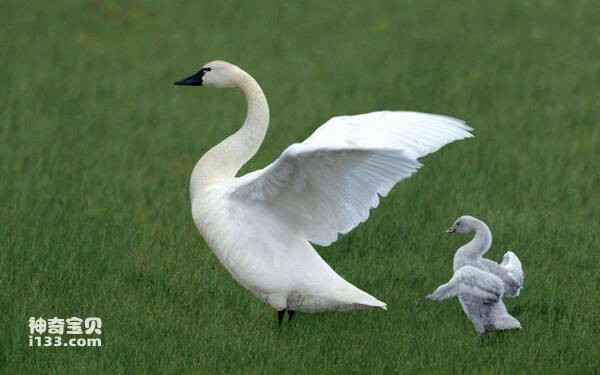
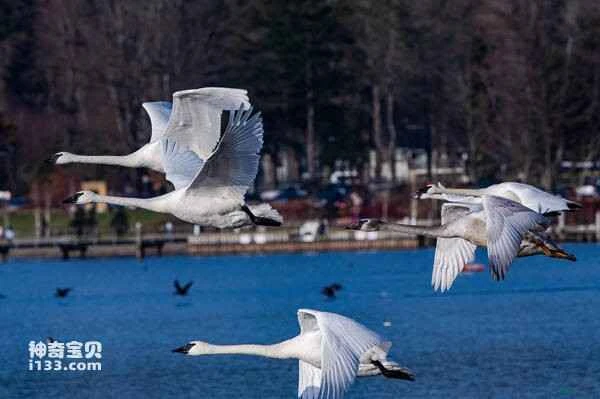
Black-billed swans are gregarious, living in flocks except during the breeding season, especially in winter when they often form family groups, sometimes as large as dozens to hundreds of individuals. During migration, they typically fly in small groups of 6-20 or more, or in family groups. They fly at relatively high altitudes, maintaining orderly formations, often in a "one," "V," or "V" shape. Migration mostly takes place along lakes, rivers, and other bodies of water, with frequent stops to rest and forage, resulting in a relatively long migration period.
Black-billed swans primarily feed on the leaves, stems, seeds, and rhizomes of aquatic plants, such as lotus roots, oleaster, and aquatic grasses. They have a strong digging ability, capable of excavating food buried up to 0.5 meters below the surface of mud. In winter, they sometimes forage for grains and seedlings in farmland. Besides plant matter, they also consume small amounts of animal matter, such as mollusks, aquatic insects, and other aquatic invertebrates. They mainly forage at dawn and dusk. Their foraging grounds and habitats are often located together or close to each other. Unless disturbed, they typically do not change locations, resulting in relatively stable habitats.
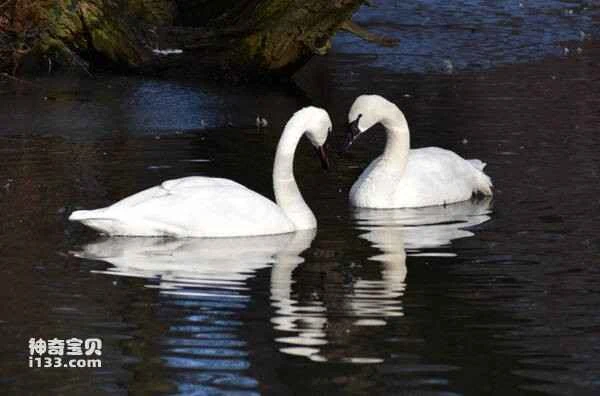
The breeding habitat of the Black-billed Swan is a vast expanse of large, shallow ponds and slow-moving rivers in the northwestern and central parts of North America, with the largest breeding population found in Alaska. These swans migrate along the Pacific coast of the United States. In winter, they migrate to Canada or the eastern and southern states of the northwestern United States, and even as far south as Pagosa and Colorado Springs.
They typically arrive at their breeding grounds between late April and early May. The breeding season is from May to June. They nest on dry reeds piled up in shallow water near the shores of large lakes, ponds, and small islands. The nest is extremely large, mainly constructed of dry reeds, sedges, and moss, lined with soft, dry grass stems, moss, feathers, and down feathers plucked from the female's chest and abdomen. The nest is cap-shaped, about 1 meter in diameter at the base and 0.6-0.8 meters high. The female builds the nest alone. Each clutch contains 4-7 eggs, usually 4-5, laid mostly from early to mid-May. The eggs are white or slightly yellowish-gray, averaging 113 × 73 mm and weighing 320 grams. Incubation is solely the responsibility of the female, while the male guards the nest. When danger is detected, the male calls loudly, and the female immediately covers the eggs with down feathers and vegetation around the nest before flying away. During incubation, the female bird typically leaves the nest only briefly each day during the warmest part of the day to forage. The incubation period lasts 32 to 37 days. The chicks are precocial, and soon after hatching, they can follow their parents to forage. If danger arises, the parents will first hide them in the grass and then fly away, only returning after the danger has passed.
Listed as Least Concern (LC) in the IUCN Red List of Threatened Species 2020 ver 3.1.
Protect wild animals and ban the consumption of wild game.
Maintaining ecological balance is everyone's responsibility!


