Basic Information
Scientific classification
- Chinese name: West Indian Tree Duck
- Scientific name: Black-tailed tree duck, Cuban tree duck, Dendrocygna arborea, West Indian Whistling-duck, Black-billed Wood-duck, Cuban Tree-duck, West Indian Tree-duck, West Indian Whistling Duck
- Classification: Waterfowl
- Family and genus: Anseriformes, Anatidae, Anatolia
Vital signs data
- Body length: 48-56 cm
- Weight: No verification information available.
- Lifespan: No verification data available.
Significant features
It is a large, upright, long-necked duck.
Distribution and Habitat
Distributed in Central America, between North and South America, including Guatemala, Belize, Honduras, El Salvador, Nicaragua, Costa Rica, Panama, the Bahamas, Cuba, Haiti, Jamaica, Dominican Republic, Antigua and Barbuda, Saint Vincent and the Grenadines, Saint Lucia, Barbados, Grenada, Trinidad and Tobago, and other countries and regions.
They inhabit mangrove forests and swamps, brackish water ponds, wetlands and mudflats, and are also found in forest edge swamps and ponds and streams surrounded by vegetation. They prefer to hide in tall grass or under lily leaves, and also live in groups on the water surface, but usually avoid open lakes.
Appearance
The West Indian Tree Duck is 48-56 cm in length and is a large, upright, long-necked duck. Adults have a black comb and light brown cheeks; dark brown back, breast, and wings; white belly with black markings; black flanks; long black beak; and long, greyish-black legs. Sexes are similar; juveniles have dull, unremarkable plumage.
Detailed introduction
The West Indian Whistling-duck (scientific name: Dendrocygna arborea), also known as the Black-billed Wood-duck, Cuban Tree-duck, West Indian Tree-duck, or West Indian Whistling Duck, is a bird belonging to the family Anatidae in the order Anseriformes.
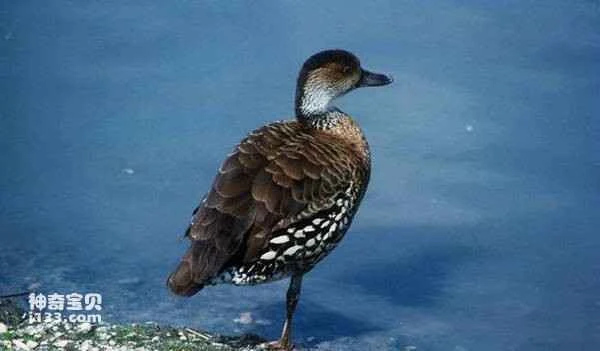
When resting, the West Indian Tree Duck stands upright, with several frequently craning their necks to look around. Upon encountering humans or predators, it is the first to take flight, followed by the others, demonstrating its extremely alert nature. They typically forage in groups of several to dozens, and sometimes in large flocks of hundreds. Their flight is weak, and their speed is slower than other ducks. They are also adept swimmers and divers, with particularly strong diving abilities, capable of diving for over ten minutes at a time. During the hot daytime, they often sleep and rest in reed beds or other tall aquatic plants. If food is plentiful and undisturbed, they tend to remain in one fixed location, generally not changing habitats or undertaking long-distance migrations.
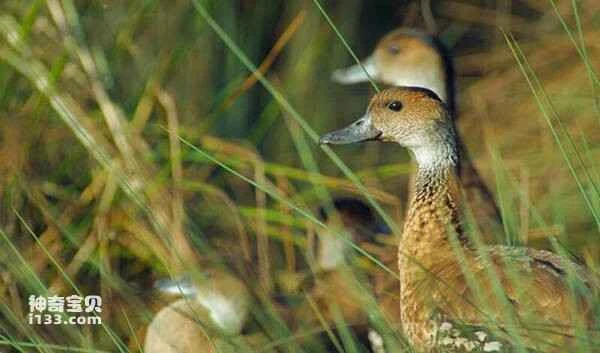
The West Indian Tree Duck breeds from May to July. They nest in grassy areas covered by trees or vegetation, or in reed marshes and tree cavities. Courtship and mating take place in the water. Before mating, the male and female swim together, with the male repeatedly dipping his beak into the water towards the female, who remains upright. Then, the male suddenly mounts the female's back to mate. The nest is constructed of grass leaves and stems, measuring 25 cm in diameter and 6 cm in height. Each clutch contains 8-14 eggs, usually around 10, which are white. Both parents incubate the eggs for 27-30 days.
Listed in Appendix I of CITES (the Washington Convention).
Listed as Vulnerable (VU) in the International Union for Conservation of Nature (IUCN) Red List of Threatened Species, 2009 ver 3.1.
Listed as Near Threatened (NT) in the IUCN Red List of Threatened Species 2019 ver 3.1. [1]
It is listed in Appendix II of the 2019 edition of the Convention on International Trade in Endangered Species of Wild Fauna and Flora (CITES).
Protect wild animals and ban the consumption of wild game.
Maintaining ecological balance is everyone's responsibility!