Basic Information
Scientific classification
- Chinese name: Pterodactylus tree duck
- Scientific name: Dendrocygna arcuata, Wandering Whistling-duck, Wandering Whistling Duck
- Classification: Waterfowl
- Family and genus: Anseriformes, Anatidae, Anatolia
Vital signs data
- Body length: 55-60 cm
- Weight: Approximately 735g
- Lifespan: No verification data available.
Significant features
The sides of the head, neck, and chest are pale yellow, forming dark patches against the front of the chest and neck.
Distribution and Habitat
It is distributed in Australia, Indonesia, Papua New Guinea, the Philippines, and East Timor.
Regional extinction: Fiji, New Caledonia.
Occasionally seen: Singapore.
They inhabit ponds, marshes, open waters, flooded grasslands, farms, canals, pastures, and irrigated rice paddies. They are also found around forest edges and marshes, in plant-covered ponds and streams. They prefer to hide in tall grass or under lily leaves, and also live in groups on the water surface, but usually avoid open lakes.
Appearance
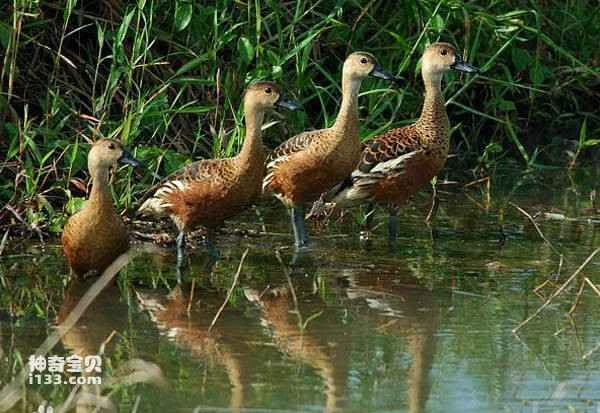
The Pleco Tree Duck measures 55-60 cm in length and weighs 735 grams. Adults have a dark brown crown, neck, and back that extends to the eyes. The upperparts and wings are dark brown, while the feathers on the wattles and shoulders are reddish-brown, giving this area a scaly appearance. The primary flight feathers are brown with dark green undersides. The head, neck, and sides of the breast show a pale yellow tinge, forming dark patches against the front of the breast and neck. The belly and sides are reddish-brown; the tail coverts are blackish-yellow and creamy. The bill, legs, and feet are dark grey, and the iris is brown.
The tarsal scales are shield-like; the male's trachea has an asymmetrical enlargement; the calls of the two are different, and their plumage and behavior are usually different as well; the mating relationship and family life are short-lived; they molt twice a year; the male often molts once for "erosion feathers" and once for bright nuptial feathers; the chicks' down feathers have obvious patterns; the female has a "teasing" performance.
Detailed introduction
The Wandering Whistling-duck (scientific name: Dendrocygna arcuata) has three subspecies.

When resting, the Pterodactylus tree duck stands upright, and several of them often crane their necks to look around. Upon encountering humans or predators, they are the first to take flight, followed by the others, demonstrating their extremely alert nature. They typically forage in groups of several to dozens, and sometimes in large flocks of hundreds. Their flight is weak, and their speed is slower than other ducks. They are also adept swimmers and divers, with particularly strong diving abilities, capable of diving for over ten minutes at a time. During the hot daytime, they often sleep and rest in reed beds or other tall aquatic plants. If food is plentiful and undisturbed, they tend to stay in fixed locations, generally not changing habitats or even undertaking long-distance migrations.
The reproductive capacity of the Pterodactylus tree duck depends on the length of the season, primarily on rainfall. It may be longer in rainy years than in dry years. The breeding season in southern New Guinea and Australia is typically from December to May, and in the Philippines from January to May. They nest in grassy areas or shrubs covered with vegetation. They are monogamous, and courtship and mating take place in the water. Before mating, the male and female swim together, with the male repeatedly dipping his beak into the water towards the female, who remains upright. The male then suddenly mounts the female's back to mate. The nest is constructed of grass leaves and stems, measuring 25 cm in diameter and 6 cm in height. Each clutch contains 7-8 eggs, up to 15, which are white. Both parents incubate the eggs for 30 days.
Listed as Least Concern (LC) on the IUCN Red List of Threatened Species 2012 ver 3.1.
Protect wild animals and ban the consumption of wild game.
Maintaining ecological balance is everyone's responsibility!