Basic Information
Scientific classification
- Chinese name: Black-bellied Tree Duck
- Scientific name: Black-bellied Whistling Duck, Black-bellied Whistling Duck, Dendrocygna autumnalis
- Classification: Waterfowl
- Family and genus: Anseriformes, Anatidae, Anatolia
Vital signs data
- Body length: 48-53 cm
- Weight: No verification information available.
- Lifespan: No verification data available.
Significant features
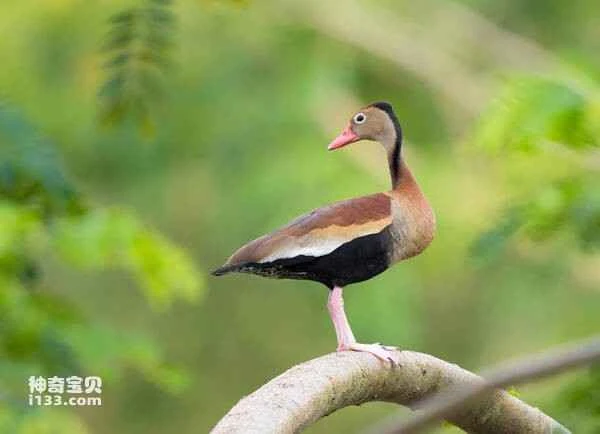
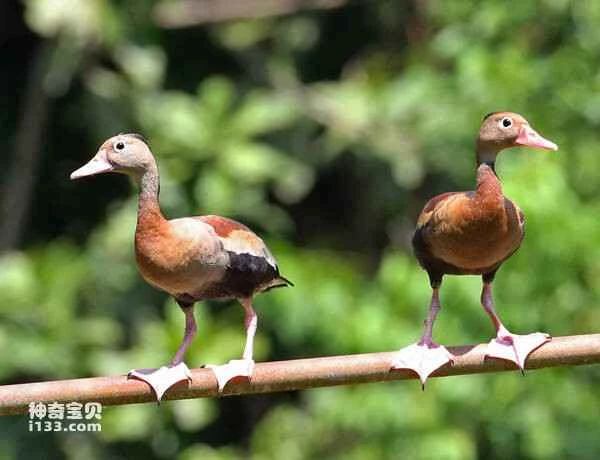
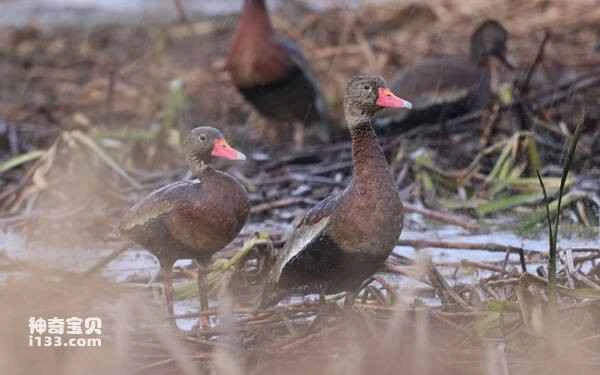
It has a long, red beak and long legs, a long, light gray head, and mostly grayish-brown plumage, with a black belly and tail.
Distribution and Habitat
Native to: Antigua and Barbuda, Argentina, Aruba, Barbados, Belize, Bolivia, Brazil, Canada, Colombia, Costa Rica, Cuba, Dominican Republic, Ecuador (Galapagos), El Salvador, French Guiana, Guadeloupe, Guatemala, Guyana, Honduras, Martinique, Mexico, Montserrat, Nicaragua, Panama, Paraguay, Peru, Puerto Rico, Saint Kitts and Nevis, Saint Lucia, Saint Vincent and the Grenadines, Suriname, Trinidad and Tobago, United States, Bolivarian Republic of Venezuela. Migratory birds: Bahamas, Cayman Islands, Chile, Gambia, Grenada, Jamaica, Virgin Islands. Inhabits ponds, lakes, reservoirs, and other bodies of water rich in vegetation, and also appears in forest edge swamps and ponds and streams surrounded by vegetation. They prefer to hide in tall grass or under lotus leaves, and also live in groups on the water, but usually avoid open lakes.
Appearance
The Black-bellied Tree Duck measures 48-53 cm in length. It has a long, red bill and long legs; a long, pale grey head; mostly greyish-brown plumage; a black belly and tail; a rich chestnut neck and upper body; grey cheeks and upper neck; brown irises with a distinct white eye ring. In flight, large white patches of secondary flight feathers are visible on both wings, while the primary flight feathers are black, and the wing coverts are brown. Sexes are similar; juveniles and adults are also similar, but the Black-bellied Tree Duck has a grey bill and less contrasting belly coloration.
Detailed introduction
The Black-bellied Whistling Duck (scientific name: Dendrocygna autumnalis) has two subspecies.
The Black-bellied Tree Duck can forage on the water's surface and underwater, and sometimes also forages on grass near the water's edge. Its diet consists mainly of plant-based foods such as rice, crop seedlings, grass, and aquatic plants, but it also eats animal-based foods such as insects, snails, molluscs, frogs, and small fish. Typically, at dusk, tree ducks fly in flocks of several to dozens to nearby rice paddies to forage, returning to their daytime roosting areas before dawn.
The Black-bellied Tree Duck is a very unique duck species with a strong monogamous pairing system. They often live together for many years and behave similarly to geese. The breeding season is from May to July. They typically nest in tree cavities, but will also nest on the ground when necessary. They also utilize chimneys, abandoned buildings, or nest boxes. In recent decades, artificial nest boxes have been increasingly provided for Black-bellied Tree Ducks, particularly in southeastern Texas and Mexico.
Listed as Least Concern (LC) on the IUCN Red List of Threatened Species 2012 ver 3.1.
Protect wild animals and ban the consumption of wild game.
Maintaining ecological balance is everyone's responsibility!