Basic Information
Scientific classification
- Chinese name: Brown Tree Duck
- Scientific name: Tawny Whistling Duck, Fulvous Whistling Duck, Fulvous Duck, Fulvous Whistling Duck
- Classification: Waterfowl
- Family and genus: Anseriformes, Anatidae, Anatolia
Vital signs data
- Body length: 48-53 cm
- Weight: 910-1300g
- Lifespan: No verification data available.
Significant features
The size is similar to that of a mallard, with a rusty brown body, a white rump, and cream-colored stripes on its flanks.
Distribution and Habitat
Distributed in Angola, Antigua and Barbuda, Argentina, Aruba, Bahamas, Bangladesh, Barbados, Belize, Benin, Bolivia, Bonaire, São Eustache and Saba, Botswana, Brazil, Burkina Faso, Burundi, Cameroon, Canada, Cayman Islands, Central African Republic, Chad, Chile, Colombia, Democratic Republic of Congo, Costa Rica, Ivory Coast, Cuba, Curaçao, Dominican Republic, Dominican Republic, Ecuador, El Salvador, Eritrea, Ethiopia, French Guiana, Gabon, Gambia, Ghana, Guadeloupe, Guatemala, Guinea-Bissau, Guyana, Haiti, and Honduras. India, Kenya, Lesotho, Madagascar, Malawi, Mali, Martinique, Mauritania, Mexico, Montserrat, Mozambique, Myanmar, Namibia, Nepal, Niger, Nigeria, Pakistan, Panama, Paraguay, Peru, Puerto Rico, Rwanda, Saint Kitts and Nevis, Saint Lucia, Saint Vincent and the Grenadines, Senegal, Saint Martin (Dutch part), South Africa, South Sudan, Sudan, Suriname, Swaziland, United Republic of Tanzania, Togo, Trinidad and Tobago, Turks and Caicos Islands, Uganda, United States (Hawaii), Uruguay, Bolivarian Republic of Venezuela, Zambia, Zimbabwe.
Migratory birds: Bermuda, Bhutan, France, Grenada, Israel, Jamaica, Morocco, Oman, Portugal, Sierra Leone, Somalia, Spain, Sri Lanka, Virgin Islands, Yemen.
They inhabit waters rich in vegetation, such as ponds, lakes, and reservoirs, and are also found in forest edge marshes and ponds and streams surrounded by vegetation. They prefer to hide in tall grass or under lotus leaves, and also live in groups on the water surface, but usually avoid open lakes.
Appearance
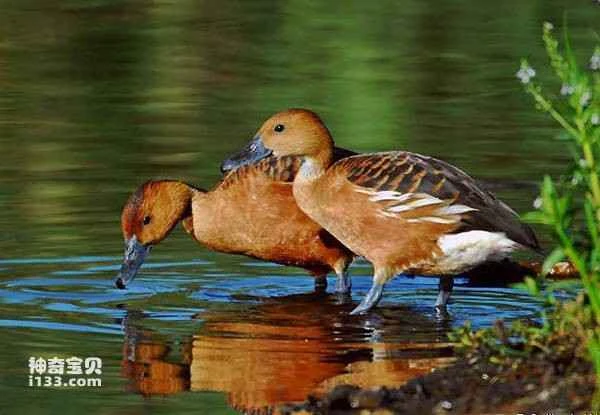
The Tawny Tree Duck is 48-53 cm long. It is about the same size as the Mallard, with a rusty brown body, white rump, and cream-colored stripes on its flanks. It has a grey beak, a long head and legs, a pale yellow head and upper body with some red on the sides, a dark crest, and a dark grey back and wings. The tail and wings have chestnut brown markings, and the upper tail has a crescent-shaped white patch, which is particularly noticeable in flight. Chicks have lighter sides and a different tail color.
Size measurements: Weight: ♂ 1000-1300 g, ♀ 910-1015 g; Body length: ♂ 540-615 mm, ♀ 470-550 mm; Proboscis: ♂ 53-61 mm, ♀ 49-59 mm; Wings: ♂ 270-285 mm, ♀ 250-286 mm; Tail: ♂ 72-112 mm, ♀ 69-125 mm; Tarsus: ♂ 40-55 mm, ♀ 39-50 mm.
Detailed introduction
The tawny tree duck (scientific name: Dendrocygna bicolor), also known as the Fulvous Whistling-duck, Fulvous Duck, or Fulvous Whistling Duck, has no subspecies.
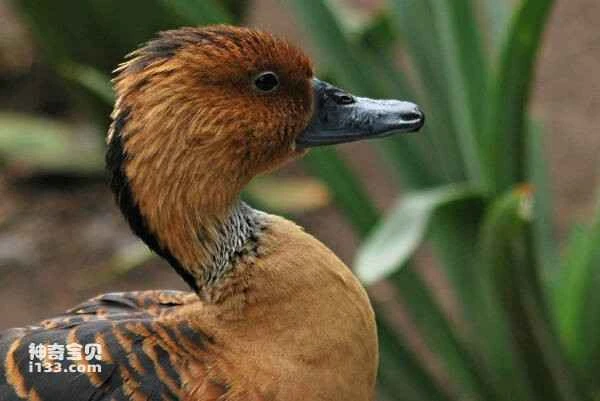
When resting, the Tawny Tree Duck stands upright, and several of them often crane their necks to look around. If they encounter humans or predators, they are the first to take flight, followed by the others, demonstrating their extremely alert nature. They typically forage in groups of several to dozens, and sometimes in large flocks of hundreds. Their flight is weak, and they are slower than other ducks. They are also adept swimmers and divers, with particularly strong diving abilities, capable of diving for over ten minutes at a time. During the hot daytime, they often sleep and rest in reed beds or other tall aquatic plants. If food is plentiful and undisturbed, they tend to stay in one fixed location, generally not changing habitats or even undertaking long-distance migrations.
Listed as Least Concern (LC) on the IUCN Red List of Threatened Species 2013 ver 3.1.
It is listed in Appendix III of the 2019 edition of the Convention on International Trade in Endangered Species of Wild Fauna and Flora (CITES).
Protect wild animals and ban the consumption of wild game.
Maintaining ecological balance is everyone's responsibility!