Basic Information
Scientific classification
- Chinese name: Red-faced Cormorant
- Scientific name: Red-faced Cormorant, Water Crow
- Classification: Waterfowl
- Taxonomic and genus: Red-faced Cormorant
Vital signs data
- Body length: 70-76 cm
- Weight: 2kg
- Lifespan: 3-5 years, some can be over 10 years.
Significant features
It is very similar in appearance to the sea cormorant, but larger in size, with a shorter neck, and a larger area of bare red skin on its face and around its eyes. Its iris is greenish-brown, its beak is yellow, darker at the tip but sky blue at the base (brown during the non-breeding season), and its legs are black.
Distribution and Habitat
Primarily found in coastal and estuary areas, these cormorants prefer locations near the ocean or large rivers, which provide abundant food sources, including fish and shrimp, and also offer favorable breeding environments. The red-faced cormorant has a wide distribution, breeding in eastern Siberia, Sakhalin Island, the Aleutian Islands, and Japan, and wintering in California, southern Japan, and China. This information indicates that the red-faced cormorant can adapt to a variety of environments, ranging from frigid to temperate zones, demonstrating its broad ecological adaptability.
Appearance
It measures approximately 70 cm in length, with glossy black plumage. Its face is red, similar to the Red-faced Cormorant, but during the breeding season, the crest feathers are sparser and softer, and the red on the face is less pronounced than on the forehead, though the cheeks are more red. Juveniles and non-breeding birds have pinkish-grey faces and are slightly smaller. Iris and bill colors: iris blue; bill yellow; legs grey.
Detailed introduction
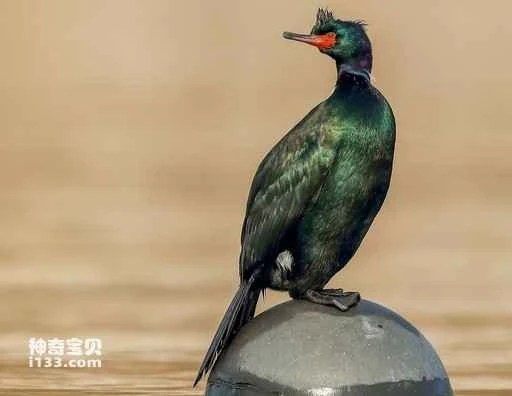
The Red-faced Cormorant (scientific name: *Phalacrocorax urile* ), also known as the Red-faced Cormorant, is a bird belonging to the genus *Phalacrocorax* in the family Cormorantidae. It is commonly called the Water Crow.
This species is distributed in the North Pacific Ocean, including Alaska, the Aleutian Islands, Siberia in Asia, the southern tip of the Kamchatka Peninsula, the Kuril Islands, and the waters around Hokkaido, as well as the northern Korean Peninsula. It winters in its breeding grounds south to the coast of Japan and the Liaodong Peninsula of China, and occasionally reaches Taiwan. This seabird breeds from the coast of the Kamchatka Peninsula to the Aleutian Islands and the Kuril Islands. Breeding occurs on rocky cliffs along the coast or on small islands. The type locality of this species is the Kamchatka Peninsula in eastern Siberia.
A large waterbird, 70-76 cm in length and weighing about 2 kg, with a wingspan of 25-29 cm ( 9.8-11.4 inches). Females are on average about 5 cm ( 2.0 inches) shorter than males. Adults weigh between 1.5 and 2.3 kg ( 3.3 and 5.1 lbs), with females on average 350 g ( 12 oz ) lighter than males . Adults have glossy, deep blue-green plumage, turning purple or copper on the back and sides. Summer plumage is mainly black, with a separate tuft of black crest feathers on the crown and nape, and a long, narrow tuft of white feathers on the rump and thighs. There are sparse, narrow white feathers at the base of the neck and under the tail. There are 11 flight feathers, black, with the second flight feather being the longest. The neck has a purple sheen, and the bill has a green sheen. Winter plumage is also black with a metallic sheen. The head and neck have a green sheen, and the tail is rounded with 12 tail feathers. The tail and belly are adorned with copper-green, while the back and shoulders are purplish-green.
During the breeding season, it has a double crest and white feathers on its sides, neck, and tail. The bare slit of its beak and the skin around its eyes are bright orange or red, which is what gives this bird its name. Although the colors are less vibrant outside the breeding season, the red facial skin is enough to distinguish it from other similar dark cormorants. It has short, thick legs, and its legs and feet are brownish-black.
The iris is brown, and the bare skin at the base of the bill, sides of the throat, and around the eyes is bright red. Juveniles are dark brown with slight purple tinges on the shoulders and wing coverts, and smoky grey on the head and upper back. Otherwise, they resemble adults.
Size measurements: Weight 2000 grams, body length 700-760 mm, beak 53-57 mm.
habitat
The red-faced cormorant primarily inhabits coastal and estuary areas. These cormorants prefer regions near the ocean or large rivers, which provide abundant food sources, including fish and shrimp, and also offer favorable breeding grounds. The red-faced cormorant has a wide distribution, breeding in eastern Siberia, Sakhalin Island, the Aleutian Islands, and Japan, and wintering in California, southern Japan, and China. This information demonstrates the red-faced cormorant's adaptability to diverse environments, ranging from frigid to temperate zones, showcasing its broad ecological adaptability.
Breeding : Breeding season is from May to August . Nests are built on cliffs and precipices along the coast and near islands, especially on relatively flat and open cliffs and rocks jutting out into the sea. Nests are often built in small, dispersed groups. Nests are typically constructed of seaweed. Parent birds usually dive underwater near the nesting area to gather seaweed for nesting material. The nest is lined with fine, soft seaweed and bird feathers. The average nest size is 40-50 cm in diameter and 15 cm high . If breeding is successful, the nest may continue to be used the following year, or even for several years. Each clutch contains 3 to 6 eggs, which are oblong-oval in shape and pale blue or white in color. The eggs measure 53-66 × 33-42 mm, with an average of 60 × 38 mm. The incubation period is approximately 28 days. The timing of the start of breeding varies considerably between different breeding groups and regions. Some begin laying eggs as early as late May or early June , while others do not lay eggs until July . Some chicks leave the nest as early as the end of July , but some don't leave until September . The chicks are altricial. They hatch naked and featherless, their eyes closed. A few days later, downy feathers grow on the middle of their backs. Newborn chicks grow very quickly, reaching adult size in just over forty days, but at this stage they only have immature downy feathers. They don't leave the nest until their flight feathers are fully developed. It is listed as a protected species of concern.
Furthermore, the breeding and growth characteristics of the Red-faced Cormorant indicate that they are relatively prolific among large birds, although their reproductive capacity is not particularly high. However, their populations are not small, and their distribution is very wide, including the Kuril Islands, the Aleutian Islands, and Japan, and even extending to Taiwan and the Gulf region of the Liaodong Peninsula in China. Most Red-faced Cormorants are resident birds, with only a few exhibiting migratory behavior.
Food and foraging
Analysis of the stomach contents revealed that the Red-faced Cormorant primarily feeds on the bottom, mainly on fish and shrimp, supplemented by small amounts of seaweed, kelp, and laver, especially sculpins. Adults rarely have predators, but otters may attempt to catch them, and various corvids, bald eagles, and golden eagles also prey on them. Seagulls and corvids are common predators of their eggs and chicks.
Morphological characteristics
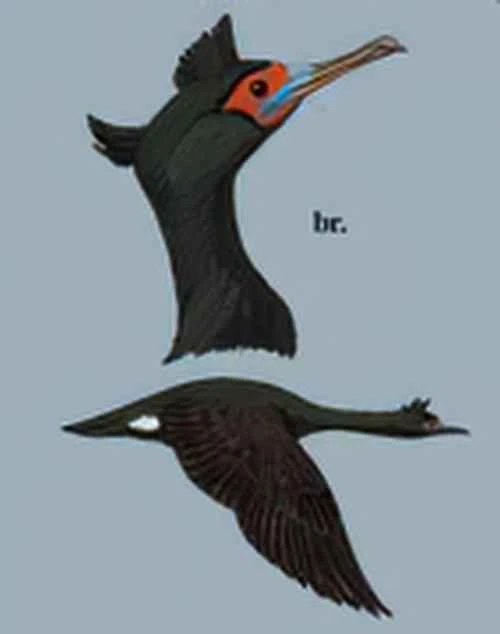
Summer plumage is primarily black, with a separate tuft of black crest feathers on the crown and nape, exhibiting a coppery-green metallic sheen. A long, narrow tuft of white feathers adorns the rump and thighs. Sparse, narrow white feathers are present at the base of the neck and under the tail. There are 11 flight feathers, all black, with the second feather being the longest. The neck has a purplish sheen, and the beak has a green sheen.
Winter plumage is also black with a metallic sheen. The head and neck have a green sheen, the tail is rounded with 12 tail feathers. The upper tail and belly are tinged with copper-green, and the back and shoulders are purplish-green.
The iris is brown, the bare skin at the base of the mouth, the sides of the throat, and around the eyes is bright red, and the legs are short, thick, and black.
The juvenile is dark brown with slight purple tinges on its shoulders and wing coverts, and smoky gray on its head and upper back. Otherwise, it resembles the adult.
Size measurements: Weight 2000 grams, body length 700-760 mm, beak 53-57 mm.