Basic Information
Scientific classification
- Chinese name: Tropical flying fish
- Scientific name: Exocoetus volitans
- Classification: Small fish
- Family: Exocoetidae Exocoetus
Vital signs data
- Body length: 20–30 cm, maximum ~35 cm
- Weight: Varies by individual/area (small pelagic fish)
- Lifespan: 2–5 years (estimated)
Significant features
Extremely elongated pectoral fins enable gliding; the lower lobe of the caudal fin accelerates "paddle" action; floating spawning with sticky silky eggs; phototaxis.
Distribution and Habitat
Global tropical-subtropical outer ocean surface 0–50 m; often associated with fronts/float lines.
Appearance
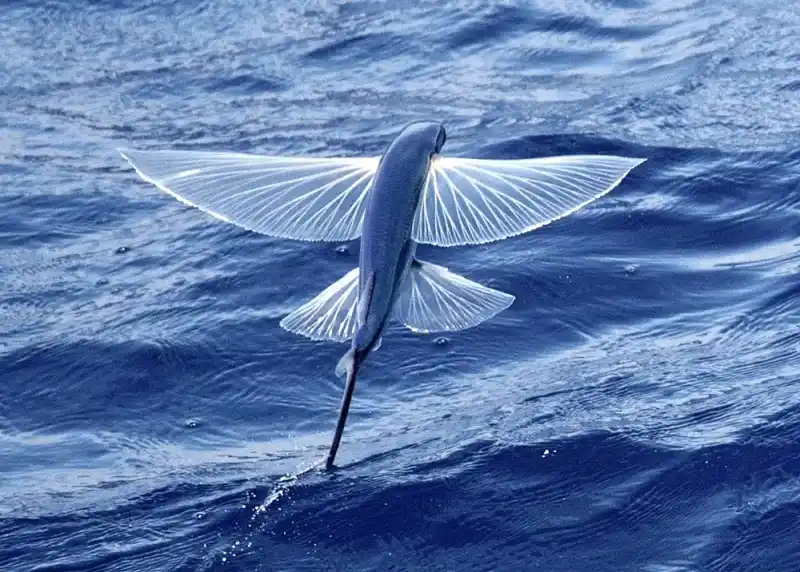
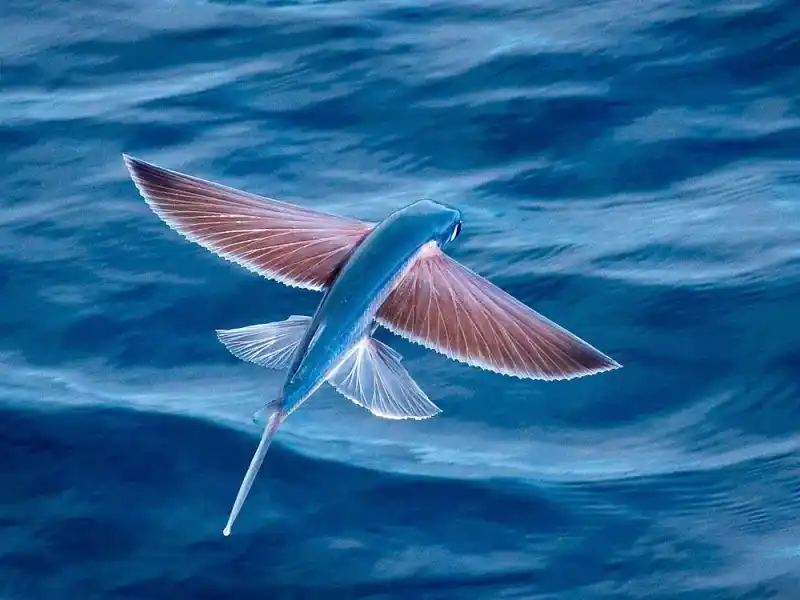
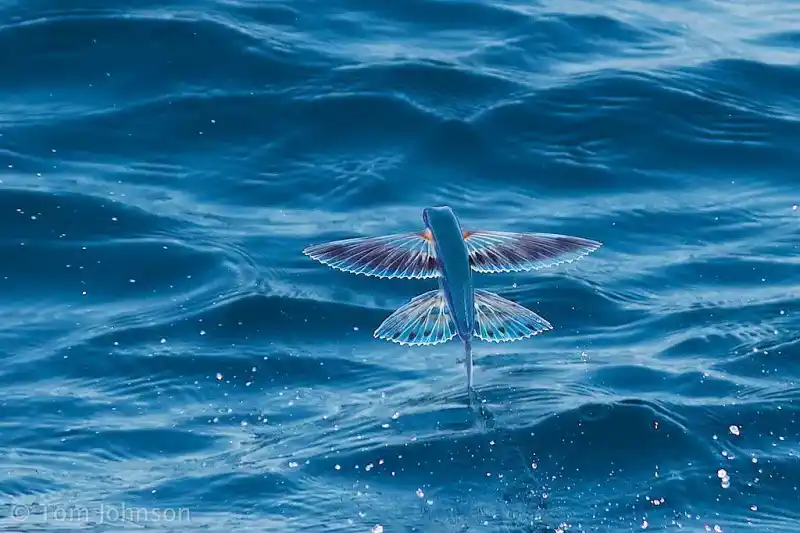
The sides of the body are silvery and shiny, and the pectoral fins are like wings; the caudal fin is asymmetrical with an elongated lower lobe; the dorsal fin is positioned posteriorly.
Detailed introduction
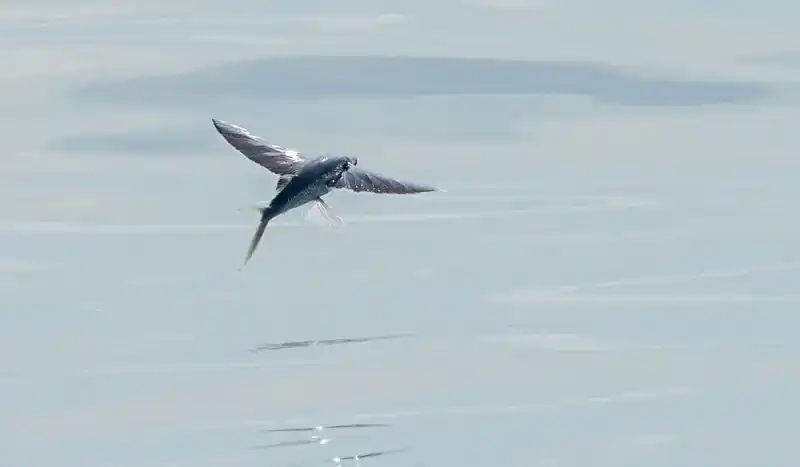
The tropical flying fish ( Exocoetus volitans ) belongs to the family Exocoetidae and is one of the most widespread pelagic flying fish. Its extremely elongated pectoral fins spread out like "wings" when it glides out of the water, and its elongated lower tail fin rapidly slaps the water surface to obtain secondary acceleration, enabling it to glide for tens of meters out of the water .
Ecology and Biology
Diet: Mainly planktonic crustaceans (copepods, etc.) and small fish/squid.
Behavior: When chased by predators (mahi-mahi, tuna, sailfish, etc.) , it leaps out of the water and glides ; at night, it is often attracted to light.
Reproduction: Floating eggs ; the eggs have adhesive filaments that can attach to floating objects such as seaweed, driftwood, and marine debris.
Morphology and Recognition
The pectoral fins are extremely long ("double wings"), while the anal fin is relatively short; the origin of the dorsal fin is usually located on the posterior half of the body.
The lower lobe of the caudal fin is significantly elongated , which facilitates "paddle-like" movements before and after surfacing.
The sides of the body are silvery; the lower jaw protrudes slightly forward; the scales are relatively large and easily fall off.
Body size and lifespan
Body length: Commonly 20–30 cm , with a maximum of ~35 cm .
Lifespan: Typically 2–5 years , depending on the sea area.
Distribution and Habitat
It is widely distributed in the tropical-subtropical outer ocean surface zone (circumtropical distribution), commonly found in the surface layer of 0–50 m , and is associated with fronts/floating lines .
Conservation and Human-Sea Interaction
Conservation: Overall population is stable; regional fishing and by-fishing, as well as light-luring fishing, have an impact on population structure.
Uses: In some sea areas, it is used as food and bait fish ; nighttime light-attracting is a local fishing characteristic.
IUCN: Least Concern (LC) (subject to the latest assessment).
Frequently Asked Questions
Q1: Do flying fish really "fly"? Strictly speaking, they glide out of the water , gaining lift by surfacing at high speed and opening their pectoral fins, and can travel distances of up to tens of meters.
Q2: Why is the lower lobe of the caudal fin longer? It is used to slap the water surface before and after surfacing to replenish speed, acting as a "run-up and accelerator".
Q3: Will they approach the lights? Flying fish are attracted to light in many sea areas and are often seen near lightships at night, so they are used as targets for light-attracting fisheries.
Q4: What is the difference between Exocoetus and "Four-winged Flying Fish"? Most Exocoetus species have two wings (only the pectoral fins are elongated) ; "Four-winged" species also have significantly elongated pelvic fins .