Basic Information
Scientific classification
- Chinese name: Common Cormorant
- Scientific names: Cormorant, River Pelican, Water Crow, Osprey, Squirrel, Blackfish
- Classification: Waterfowl
- Taxonomy and Genus: Cormorant, Pelican, Crowfish, Eagle, Blackfish, Black Gourami
Vital signs data
- Body length: 720–900 mm
- Weight: 2kg
- Lifespan: 13-15 years
Significant features
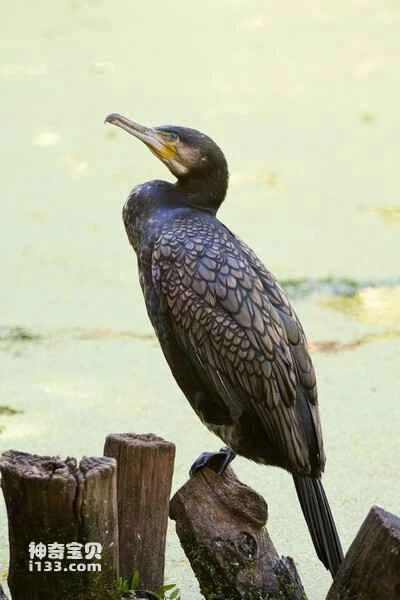
Its body is almost entirely black with a greenish-brown metallic sheen. During the breeding season, it develops white filamentous feathers on the back of its head and a white patch on its lower flanks; these features disappear outside the breeding season. Juveniles have brown plumage. The iris is red, the beak is grayish-black, and the legs are blackish-green.
Distribution and Habitat
They inhabit rivers, lakes, ponds, reservoirs, estuaries, and marshes. They also often perch on rocks or branches to dry their wings. Wild cormorants usually live in rivers and marshes, and in summer they nest on rocky cliffs or tall trees near water, or in low trees in marshland. They are not very afraid of humans. They are often active at seashores, lakeshores, and in freshwater areas.
Appearance
It has a blackish sheen, a thick bill, and white cheeks and throat. During the breeding season, the neck and head are adorned with white filamentous feathers, and the flanks have white patches. Juveniles: dark brown, with dirty white underparts. Iris is blue; bill is black, with yellow bare skin at the base of the lower mandible; legs are black.
Detailed introduction
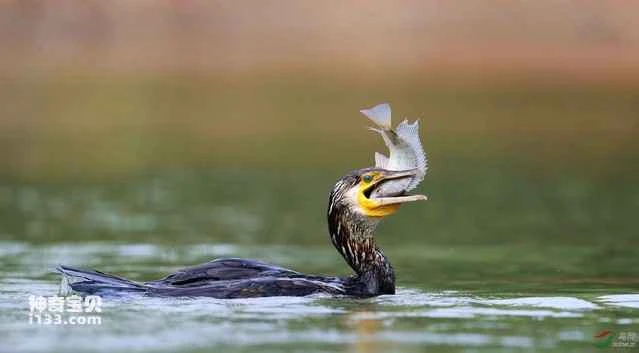
The cormorant (scientific name: *Phalacrocorax carbo* ), also known as the heron cormorant, river pelican, water crow, fish eagle, gull (phonetic), black ghost, and black fish roe, is a widely distributed seabird belonging to the genus *Phalacrocorax* in the family Phalacrocoridae of the order Pelecaniformes. It has a body length of 720–900 mm and a wingspan of 1210–1490 mm, with males and females being similar in appearance. Its plumage is black with a purplish metallic sheen, and its iris is green. During the breeding plumage, large patches of white appear on the sides of the head and neck. In the non-breeding plumage, the white on the head and neck disappears; the beak is thick, with an orange-yellow base and throat pouch, and white cheeks and throat; in summer plumage, the neck and head ornament have white filamentous feathers, which disappear in winter plumage, and white patches are present on the flanks; juveniles are dark brown with dirty white underparts.
Distributed in North America, Europe, Russia, Northwest and South Africa, the Middle East, Asia, Australia, and New Zealand. In China, they breed in suitable environments throughout the country, congregating in large flocks around Qinghai Lake. They inhabit large, open rivers, lakes, and reservoirs. They usually live in small groups, sometimes numbering in the hundreds. Their diet consists mainly of fish and crustaceans. After catching fish, they often dry their feathers in open areas near the water or on tree branches. The breeding season is from April to June . Each clutch contains 3-5 eggs, which are pale blue or pale green. Both parents take turns incubating the eggs, which takes 28-30 days . After about 60 days of feeding by the parents, the chicks can fly and leave the nest, reaching sexual maturity at around 3 years old.
The common cormorant is relatively common in southern China and has long been domesticated by the local people for fishing. Due to long-term overhunting and environmental destruction, the wild population has become very small. The common cormorant is listed in the "List of Terrestrial Wild Animals of Beneficial or Important Economic and Scientific Research Value under State Protection" issued by the State Forestry Administration of China on August 1, 2000 ; it is a key protected bird species in Hebei Province, China.
The common cormorant's summer plumage features a black head, neck, and crest with a purplish-green metallic sheen, interspersed with fine white filamentous feathers; upperparts are black; shoulders, back, and wing coverts are bronze-brown with a metallic sheen; feather edges are dark bronze-blue; tail is rounded with 14 tail feathers, greyish-black with greyish-white bases on the shafts; primary flight feathers are blackish-brown, secondary and tertiary flight feathers are greyish-brown with a green metallic sheen; cheeks, chin, and upper throat are white, forming a semi-ring shape, with a brownish-gray tinge at the trailing edge; the rest of the underparts are bluish-black with a metallic sheen, and have a white patch on the lower flanks. Winter plumage is similar to summer plumage, but lacks the white filamentous feathers on the head and neck, and the white patches on the flanks. During the breeding season, there is a triangular white patch on each side of the rump. The head and upper neck have white filamentous feathers, and there is a faint crest on the back of the head.
The iris is emerald green, the lores are olive green, and the bare skin around the eyes and sides of the throat is yellow. The beak is thick, strong, long, and conical with a sharp hook at the tip; the upper mandible is black, while the edges and lower mandible are grayish-white, suitable for catching fish. There is a small pouch in the lower throat, which is orange-yellow. Juveniles resemble adults in winter plumage, but are paler, with the upper body mostly dark brownish-brown. The head lacks a crest, and the chest and abdomen are covered with a velvety white. The cormorant's plumage is primarily black with a purplish metallic sheen. During the breeding season, the male develops numerous white filamentous feathers on its head and neck. The legs are black, positioned posteriorly, with flattened toes, the hind toe being longer, and fully webbed. It inhabits seashores and marshes. In flight, the neck and legs are extended.
Size measurements: Weight: ♂ 1990-2250 g, ♀ 1340-2300 g; Body length: ♂ 770-870 mm, ♀ 716-836 mm; Bill length: ♂ 64-75 mm, ♀ 61-66 mm; Wing length: ♂ 318-375 mm, ♀ 337-342 mm; Tail length: ♂ 185-220 mm, ♀ 160-182 mm; Tarsus length: ♂ 70-90 mm, ♀ 61-78 mm. (Note: ♂ male; ♀ female)
Habitat
They inhabit rivers, lakes, ponds, reservoirs, estuaries, and marshes. They also often perch on rocks or branches to dry their wings. Wild cormorants usually live in rivers and marshes, and in summer they nest on rocky cliffs or tall trees near water, or in low trees in marshland. They are not very afraid of humans. They are often active at seashores, lakeshores, and in freshwater areas.
Migration
Most common cormorants are resident birds, especially those breeding in southern China, which generally do not migrate. Those breeding north of the Yellow River typically migrate south of the Yellow or Yangtze River for the winter. Spring migration to their northern breeding grounds usually begins in late March or early April, while autumn migration typically begins in late September or early October , heading south to their wintering grounds. During migration, they often form small flocks, but sometimes large flocks of nearly a hundred individuals can be found.
Habits
They are accustomed to acting in groups and have a strong sense of "organization and discipline." Like geese and ducks, they also fly in V-formation during long migrations. Sometimes they will form a long line on the water, with their heads and necks held up, their beaks pointing in the same direction, and their bodies submerged in the water. From a distance, one can only see a row of neat bird heads rising and falling in the waves.
They often move in small groups. They are excellent swimmers and divers; when swimming, their necks are stretched straight upwards and their heads are slightly tilted upwards. When diving, they first half-leap out of the water before flipping and submerging again. In flight, their head and neck are stretched forward, their legs extend backwards, and their wings flap slowly, flying low and skimming the water's surface. When resting, they stand on rocks or trees near the water's edge in a vertical sitting posture, occasionally flapping their wings. They are not particularly afraid of humans. They are often found near the sea, lakeshores, and in freshwater. When perched, they remain motionless on rocks or tree stumps for extended periods. They are strong fliers. Except during migration, they generally do not leave the water. Their main diet consists of fish and crustaceans. When hunting, cormorants submerge their heads in the water to track prey. Their wings have evolved to aid in swimming. Therefore, in seaweed-covered waters, cormorants primarily use their webbed feet to swim, while in clear waters or sandy-bottomed waters, they use both their webbed feet and wings. In low-visibility waters, cormorants often stealthily approach their prey, then suddenly stretch their necks and deliver a fatal blow with their beaks. This makes escape nearly impossible for even the most agile prey. In the dim underwater light, cormorants generally cannot see their prey clearly. Therefore, they rely heavily on their keen hearing to achieve perfect accuracy. After catching their prey, cormorants must surface to swallow it. During the breeding season, they emit a guttural cooing sound; otherwise, they are silent. However, when in groups, disputes over advantageous positions will result in a low, guttural " coo, coo-coo " sound.
feeding habits
They feed on various types of fish. Primarily, they hunt by diving, with about 60% of their feeding grounds located in the benthic zone. They dive to depths of 1-3 meters, with a maximum depth of 19 meters, and can stay underwater for up to 70 seconds, making them arguably the diving champions among birds. After catching a fish, they surface to eat . A single cormorant can catch over 500 kilograms of fish per year. Sometimes, they also stand for extended periods on rocks or trees near the water's edge, silently observing and then diving into the water to hunt their prey.
Distribution range : Afghanistan, Albania, Algeria, Angola , Armenia , Australia, Austria, Azerbaijan, Bahrain, Bangladesh, Belarus, Belgium, Bermuda, Bhutan, Bosnia and Herzegovina, Botswana, Brunei Darussalam, Bulgaria, Burkina Faso, Burundi ; Cambodia, Cameroon, Canada, Chad, China, Democratic Republic of Congo, Ivory Coast, Croatia, Cyprus, Czech Republic, Denmark, Egypt, Eritrea, Estonia, Ethiopia, Faroe Islands, Finland, France, Gabon, Gambia, Georgia, Germany, Ghana, Gibraltar, Greece, Greenland, Guinea, Guinea-Bissau, Hungary, Iceland, India, Indonesia, Islamic Republic of Iran, Iraq. Ireland, Israel, Italy, Japan, Jordan, Kazakhstan, Kenya, South Korea, North Korea, Kuwait, Kyrgyzstan, Lao People's Democratic Republic, Latvia, Lebanon, Lesotho, Libya, Lithuania, Luxembourg, Macedonia, Malawi, Malaysia, Malta, Mauritania, Moldova, Mongolia, Montenegro, Morocco, Mozambique, Myanmar, Namibia, Nepal, Netherlands, New Caledonia, New Zealand, Nigeria, Norway, Oman, Pakistan, Palestine, Philippines, Poland, Portugal, Qatar, Romania, Rwanda, Saint Pierre and Miquelon, Saudi Arabia, Senegal, Serbia, Slovakia, Slovenia, Solomon Islands, Somalia, South Africa, South Sudan, Spain (Canary Islands) Sri Lanka, Sudan, Swaziland, Sweden, Switzerland, Syrian Arab Republic, Tajikistan, United Republic of Tanzania, Thailand, Tunisia, Turkey, Turkmenistan, Uganda, Ukraine, United Arab Emirates, United Kingdom, United States (Hawaii Islands), Uzbekistan, Vietnam, Western Sahara, Yemen, Zambia, Zimbabwe.
Introduced from Singapore. Origin uncertain: Guam. Migratory birds: Cape Verde, Christmas Island, Liberia, Liechtenstein, Federated States of Micronesia, Norfolk Island, Northern Mariana Islands, Papua New Guinea, Seychelles.
They breed in the northern part of the Northern Hemisphere and winter in the southern part of their breeding grounds. They breed in central and northern China, with large flocks gathering at Qinghai Lake. They migrate through central China, wintering in southern provinces, Hainan Island, and Taiwan. Tens of thousands of cormorants winter annually at the Mai Po Nature Reserve in Hong Kong, with some remaining there year-round; they are rarely seen in other locations.
Reproduction methods
The breeding season is from April to June . They usually nest in pairs, and by the time they arrive at the breeding grounds, the pairs are already largely formed. They nest in trees near lakes, riverbanks, or marshes, sometimes with nearly 10 nests in a single tree. They also nest on rocky ground near lakes or rivers, on small islands in lakes, gravel islands, or coastal islands. Nests are constructed from twigs and aquatic plants. They also prefer to reuse old nests, and soon after arriving at the breeding grounds, they begin repairing old nests and building new ones. Each clutch contains 3-5 eggs, pale blue or pale green, oval, blunt oval, or pointed oval, measuring 51-70 mm × 34-49 mm, averaging 65 mm × 41 mm, and weighing 42-49 grams, averaging 46 grams. Both parents take turns incubating the eggs, with an incubation period of 28-30 days. The chicks are altricial, initially naked and featherless. They develop full down feathers around two weeks after hatching, and flight feathers and tail feathers begin to grow at the same time. Both male and female parents raise their chicks together. The chicks put their beaks into the parents' throats to eat semi-digested food. After about 60 days of feeding by the parents, the chicks can fly and leave the nest. They reach sexual maturity in about 3 years.
Protection level
It is listed in the "List of Terrestrial Wild Animals of Beneficial or Important Economic and Scientific Research Value under State Protection" issued by the State Forestry Administration of China on August 1, 2000 .
Listed as Least Concern ( LC ) on the IUCN Red List of Threatened Species 2012 ver 3.1 .
Population status
Common cormorants are relatively widespread and common in southern China, and have long been domesticated by the local people for fishing. Due to long-term overhunting and environmental destruction, wild populations have become very scarce and uncommon. According to the Asian midwintering waterbird surveys organized by the International Waterfowl Research Bureau in 1990 and 1992 , 2,031 cormorants were observed in mainland China in 1990 , plus 3,407 in Hong Kong and 130 in Taiwan, for a total overwintering population of 5,568 ; in 1992 , 273 were observed in mainland China, plus 1,473 in Hong Kong and 337 in Taiwan, for a total overwintering population of 2,083 . The population has declined by more than half. Across Asia, the wintering population in 1990 was 19,305 in East Asia, 20 in Southeast Asia, 10,371 in South Asia, and 2,505 in Southwest Asia, totaling 42,201 . In 1992 , the population was 40,495 in West Asia, 7,547 in South Asia, and 2,126 in East Asia, bringing the total wintering population in Asia to 50,168 , showing a slight increase.
This species has a wide distribution range and does not approach the threshold for vulnerable or endangered status (distribution area or fluctuation range less than 20,000 square kilometers, habitat quality, population size, fragmentation of distribution area), and its population trend is stable. Therefore, it is assessed as a species with no survival crisis.
On March 25, 2023 , during a monitoring activity for wild birds during the spring migratory bird season in Baiyangdian organized by the Xiongxian Forestry Comprehensive Service Center of Xiong'an New Area, bird-loving volunteers recorded more than 200 wild common cormorants. This is the largest single record of wild common cormorant population in Baiyangdian.
Related knowledge
Cormorants are highly skilled fishermen, using their sharp, hooked beaks to catch fish while rapidly diving underwater. They have been domesticated for fishing since ancient times. In Yunnan, Guangxi, Hunan, and other parts of China, people still raise cormorants for fishing. In the rivers, lakes, and coastal areas of southeastern China, it used to be common to see several or even a dozen trained cormorants (also known as fishing eagles or water ducks) perched on long, narrow boats, diligently helping fishermen catch fish. About 60% of their feeding grounds are in the benthic zone. Fishermen row their small boats to areas teeming with fish, and rows of cormorants take flight from the boat, resembling wild ducks. They swim to and fro in the water, sometimes diving, sometimes surfacing. When they spot a fish, they dive 1-3 meters, sometimes up to 19 meters, for up to 70 seconds, making them arguably the diving champions among birds. They use their conical, hooked beaks to catch small, inexpensive fish or those that are not strong swimmers. When they encounter a larger fish, two or three cormorants work together, some pecking at its head, others grabbing its tail, pushing and carrying it to the side of the boat so that the fishermen can immediately catch it with nets. A single cormorant can catch over 500 kilograms of fish in a year.
Cormorant chicks can be allowed to enter the water when they are around 60 days old. After 100 days, they are gradually allowed to learn to fish by following adult cormorants. After 150 days, they can gradually begin normal fishing. When training them to fish, a ring made of sedge, straw, or other grass stems (or a specially made copper ring) should be placed around the cormorant's neck so that it can only swallow small fish and not larger ones. Each time a cormorant catches a large fish, it should be fed a small fish as encouragement to encourage it to go into the water to fish more. The fish they "regurgitate" do not enter their esophagus but are temporarily stored in the throat pouch at the bottom of their mouths. To begin training, you can tie many ropes to the cormorant's legs, with the other end tied to the riverbank. Release the cormorant into the water and let it go in to catch fish. Once it catches a fish, the trainer makes a special call to call the cormorant back to shore, where it is fed small fish. After eating, it is driven back into the water to catch fish. After about a month of this daily training, you can use a small boat. Have the cormorant stand on the gunwale, then row the boat to a certain spot and drive it into the water to catch fish. After more than a month of this training, it will be completely tamed and obey the fisherman's commands.