Basic Information
Scientific classification
- Chinese name: Vizsla
- Scientific name: Hungarian Vizsla, Hungarian Pointer, Hungarian Vizsla Dog
- Classification: Rodentia
- Classification and genus: Mammalia, subphylum Vertebrata
Vital signs data
- Body length: 53-61cm
- Weight: 22-30kg
- Lifespan: Approximately 13 years
Significant features
Pointer dogs, hunting dogs, companion dogs, domestic dogs
Distribution and Habitat
Hungary
Appearance
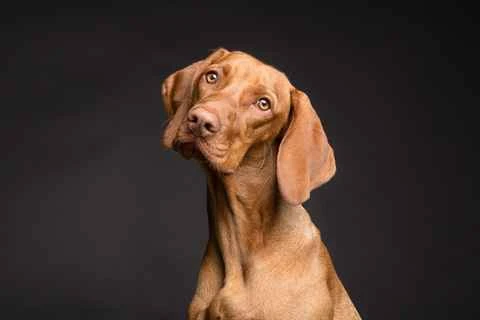
The head is sloping and muscular, slightly broad, with a center line extending forward to the forehead. The muzzle is roughly the same length as or slightly shorter than the head, tapering in shape and gradually narrowing from the stop to the tip of the nose, becoming square and deep. The eyes are medium-sized, set relatively dark, and their color matches the coat. The ears are thin, smooth, and long, with rounded tips, set low close to the cheeks. The nostrils are slightly open, and the nose is brown.
Detailed introduction
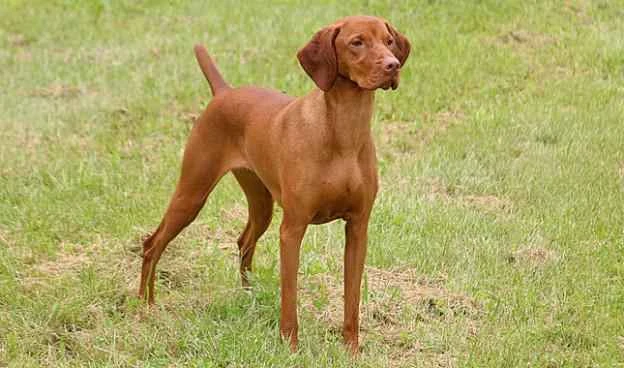
The Vizsla (scientific name: *Hungarian Vizsla*, English name: Vizsla), also known as the Hungarian Vizsla Pointer, is a breed whose ancestors may have been brought to Hungary by the Magyars more than 1,000 years ago. Other breeds developed from the Vizsla include the Weimaraner, the German Wirehaired Pointer, and the German Shorthaired Pointer. It is a beautiful and elegant hunting dog, often called the "Silver Ghost" because of its ghostly appearance and movements. Originating in Hungary, the Vizsla was initially used as a hunting dog for catching birds. Today, they are also widely kept as family pets and working dogs.
Weight: (Male) 22-30kg (Female) 22-30kg
Body length: (male) 56-61cm (female) 53-58cm
Country of origin: Hungary
Purpose: Pointer, hunting dog, companion dog, domestic dog
Lifespan: Approximately 13 years
Canine intelligence ranking: 25
This is a medium-sized, short-haired, smooth-smooth hunting dog with a noble appearance and bearing. A high level of energy and a light build are preferred; the coat is an attractive rusty, golden-red, or sandy yellow. This dog is very powerful and driven in the field, but in the family, it is an easily trained and beloved companion. It is important to emphasize the coat's suitability for field work, and the strongest and most developed muscles possible. Scars are a mark of honor for working and hunting dogs and are not considered a fault. Its qualities make it a "dual" dog, which is commendable and not a fault.
They have a long, narrow face, long ears, and deep brown eyes. Their bodies are very graceful, and their tails are also long. The Vizsla's coat is very short and dense, usually silver, brown, or golden. They typically weigh between 50 and 60 pounds and stand approximately 23 to 27 inches tall.
Hungarians who fled Hungary before the Soviet occupation in 1945 took it to Australia, Italy, and Germany. Some of it then spread to the Czech Republic, Turkey, and the southern part of the former Soviet Union.
The Vizsla was introduced to the United States in the 1950s and registered with the American Kennel Club in 1960. As a hunting dog, the Vizsla possesses abundant energy and endurance, while also being a gentle and friendly companion dog.
The Hungarian Vizsla is a very intelligent, loyal, gentle, friendly, and lively dog, elegant and obedient yet full of energy. Originally intended as a guiding and retrieving dog, the Vizsla has, in the last 20 years, expanded into a third purpose: a widely admired, obedient, and reliable family companion. Their popularity in Hungary is on the rise, and their original purpose has not been forgotten. In Canada, the wire-coated variety is often seen as a gun dog, working alongside hunters on weekends. They relentlessly track tracks and diligently retrieve game or thrown tennis balls. Highly perceptive hunting dogs, they excel at scent and sight tracking and can hunt efficiently in grasslands, forests, and waters, possessing abilities such as signaling locations and retrieving prey.
The Hungarian Vizsla is an excellent hunting dog, gets along well with other animals, is very loyal to its owner, and gentle with children. If given ample space for exercise, it can also be a family dog. It is well-suited to city life and hot weather, but struggles in cold climates. It does not require frequent grooming and is easy to train.
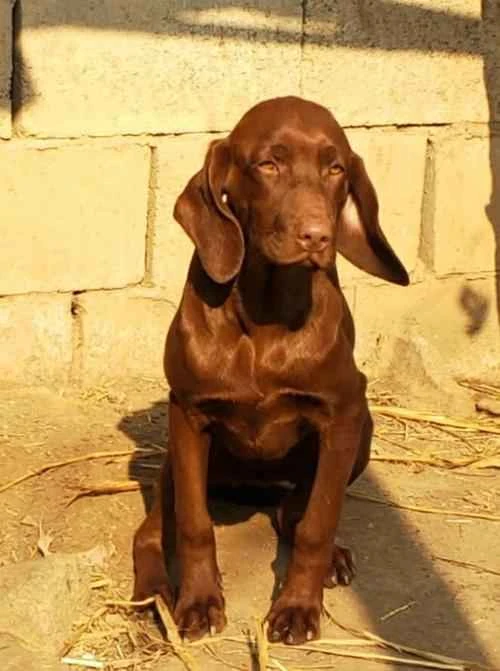
On November 25, 1960, it received certification from the AKC (American Kennel Club) and the FCI (Fédération Cynologique Internationale).
Certification Standards
[General Appearance] Elegant in demeanor, short-haired, with a striking pure golden-brown coat. It is a powerful runner in the field, and a gentle and affectionate companion at home. Particular emphasis is placed on its field-ready coat and strong, muscular build. Dual-purpose qualities are appreciated and not opposed.
[head]
Sloping and muscular. Head: Slightly broad between the ears, with a center line extending forward to the forehead. The stop between the muzzle and head is moderate and not deep. In outline, the muzzle or mouth: approximately the same length as or slightly shorter than the head, tapering gradually from the stop to the tip of the nose. The muzzle is square and deep. It neither curves upwards to form a so-called "plate" face, nor slopes downwards. Whiskers serve a purpose and can be used for grooming, but are not preferred. Nostrils: Slightly open. The nose is brown. Any other color is a fault. A completely black nose is a disqualification. Ears: Thin, smooth, and long (in proportion), with rounded tips, set low, and close to the cheeks. Jaw: Strong and very well-developed white teeth with a scissor bite. Eyes: Medium-sized, set dark, and surrounded by a thin layer of white. The eye color should match the coat color. Yellow or any other color is a fault. Protruding eyes are a disqualification. The lower eyelid should neither turn inward nor outward, as this would allow grass seeds or dust to fall into the eye. Lips: Completely cover the jawline, but neither loose nor drooping.
[Neck, backline, torso]
Neck: Strong, smooth, and muscular, of medium length, arched and without dewlap, gradually widening towards the shoulders with a moderate sloping rear. This is essential for balance with the angular hindquarters. Body: Strong and very well-proportioned. Short back. The withers are the highest point on the topline, which is slightly arched, crossing the loin and ending at the tail root. Chest of moderate width, deep, extending to the elbows. Ribs well-sprung; underbelly curve moderately tucked below the loin. Tail: Set below the level of the croup, thick at the base, docked, with one-third removed. Ideally, it should extend to behind the stifle joint, carried nearly horizontally. Undocked tails are a fault.
[Forequarters]
The shoulder blades are quite long (in proportion) and broad, moderately sloping backward, with the tips very close together. The forelegs are straight and muscular, with elbows close to the body. The feet are cat-like, round and compact, with closely spaced toes. The nails are brown and short. The pads are thick and hard. If dewclaws are present, they must be removed (on both forelegs and hind legs). Hare feet are a fault.
[Hindquarters]
Hind legs: Thighs are very well-developed, with moderately angulated stifle joints, and hocks balanced with moderately sloping shoulder blades. Viewed from behind, they must be very straight. Too large or too small an angle of the hocks are considered faults. The hocks are set low and parallel to each other.
[Furry]
Short, smooth, dense, and lying flat, with no woolly undercoat. Noticeably long coats are a disqualification.
[color]
Different shades of pure gold rust color. Pure deep peach red or pale yellow are considered faults. The smaller the white on the chest, the better; white on the toes is permissible. White extending above the toes, or anywhere other than the chest, is a disqualification. When the dog is standing naturally, viewed from the front, the white on the chest must be limited to the area between the upper end of the sternum and the elbow. White extending to the shoulder blades or neck is a disqualification. White hairs appearing due to age are not considered a fault. Any perceptible black area on the coat is a serious fault.
[gait]
With full extension, the gait is light, smooth, and graceful. When running at high speed, a well-structured dog tends to follow a single trajectory.
[body shape]
The ideal shoulder height for males is 22-24 inches; for females, it is 21-23 inches. Since the Vizsla is a medium-sized hunting dog, any deviation exceeding 1.5 inches is a disqualification.
[temperament]
A natural hunting dog with an excellent sense of smell and above-average trainability. Lively, gentle, and well-behaved, clearly showing affection and sensitivity, and very brave with a protective instinct. Shyness, timidity, or nervousness are all considered faults.
[Disqualification]
The nose mirror is completely black.
The white color extends above the toes, or appears anywhere other than the chest.
White extends to the shoulder blades or neck
Long fur
Males have a shoulder height of more than 25.5 inches or less than 20.5 inches; females have a shoulder height of more than 24.5 inches or less than 19.5 inches.
Basic beauty
Hair Standards
The hair is short, smooth, dense, and close to the skin, with an inner layer of hair resembling wool.
Variety Notes
The Vizsla is a breed that developed in Hungary from the continental Panda dog, and it is an ancient breed. The ancestors of the Vizsla can be traced back thousands of years, existing when the Maya migrated to Hungary. Over the years, this breed has continuously adapted to the local hunting conditions and evolved into the breed we know today.
The Vizsla is highly skilled at hunting in the mountains and catching ducks in the water, and it is also adept at catching birds in the mountains. Since its introduction to the United States, the breed has remained relatively stable in number. Today, it is loved by many as a hunting dog, a family pet, and a beauty contest dog.
Beauty methods
The Vizsla dogs to be exhibited must have their whiskers and the unusual hairs around their eyes and cheeks trimmed short to create a smooth face that complements their golden-brown coat. They should be bathed to make their coat shiny and silky soft. The ears need to be thoroughly cleaned, which is a key focus for the judges. The toenails should be trimmed as short as possible so they don't touch the ground and are very clean. The hair between the toes should be trimmed, and the small tuft of hair at the tip of the short tail should be neatly trimmed and gently curled for a natural look.
Teeth can be brushed if needed. This dog has sensitive skin, similar to human skin, so soap and shampoo can be used. Its fur is less than 1 cm long, making grooming easy.
Nursing methods
Because Vizsla dogs have very short and dense fur, they don't require much grooming. Brushing once a week is sufficient. However, you should be careful when cleaning a Vizsla's ears, as their droopy ears often cover the ear canals, resulting in less ventilation and a higher risk of bacterial growth.
Therefore, you should clean its ears regularly. First, put ear cleaning solution into its ear, and it will shake its head on its own. Then, use a clean cotton swab to clean the ear canal. Repeat this 1-2 times until there is no dirt in the ear, then stop cleaning.
For older Vizsla dogs, do not use a dryer after bathing; it's best to use a hairdryer to dry them completely. If their fur is matted, use electric clippers to trim it; do not forcibly comb it out. Pay close attention to them during the bath.
Training methods
Command training
Training a Vizsla involves many aspects, and here we will discuss some basic training, such as the "down" command.
Training a dog to "lie down" involves teaching it to lie down quickly upon the trainer's command and not to stand up without a command.
Command: "Lie down"
Gesture: Raise your right hand, palm facing backward. Then extend it forward horizontally, palm facing down.
First, have the dog sit on your left. The trainer steps forward, bends down, and uses their right hand to hold food to lure the dog. When the dog tries to reach it, slowly move the food from below its mouth down while simultaneously giving the "lie down" command and pulling the leash down. Reward the dog with food immediately after it lies down. As the conditioned reflex develops, gradually eliminate food and mechanical stimulation, relying solely on verbal commands and hand gestures to make the dog lie down. Another training method is: after having the dog sit, the owner steps back and squats down, holding the dog's two front paws with both hands. Give the "lie down" command and stretch the dog's front paws forward while pressing down on the dog's shoulder blades with their left arm. Reward the dog immediately after it lies down correctly. Once the dog can lie down, further train it to lie down at a certain distance from the owner, eventually reaching a point where the dog cannot stand up without a command.
Fixed-point defecation
First, you need to understand the defecation habits of dogs. Newborn puppies have closed ears and eyes and are unable to move easily, so they cannot defecate outside the nest. The mother dog will regularly lick the puppies' perineum with her tongue and eat their feces. This is a maternal behavior.
After about three weeks, puppies will learn to leave their nests and relieve themselves elsewhere. By six months old, most puppies can relieve themselves in a designated spot, as dogs naturally prefer to do so in the same place. Before choosing a fixed spot, puppies often sniff their surroundings, and if they smell the scent of previously leftover excrement, they will return to that spot to relieve themselves.
Dogs (especially females) prefer to defecate in inconspicuous corners to avoid attracting attention. In gardens or outdoors, they may bury their feces with sand, grass, or leaves. This behavior is very useful for training dogs to defecate in designated areas. Dogs older than 8 months will absolutely not want to defecate in their sleeping area, nor will they defecate randomly during long sleeps; they can tolerate it for at least 4-6 hours unless they are sick or have diarrhea.
However, upon waking in the morning, one will inevitably have a bowel movement within an hour. And within an hour, or even less than 10 minutes, after eating, the stomach is stimulated by food, triggering pressure receptors and causing a bowel movement.