Basic Information
Scientific classification
- Chinese name: Shira poison lizard
- Scientific name: American tarantula, Gila tarantula, Gila tarantula, blunt-tailed tarantula, Aztec lizard
- Classification: Squamata
- Genus and species: Venomosaurus, genus Venomosaurus, family Venomosauridae, phylum Chordata.
Vital signs data
- Body length: 48-56 cm
- Weight: 900-1200 grams
- Lifespan: 20-30 years
Significant features
Venom is a neurotoxin
Distribution and Habitat
The southwestern United States and northwestern Mexico. Its range extends from the extremes of southwestern Utah and southern Nevada, to neighboring southern California, southern Arizona, southwestern New Mexico, and much of Sonora, and further to northern Sinaloa, Mexico.
Appearance
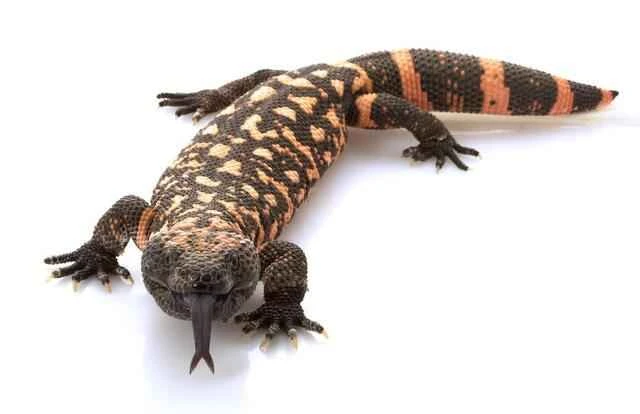
The tail usually has 4 to 5 black stripes, the snout and cheeks are black, the head is covered with large, bead-like scales, and the tongue is dark and forked, flicking its tongue like a snake to detect surrounding scents.
Detailed introduction
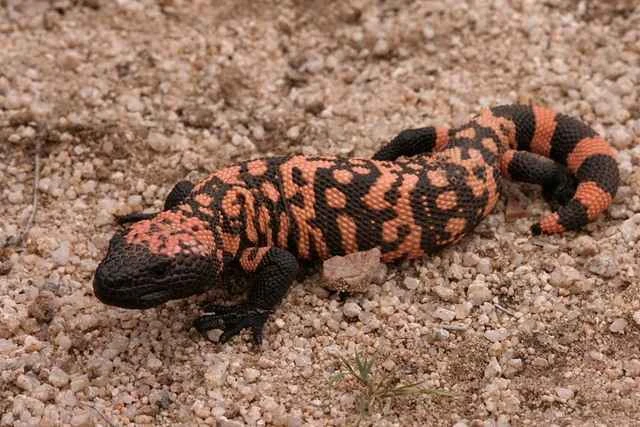
The Gila monster (scientific name: *Heloderma suspectum*), also known as the American tarantula, Gila monster, blunt-tailed tarantula, or Aztec lizard, is named after the Gila River Basin. It measures 48-56 cm in length, with most commonly observed measuring around 45-50 cm. Its weight typically ranges from 900-1200 grams, with the largest individuals reaching up to 2300 grams. It is one of the few dangerous lizards; its venom is neurotoxin, and a bite can cause symptoms such as limb paralysis, drowsiness, shock, and vomiting.
The entire body resembles a large gecko, robust and heavy, with a short, thick tail that serves as a fat storage organ. This unique energy storage mechanism allows them to sustain themselves for a year after four or five large meals in the wild. The body is covered with small, non-overlapping scales; the limbs are short and powerful, with five slender claws. The head is relatively large, black at the front and yellow at the back. The eyes are small, black, with round pupils; the tongue is pink or purple and forked in the middle. The face is black, with small, bead-like scales. The head is relatively large, black at the front and yellow at the back, interspersed with black spots; the teeth have sharp tips and distinct longitudinal grooves. The tongue is pink and forked in the middle; the body is mottled with dark colors, including yellow, pink, light red, or black markings. The reticulated tarantula's spots or bands are broken, forming a reticulated pattern. The black-banded tarantula's spots usually form a continuous band on its back.
Distributed across the western and southern states of the United States, including Arizona, California, Nevada, Utah, and New Mexico, centered around the Mojave and Sonora deserts, extending into the southern Mexican state of Sonora.
They inhabit relatively arid environments, ranging in altitude from sea level to 5100 feet (1600 meters). Their habitats include desert scrubland, semi-desert grasslands, oak and juniper thickets, and sand, gravel, and rocks in semi-arid regions. Vegetation includes cacti, prickly pear trees, and other cacti found in desert areas. They prefer to hide in canyons, rocky slopes, burrows, and mounds of mouse bones. They enjoy digging burrows, and if possible, they will build up a sufficient layer of substrate for digging, maintaining a temperature between 30-35 degrees Celsius.
The venom of the tarantula is neurotoxin; a bite can cause symptoms such as limb paralysis, drowsiness, shock, and vomiting, but it is usually not fatal. The tarantula's fangs and venom glands are located in its lower jaw. The fangs are grooved, allowing the venom to seep into the saliva and enter the wound through the grooves. With each bite, the tarantula uses only about one-third of its venom. Therefore, both the amount of venom entering the wound and the rate of penetration are relatively small and slow. Although the mortality rate for healthy adults is low, extreme caution is still necessary, especially since the tarantula's bite force is not only strong but it also does not release its grip, continuing to bite and causing severe wounds.
The intense pain from a tarantula's bite stems from two main factors: First, the tarantula's teeth are extremely sharp, and when it bites, it holds on tightly. Second, the tarantula's venom has a unique composition that can block collagen and venous diaphragms, ultimately leading to inflammation and extreme pain. At the peak of the pain, compounds in the venom can cause sweating, diarrhea, vomiting, and even a drop in blood pressure.
The Shira monster lizard spends 90% of its time hiding in underground burrows. Its slow metabolism means it doesn't need to eat as frequently as smaller, more active lizards. Its main diet consists of mice and eggs, but it also preys on small mammals and birds. They are excellent climbers, often scaling trees in the wild to hunt chicks or eggs. Although slow and clumsy, their bite is not only fast but also powerful. Their prey includes eggs, small mammals, and chicks, which they usually swallow whole. When hunting, they use venom in their mouths to kill their prey before slowly swallowing them, thus obtaining both water and nutrients. After a large meal, the Shira monster lizard will rest quietly until it needs to eat again or bask in the sun, at which point it will be unable to excrete.
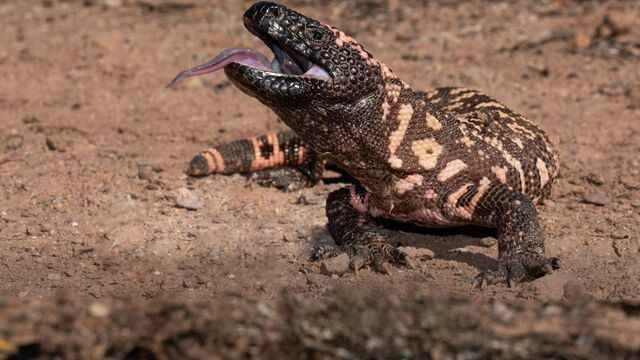
The Gila monster lizard hibernates, emerging from hibernation in January and February each year and remaining there until May or June, when it enters its breeding season. Males use scent to locate females and court them. If the female rejects them, she will attack the male and leave. If both are attracted to each other, they will mate. Gila monster lizards use similar postures and movements to other lizards during mating, but the process is much longer, lasting from 15 minutes to up to two and a half hours.
By July and August, the females begin laying eggs, burying them in a sand burrow about 13 centimeters deep. Each female lays 2 to 12 eggs at a time (but usually around 5). The incubation period is generally 9 to 10 months. The hatchlings, typically 10 months old, can reach 16 centimeters in length and possess formidable venom, making them quite dangerous. After hatching, the young lizards must fend for themselves.
If they grow up smoothly, the Shira monster can live for more than 30 years, making it a very long-lived lizard.
The venom of the Shira monster contains a substance that can treat diabetes. More than ten proteins and toxins have been extracted from its saliva. Among them, a protein called exendin-4 was found to have 50% similarity to a hormone found in the human digestive tract. This hormone in the human digestive tract stimulates insulin secretion when blood sugar is high, thereby lowering blood sugar; it has no effect when blood sugar is low, thus not causing hypoglycemia. A three-year study found that exendin-4 helps people with type 2 diabetes maintain healthy blood sugar levels and also has weight-loss benefits.
Wild populations are currently listed as protected species, and capturing them is prohibited.