Basic Information
Scientific classification
- Chinese name: Coconut crab
- Scientific name: Robber crab (also known as octopus crab)
- Classification: Arthropoda
- Genus and family: Coconut crab (Crabidae family, Arthropoda phylum)
Vital signs data
- Body length: 1 meter
- Weight: 6-12 kg
- Lifespan: 40–60 years
Significant features
Huge size, powerful claws, and a master climber
Distribution and Habitat
They live in tropical forests near the sea, spending most of their time on land, but returning to the sea during the breeding season.
Appearance
Its appearance is very similar to that of a giant spider, with calcified exoskeletons on its body and appendages.
Detailed introduction
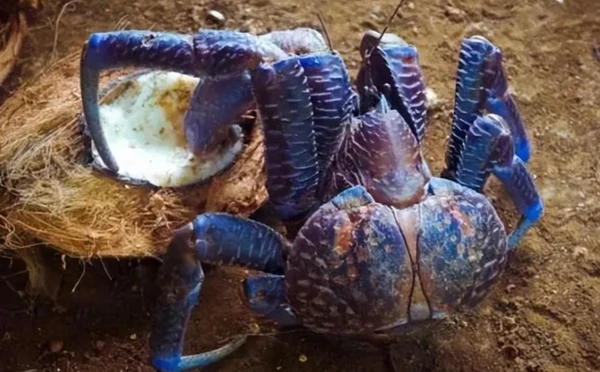
The coconut crab (scientific name: *Birgus latro*, also known as the Coconut Crab or Robber Crab) belongs to the family Hermitidae and is an arthropod of the order Decapoda. It is the largest terrestrial arthropod in the world and the largest living terrestrial crustacean. It gets its name from its ability to crack open the coconut shell with its pincers to eat the coconut meat inside. It grows slowly and has a long lifespan, living from 40 to 60 years.
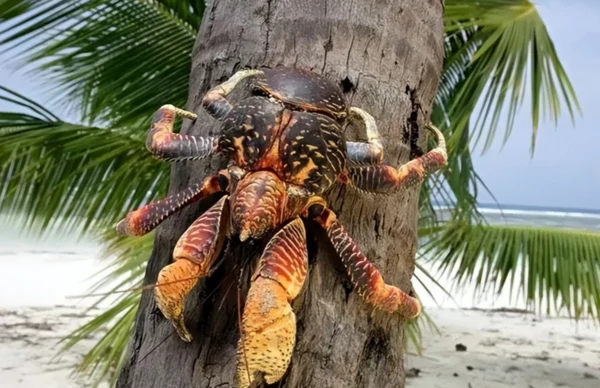
Coconut crabs weigh approximately 6-12 kg, are about 1 meter long (from head to leg tips), and have a claw-to-claw length of about 1 meter. They possess two strong, powerful claws and are adept climbers, reaching heights of up to 18 meters to forage at the treetops. Some call them "robber crabs" due to rumors that they steal items like jars and silverware from homes and tents. Due to habitat destruction, human predation, and a rapid decline in global populations in recent years, coconut crabs were listed as vulnerable on the IUCN Red List in 1981. However, due to a lack of biological data, this was revised to "insufficient data" in 1996, and in 2018, the IUCN updated its assessment to "vulnerable." Taiwan has included coconut crabs in its list of protected species.
Resembling a giant spider in appearance, its body and appendages are calcified and thickened, divided into a cephalothorax and abdomen. The cephalothorax and legs have wavy wrinkles. The cephalothorax is round and protrudes forward, with a well-developed carapace. The second maxillae are well-developed, forming a maxillofacial lobe. The first three pairs of thoracic appendages are specialized into maxillipeds, and the last five pairs are walking legs. Several rows of gills are attached to the base of the thoracic appendages, the lateral walls of the thorax, or the articular membranes between them. The gill area of the cephalothorax is particularly enlarged, the rostrum is triangular, and the oculomotor scales are small. The segments of the first antennal peduncle are slender, the tip of the flagellum is thick and slightly club-shaped, and it has a tactile function. The inner wall of the gill cavity has many folds formed by epithelium, containing clusters of blood vessels for terrestrial respiration. The chelicerae are asymmetrical, with the left chelicerae larger than the right, and are very strong and powerful, used to open hard coconut shells to extract the coconut meat. The first and second pairs of walking legs are powerful, with claw-like tips, used for climbing trees. The third pair of walking legs ends in chelicerae, and the fourth pair of walking legs is very small and lies hidden in the gill cavity under the cephalothorax.
Part of the abdomen folds towards the ventral surface of the cephalothorax. Both the carapace and lateral plates of the abdomen are calcified, slightly asymmetrical, with some sections bent beneath the cephalothorax. Only one side retains a vestigial abdominal appendage. The abdominal appendages are similar to those of hermit crabs, with only one side retaining the vestigial appendage, while the other side has completely disappeared. Significant metamorphosis occurs during development; newly hatched larvae are nauplii.
With red eyes, this crab's body color varies between the islands it inhabits, ranging from purplish-blue to orange-red. Studies have shown that male coconut crabs are significantly larger than females.
With one large and one small claw for hunting, and the rest of its body bilaterally symmetrical, it belongs to the hermit crab family. Its legs are robust, with the left claw slightly larger than the right; the inner wall of its gill cavity has multiple clusters of blood vessels that aid in respiration. Because they do not live in shells that restrict their growth, adult crabs are quite large, with records showing some weighing over seven kilograms and reaching nearly half a meter in length, making them the largest arthropods on land.
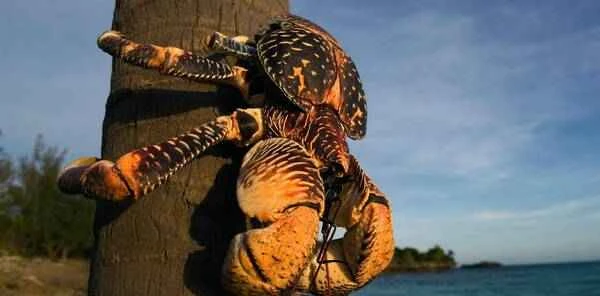
Scientists measured the force of the coconut crab's claws and found that they can exert hundreds of Newtons of pressure, enough to crush coconut shells and other hard objects. Its enormous size and powerful claws make it one of the top predators in the island ecosystem.
Most hermit crabs live inside the spiral shells of gastropods, resulting in soft, asymmetrical bodies. However, coconut crabs have broken free from the constricting shells of other hermit crabs. They find or dig burrows in sand or among tree roots, resulting in large, robust individuals. Except for their pincers, which are of different sizes, their bodies are symmetrical.
They dig as deep as possible when molting, losing their original exoskeleton in the process to create a larger one for themselves. Although their larvae thrive in water, adults spend most of their time on land, occasionally venturing into the water.
Coconut crabs typically inhabit coastal habitats on oceanic islands or small islands near larger continental islands, with a maximum coastline of 6 kilometers. They are mostly found on tropical coasts and some subtropical archipelagic coasts, with the largest distribution in Taiwan (such as the east coast, Green Island, Orchid Island, and Hengchun Peninsula), as well as on islands in the Indian and Pacific Oceans. They are also found in American Samoa, Australia, Christmas Island, the Cook Islands, Fiji, French Polynesia, Guam, India, Indonesia, the Izu and Ryukyu Islands south of Japan, Kiribati, Malaysia, the Marshall Islands, the Federated States of Micronesia, Nauru, Niue of New Caledonia, the Northern Mariana Islands, Palau, Papua New Guinea, the Philippines, Samoa, the Seychelles, the Solomon Islands, China, the United Republic of Tanzania, Thailand, Tokelau, Madagascar, the Seychelles, Easter Island, Tonga, Tuvalu, and Vanuatu.
Regional extinction: Mauritius.
The largest extant terrestrial arthropod. Originally marine animals, they were able to live on land for extended periods due to the numerous blood vessels lining their gill cavities, which aided in respiration, and thus they did not frequently inhabit the ocean. Unlike crabs, they do not walk sideways; they can walk in a straight line. They live in the sea during their juvenile stage, but once mature, they leave the water and move to land, living in the tropical rainforests of islands. After adapting to terrestrial life, they would drown if they stayed in the sea for an extended period.
Coconut crabs use burrows in the substrate as refuges and food storage spaces. These burrows serve as safe havens from predators and also as secure places to store food for later use. They moisten their gills or reproduce in the sea, often hiding during the day in shady woodlands, under rocks, and on coral reefs. They are nocturnal, choosing to rest in cool, shady places like under rocks or coral reefs during the day and only emerging at night to hunt—typical "night owls." Their diet is very varied, including coconuts, fruits, nuts, and carrion. They possess vision and sensory abilities similar to marine crustaceans, with up to 40% of their brain dedicated to smell. Their sense of smell is their secret weapon. When hunting at night, the scents of fruits, nuts, or small animals act like magnets, attracting them to their prey.
They live primarily on land and breathe through gills (but cannot breathe underwater). Coconut crabs are oviparous, returning to the ocean to lay their eggs during the breeding season, where the eggs hatch in seawater.
In the early stages of reproduction, the larvae are similar to other land hermit crabs. As they grow from megalopa larvae to juvenile crabs, they carry a snail shell on their backs to protect their abdomens until the abdominal carapace hardens and they detach from the snail shell.
Coconut crabs grow very slowly, molting several times a year. Each molt allows them to grow slightly larger, and molting usually occurs in autumn and winter. Juvenile crabs molt about 2-3 times a year, and the frequency decreases as they grow larger, with adult crabs molting only once a year.
When coconut crabs reach the age of five, they are sexually ready and mate between May and September. Courtship is a lengthy process for coconut crabs during the annual breeding season, but mating is remarkably quick and simple. Coconut crabs climb down from coconut trees or emerge from burrows. Mating takes place on land. After mating, the female carries fertilized eggs under her abdomen back to rivers, lakes, or seas to lay them. The female coconut crab scatters the eggs in the water, where the larvae hatch. After hatching, the larvae reside in the upper part of the egg sac and float for the next four to six weeks to a new area on logs, coconuts, or other rafts. They remain afloat for up to 28 days, followed by an amphibious stage lasting 21 to 28 days, living in the water. After this stage, they transform into shrimp-like snails, diving to the seabed to find suitable snail shells for refuge. Then, they go to the beach and live at high tide for about four weeks, becoming juvenile crabs.
As they grow larger, they crawl into coconut groves. At this stage, the young crabs occupy the shells of gastropods and migrate to land. Their early shells and lives are fragile, but sufficient to protect them from dehydration and predation. After two to three years, still less than 2 centimeters long, they shed their shells, strengthen their skin, and transform into a miniature adult coconut crab, with a thorax only 5 to 10 millimeters long. Their exoskeleton allows for continued growth and regular molting. Molting occurs in burrows for safety and takes about 30 days, after which the coconut crab possesses a strong skeleton. After this, coconut crabs grow very slowly; evidence suggests they can live to over 40 years old, and after reaching adulthood, they no longer increase in length.
The International Union for Conservation of Nature (IUCN) Red List classifies the coconut crab as a "vulnerable" species.
In 1978, Christmas Island, Australia, enacted a law explicitly prohibiting the killing of coconut crabs, with violators to be dealt with severely.
Human activities have led to the destruction of coconut crab habitats, including coastal development, beach pollution, and habitat fragmentation. These factors threaten the coconut crab's living space and food sources.
In some areas, the coconut crabs have been overfished due to their delicious meat, which has had a significant impact on their population size and genetic diversity.
Frequently Asked Questions
What kind of animal is a coconut crab?
Coconut crabs are the largest land arthropods, belonging to the family Birgus latrodea in the order Decapoda. They are known for their powerful claws and unique ability to climb trees.Can coconut crabs really open coconuts?
Yes, coconut crabs get their name from their powerful claws that can crack open coconut shells. But their diet isn't limited to coconuts; they also eat fruit, carrion, and small animals.Where do coconut crabs live?
Coconut crabs are mainly distributed on tropical islands in the Indian and Pacific Oceans. They prefer to live in caves and sandy areas, and near places covered with vegetation.Are coconut crabs poisonous?
Coconut crabs themselves are not poisonous, but they may carry toxins if they consume certain poisonous plants. Therefore, caution should be exercised when consuming coconut crabs in some areas.Why are coconut crabs endangered?
Due to overfishing, habitat destruction, and slow reproduction, coconut crab populations have declined significantly in many areas and are currently listed as a near-threatened species (NT).