
Basic Information
Scientific classification
- Chinese name: Little Spotted Woodpecker
- Scientific name: Dendrocopos minor, Dryobates mino, Lesser spotted woodpecker
- Classification: Climbing birds
- Family and genus: Order Gastropoda, Family Woodpecker, Genus *Leptochloa*
Vital signs data
- Body length: 13-18 cm
- Weight: 20-29g
- Lifespan: No verification data available.
Significant features
Distribution and Habitat
The Little Spotted Woodpecker is distributed worldwide in: Albania, Algeria, Andorra, Armenia, Austria, Azerbaijan, Belarus, Belgium, Bosnia and Herzegovina, Bulgaria, China, Croatia, Czech Republic, Denmark, Estonia, Finland, France, Georgia, Germany, Greece, Hungary, Iran, Iraq, Italy, Japan, Kazakhstan, South Korea, Latvia, Liechtenstein, Lithuania, Luxembourg, Macedonia, Moldova, Monaco, Mongolia, Norway, Poland, Netherlands, Montenegro, Portugal, Romania, Russia, San Marino, Serbia, Slovakia, Slovenia, Spain, Sweden, Switzerland, Tunisia, Turkey, United Kingdom, and Ukraine.
The Lesser Spotted Woodpecker is distributed in Xinjiang, Inner Mongolia, Heilongjiang, Jilin, and Liaoning provinces in China.
The Little Spotted Woodpecker mainly inhabits broad-leaved forests and mixed forests in low hills and plains at the foot of mountains. In autumn and winter, it also often goes to secondary forests at the edge of forests, sparse forests along roads or fields, courtyards and orchards to move around and forage.
Appearance
The male Lesser Spotted Woodpecker has a dirty white or brownish-red forehead, a vermilion crown and nape, sometimes speckled with white spots; brownish-red lores, black supercilium, greyish-brown ear coverts, white sides of the neck, black from the nape to the upper back, white on the lower back with black horizontal bars; black rump and upper tail coverts; black tail, white outer tail feathers with black tips; blackish-brown lesser and median wing coverts, black greater wing coverts with white horizontal bars; blackish-brown flight feathers with white horizontal bars; black malar stripe, greyish-white whiskers and throat, greyish-white or brownish-grey foreneck to breast, brownish-grey sides of breast and flanks with black longitudinal stripes, and a white or greyish-white belly. The female has a greyish-white forehead, a black crown to nape, and is otherwise similar to the male. Her iris is reddish-brown, her bill is greyish-black or horn-grey, and her legs are blackish-brown.
Size measurements: Weight: ♂ 20-29 g, ♀ 20-28 g; Body length: ♂ 131-162 mm, ♀ 143-179 mm; Bill length: ♂ 13-19 mm, ♀ 14-17 mm; Wing length: ♂ 87-94 mm, ♀ 60-100 mm; Tail length: ♂ 59-72 mm, ♀ 60-82 mm; Tarsus length: ♂ 13-19 mm, ♀ 14-19 mm. (Note: ♂ male; ♀ female)
Detailed introduction
The Lesser Spotted Woodpecker, scientifically known as Dendrocopos minor or Dryobates mino, has three subspecies.
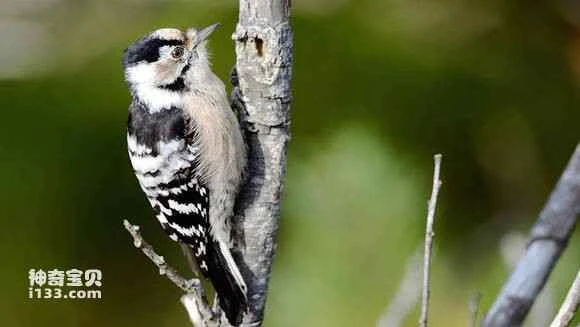
The Little Spotted Woodpecker is a resident bird, usually solitary except during the breeding season. It feeds on thick branches and leaves, mostly inhabiting and roosting in the upper forest canopy, rarely foraging along tree trunks. Sometimes it forages along tree edges while calling, its call being a single syllable, resembling "zha--zha--zha". It flies swiftly, its wings opening and closing in a wave-like motion. Its tapping sound is slower and weaker than that of the Big Spotted Woodpecker. Its diet consists mainly of adult and larval longhorn beetles, bark beetles, coleopteran and dipteran insects, ants, aphids, flies, and various other insects.
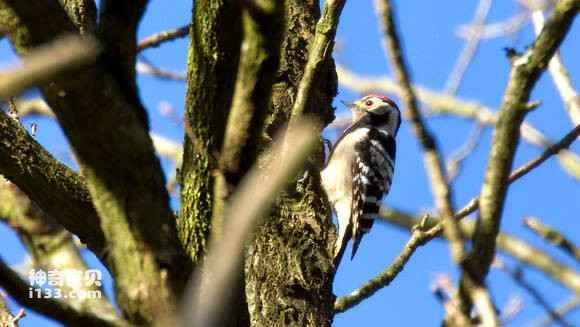
The breeding season for the Little Spotted Woodpecker is from May to June. Pairing and courtship behavior begin as early as April. The male often chases the female through the canopy, emitting a series of short, loud "ga-ga-ga" calls. They nest in cavities in broad-leaved trees, the nest holes being carved by both parents, usually in trees with decaying heartwood. They do not reuse old nests and rebuild the nest hole every year. The entrance is usually round or nearly round, 3-9 meters above the ground. The entrance diameter is 2.6-3.2 mm, the inner diameter is 6-13 cm, and the depth is 16-22 cm. The nest is empty of any lining material, containing only a few wood shavings. Each clutch contains 3-8 white, oval eggs. Both parents take turns incubating the eggs for 14 days. The chicks are altricial and are fed by both parents. After about 21 days of feeding, the chicks are ready to fly.
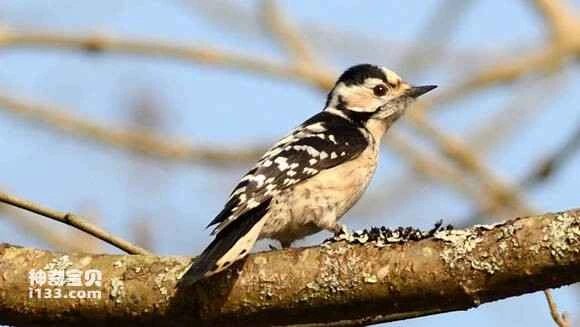
Listed as Least Concern (LC) on the IUCN Red List of Threatened Species 2012 ver 3.1.
Protect wild animals and ban the consumption of wild game.
Maintaining ecological balance is everyone's responsibility!


