Basic Information
Scientific classification
- Chinese name: Two-spined spider
- Scientific name: Poecilopachys australasia (Griffith & Pidgeon, 1833)
- Classification: Arthropoda
- Family: Poecilopachys
Vital signs data
- Body length: Female spiders are about 8 mm long, while males are about 2.5–3 mm long, making them relatively small orb-weaver spiders.
- Weight: Only tens of milligrams in weight, varying slightly with individual size and nutritional status.
- Lifespan: Estimated to be around 1 year, with some individuals able to span more than one breeding season under suitable climates.
Significant features
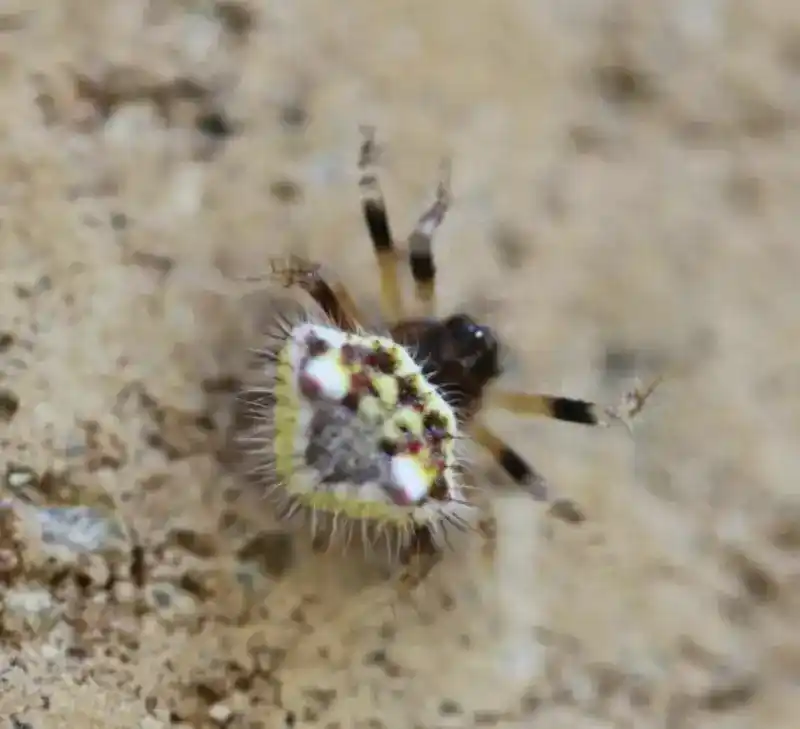
The female spider has two white, horn-like protrusions on its abdomen and back, and its body color is bright. It is nocturnal and weaves wheel-shaped orbes at night and ingests and retrieves them in the early morning. It is commonly found on the undersides of leaves of citrus and other garden trees.
Distribution and Habitat
Native to Australia, it is now widely distributed in New Zealand and is commonly found in the canopies and shrubs of urban and rural gardens, orchards, and greenbelts. It particularly prefers environments with dense foliage, such as citrus trees, where nocturnal flying insects gather.
Appearance
The female spider has a yellow-green abdomen with two white "spine-like" protrusions on its back, accompanied by a creamy yellow band and reddish-brown markings; the male spider is smaller, darker in color, and has no obvious spines.
Detailed introduction
The two-spined spider ( Poecilopachys australasia ) is a small, brightly colored garden spider. It gets its name from the two prominent white , horn -like projections on the female's abdomen. It belongs to the Araneidae family and is native to Australia, but is now also quite common in New Zealand and other regions.
Classification and nomenclature
Common Chinese names: Two-spined spider, two-spined garden spider, two-thorned garden spider (regional names may vary slightly)
English name: Two-spined Spider
Scientific name: Poecilopachys australasia (Griffith & Pidgeon, 1833)
Belongs to: Phylum Arthropoda → Class Arachnida → Order Araneae → Family Araneidae → Genus Poecilopachys
Appearance and Identification Features
The spiny spider has a very distinctive appearance, especially the adult female:
Size: Female spiders are about 8 mm long, while male spiders are only about 2.5–3 mm long; females are significantly larger than males.
Abdominal "horn-like spines": The female spider has two distinct white horn-like protrusions on its abdomen and back, resembling small short spines, hence the name "two-spined";
Body color and pattern: The back of the abdomen is mostly a mixture of yellow and olive, the front often has a broad milky yellow or light yellow band, and the back has V or herringbone patterns, with reddish-brown and white patches, making the whole look like a piece of colored enamel.
Male spider appearance: Male spiders are smaller in size, darker in color, and lack obvious "spines" and gorgeous patterns. In the past, they were even mistaken for a different species.
With their rounded appearance and bulging abdomen, they are very conspicuous when lying still on the back of leaves, making them highly ornamental small garden spiders.
Distribution range and habitat
The spiny spider is native to Australia and has been recorded in several eastern states. Since the 1970s, it has been unintentionally introduced to New Zealand by human activity and is now widely distributed throughout most of the North Island and parts of the South Island.
Common habitats include:
Shrubs and trees, especially citrus fruit trees , in urban and rural gardens;
Courtyards, green belts, orchards, and tree belts along roadsides;
In these places, they often hide on the underside of leaves or among branches during the day.
Life habits and circular net
The spiny spider is a typical nocturnal orb-weaver spider :
During the day: They usually curl up on the back of the leaves or in the gaps between the branches and leaves, remaining still and using their body color and markings for camouflage;
At night: Emerging from their hiding place, they weave a cartwheel -like orb web among the branches and leaves to catch nocturnal flying insects;
Around dawn: It will devour and recycle the entire web, recovering the silk protein and energy, before returning to the back of the leaf to rest.
They can capture moths and other flying insects that are significantly larger than themselves. Although spiders are small, they are quite capable of preying on prey thanks to their fine orb webs and sticky silk.
Diet and ecological role
The spiny spider primarily feeds on various nocturnal flying insects :
Small to medium-sized moths;
Small beetles, dipteran insects (such as flying insects, midges, etc.);
Other small arthropods that crashed into the net.
In citrus orchards, family gardens, and urban green spaces, they can help reduce the number of nocturnal flying insects and are typical beneficial natural enemy spiders .
Reproduction and egg sacs
The female spider lays spindle-shaped, papery brown egg sacs , usually fixed in concealed places on leaves or branches, where the female often guards them. The spiderlings that hatch from the egg sacs initially gather together, but gradually disperse, each finding a suitable small area to weave its own web.
Toxicity and its effects on humans
Based on current information, the spiny spider is considered to have almost no medical significance for humans.
They are small in size and do not actively attack humans;
If someone bites accidentally, it will usually only cause mild local pain, redness, swelling or temporary discomfort.
Severe systemic reactions are extremely rare and usually do not require special attention.
It is generally recommended to simply clean the wound and observe the symptoms after being bitten; if people with allergies or children experience significant discomfort, they should seek medical attention promptly.
Relationship with humans
With their vibrant colors and unique shapes, the spiny spider, along with its orb-weaving web, is ideal for nature observation and science photography. When you see them in gardens or fruit trees, they usually don't bother people unless you deliberately touch them; in fact, they can help control some pests.
If the orb happens to block the passage, you can gently move the web and the spider together to a nearby branch or bush when the spider is not in the center of the web, without the need to use insecticides.
Frequently Asked Questions
Q1: Are spiny spiders dangerous? Do they bite?
The spiny spider is small in size and not particularly aggressive; it generally does not bite people unless provoked.
If forced to come into contact with or squeeze the animal, it may be a defensive bite, but it usually only causes a mild local reaction and is generally not a serious danger to healthy adults.
Q2: Why is it called a Two-spined Spider?
Adult female spiders have two white, horn-like projections on their abdomen, which look like two short spines or small horns.
Therefore, its English name is "two-spined spider", and it is also often translated into Chinese as "双棘蛛" or "双刺园蛛".
Q3: Why are they so hard to spot during the day?
The spiny spider mostly hides motionless on the underside of leaves or in the shade of branches during the day, its color blending in with the plants and dappled light.
Therefore, it is not easily seen with the naked eye. It is easier to observe when they come out at night to weave their nets.
Q4: If I see a spiny spider on a fruit tree (such as a citrus tree), do I need to get rid of it?
Generally, this is not necessary. They mainly prey on nocturnal flying insects and pose no direct harm to fruit trees or humans.
This can actually help reduce the number of pests. If you are still concerned, simply shake the branch gently or move the spider to another tree.