Basic Information
Scientific classification
- Chinese name: Mule
- Scientific name: mule, stag
- Classification: Hoof Order
- Genus and class: Equine, tribe Equine, order Perissodactyla, class Mammalia
Vital signs data
- Body length: 65-160 cm
- Weight: 540-725 kg
- Lifespan: Around 35 years
Significant features
Infertility
Distribution and Habitat
Around the world, including Asia, Africa and Europe.
Appearance
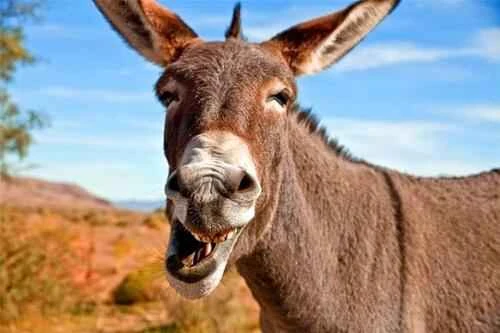
The mule has a compact and well-proportioned body, firm muscles, tight and elastic skin, and a glossy coat. Dark stripes are often found on its back and the middle of its limbs. Mules have large heads, long ears, long and strong necks with good neck-shoulder integration, well-developed tendons in their limbs, and relatively small hooves.
Detailed introduction
A mule (scientific name: *Equus ferus × asinus*, English name: Mule) is the offspring of a donkey and a horse, also called a horse mule or donkey mule. The offspring of a male horse and a female donkey is called a donkey mule, also known as a hinny. Because the genes of a female horse and a male donkey are more easily combined, most mules are horse mules. Horse mules resemble horses more, while donkey mules resemble donkeys more. They generally live to around 35 years old, but with good husbandry and management, they can live up to 50 years, and can be used for working for up to 20 years.
Mules are hybrids, resembling horses in size. They have larger bodies, smaller ears, and thick, black tail hair. They are strong and live longer than horses or donkeys.
Donkeys and mules are hardy, adaptable, and disease-resistant, with great and sustained energy, though not as much as horses and mules. They are mainly distributed in North China.
Records indicate that mules were discovered by ethnic minorities in northern China around the Xia and Shang dynasties (around the 16th century BC), approximately 1000 years earlier than in ancient Greece. Mules were introduced to the Central Plains during the Spring and Autumn and Warring States periods as draft animals. The development of the mule industry in the Central Plains region was essentially a linear, rapid growth from nothing to something, and from few to many. Since the Qing Dynasty, mules have become a crucial draft animal in China. China is the world's largest producer of mules.
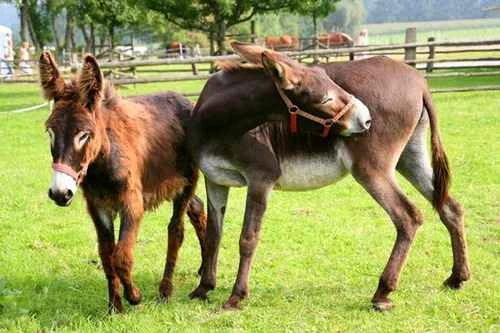
Smaller than a horse but larger than a donkey, with ears longer than a horse but shorter than a donkey's, the mule has a compact, well-proportioned build and a stable, balanced physique. Its body is muscular and mostly black, with a hip height of approximately 1.55 meters and a weight of 540-725 kilograms. The mule has a slightly larger, short, thick head, long ears, a dry mane, large, bright eyes, large nostrils, a square mouth, a wide jaw, and even teeth; its throat structure is also more similar to a donkey's. Its nasal cavity is smaller than a horse's, its limbs are slender, its hooves are narrow, its mane is short, and it lacks the inward hook of horny hooves. In terms of height, body shape, neck length, and teeth, it resembles a horse. It is generally believed that the mule's skin makes it more resistant to sun, rain, and violent impacts.
Mules have tight, elastic skin and glossy coats. Their manes and tails are longer than those of horses, and they often have dark stripes on their backs and the middle of their limbs. Their coat color largely depends on the coat color of their parent horses.
Mules share similarities in behavior with horses and donkeys, exhibiting a relatively balanced nervous system. They enjoy observing novel things. They are more gregarious than horses, but can be stubborn; if not properly trained and managed, they can easily develop bad habits. Mules are not very cold-resistant, but are heat-resistant, tolerant of roughage, hardworking, and highly adaptable.
Mules inherit the sensitivity of horses and the stubbornness of donkeys. When faced with danger, a mule's reaction is somewhere between that of a horse and a donkey; it will first become alert, then take defensive actions. If the danger persists, a mule may exhibit an explosive reaction and may display violent behavior.
Mules are generally well-proportioned and suitable for carrying loads, pulling, and riding. They have short bodies, strong backs and loins, steady pace, and great endurance, making them adept at traversing mountainous terrain and well-suited for carrying loads. While mules are not as fast runners as horses, their pulling power is greater, typically around 18%-20% of their body weight.
They feed on grass and leaves. Mules eat more than donkeys but less than horses, about 20% less. Mules have a 10% higher digestibility of feed than horses, and during work, their dry matter digestibility is 8% higher. Mules also drink less water than horses; an adult mule needs about 15-30 liters of water per day, while a horse typically needs 30-50 liters.
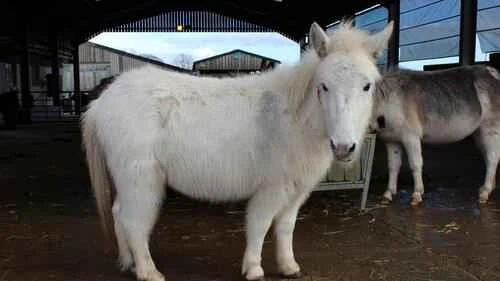
Male donkeys have a higher conception rate when mated with female horses, while male horses have a lower conception rate when mated with female donkeys. Furthermore, mules are prone to dystocia (difficult birth), so it is more reasonable to use large donkeys and high-quality female horses to produce mules.
Because horses and donkeys have different numbers of chromosomes—32 pairs for horses and 31 pairs for donkeys—their offspring, the mule, has 63 chromosomes. Male mules are infertile because their spermatogonia cannot divide normally, often producing no sperm or only dead sperm. Although some female mules can give birth to foals, only about 50 mule foals have been found to be born to female mules in the last 200 years.
The estrus cycle of female mules is similar to that of mares, and their estrus symptoms are also quite obvious. Some female mules experience ovarian atrophy, or even complete loss of sexual function, while others have normally developed reproductive organs such as ovaries, fallopian tubes, uterus, and vagina. Therefore, some female mules can still develop follicles on their ovaries and release mature eggs during the estrus season. The estrogens content in the follicular fluid can reach a certain level in the female mule's body. Both male and female mules exhibit estrus symptoms. To facilitate training and work, male mules are castrated at the age of two.
Mules are the product of distant hybridization, exhibiting significant hybrid vigor in growth and development, growing rapidly and maturing early. Therefore, at every developmental stage, they develop faster than donkey foals or horse foals born from the same species. They can be used for light work around 2 years old and reach full maturity at 4 years old. They have a long lifespan, exceeding 30 years, with a working life of up to 20 years.
With their exceptional endurance, mules have become the primary mode of transport for many, carrying goods and significantly increasing labor productivity while reducing the burden of human labor.
Establish a work schedule for draft mules and adhere to mule hygiene regulations. First, use mules within their capabilities to prevent overwork. Second, pay attention to the balance between work and rest, and provide post-work care; treat any abrasions or hoof injuries promptly. Third, assign work according to the animal's capacity and ensure reasonable allocation of resources. Fourth, maximize effective working time and minimize wasted effort.
Disease prevention and control
Mules have a significantly lower incidence of limb disease, osteoma, and hoof splits than horses, and rarely suffer from lymphangitis. They are susceptible to many of the same diseases as horses. Many common equine diseases can be prevented through vaccination and good management practices. Like their horse relatives, mules should be vaccinated against common diseases such as sleeping sickness, West Nile disease, and tetanus.
Newborn mule foal hemolytic disease, also known as hematuria in newborn foals, is a common acute illness characterized by rapid onset, severe symptoms, severe anemia, jaundice, and sometimes hemoglobinuria. The disease has a high mortality rate; without timely treatment, death often occurs within 3-5 days of onset. Treatment options include blood transfusions and oral administration of herbal decoctions.
Mules are susceptible to parasites. Parasites can carry diseases and cause skin irritation and distress in mules. Applying a parasite repellent after grooming can reduce parasite irritation. These include flies, mosquitoes, ticks, and lice.
Mules generally do not need horseshoes. Their hooves are relatively high and narrow, more flexible, and more resilient. They are less prone to splitting and breaking. Mule hooves should be kept clean and dry and trimmed regularly. Oral health is important for mules and should be checked regularly; healthy teeth are crucial for their normal eating and digestive health.
Colic is a common symptom in mules. It primarily results from a blockage in the digestive system, causing an accumulation of gas, liquid, or feed. However, its causes are numerous and require careful diagnosis and treatment. Common intestinal blockages are caused by internal parasite infections. Impaction of the colon and cecum may be caused by ingesting poor-quality roughage or sand. Intestinal torsion or hernia can also cause colic and is one of the most severe forms of intestinal obstruction, usually requiring surgical treatment.