Basic Information
Scientific classification
- Chinese name: Dark Green-backed Cormorant
- Scientific name: Terming's cormorant, bar-headed cormorant, green-backed cormorant, Dan's cormorant, green cormorant, green-backed cormorant, Japanese cormorant
- Classification: Wading birds
- Family: Temin's Cormorant, Bar-headed Cormorant, Green-backed Cormorant, Dan's Cormorant, Green-backed Cormorant, Japanese Cormorant
Vital signs data
- Body length: 80-84 cm
- Weight: 2500kg
- Lifespan: 25 years
Significant features
Very similar to the common cormorant, this species has a greenish back, shoulders, and wing coverts with a metallic sheen, while the common cormorant's feathers in these areas are more coppery-brown. It has a larger area of bare white skin on the face and exposed skin on the throat pouch. The iris is blue, the beak is yellow, and the legs are black.
Distribution and Habitat
It inhabits the temperate ocean coasts of the eastern Pacific Ocean and on cliffs and coastal trees of nearby islands. During winter and migration, it is also found in estuaries and nearby inland lakes. Its habits are similar to those of the common cormorant.
Appearance
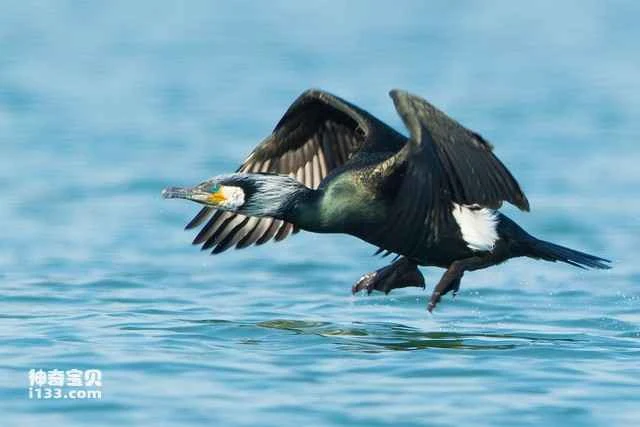
The body plumage is dark green with a bluish-green metallic sheen. The inner base of the bill is yellow, the bare skin is white, and there are white feathers behind the cheeks and on the back of the head. The back is dark green with black feather edges, and there are coarse white patches on the flanks. The bill is long, straight, and pointed, rather stout, conical in shape, with a hooked tip. The bill and the area around the eyes are bare. The tail is relatively long and rounded, with 14 tail feathers. The wings are relatively broad and long, with dark green back, shoulders, and wing coverts, and white filamentous feathers mixed in behind the cheeks, on the back of the head, and on the nape. There is a large white patch on each flank.
The iris is green, the beak is dark brown at the corners, the base of the lower mandible, the bare skin around the eyes, and the glottis are orange-yellow, and the cheeks behind the eyes are white. The legs are short, stout, and strong, black with yellow markings on the inside. The four toes point forward, are relatively flat, and are fully webbed. The winter plumage is similar to the summer plumage, but there are no white filamentous feathers behind the cheeks, back of the head, and nape, nor are there white spots on the flanks.
Detailed introduction
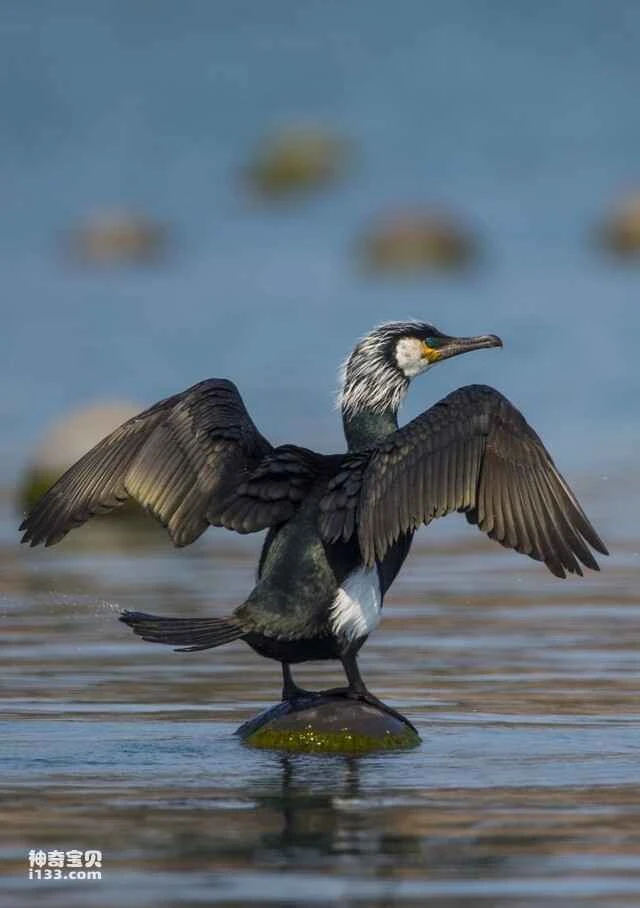
The Japanese Cormorant (scientific name: * Phalacrocorax capillatus* , Temminck et Schlegal ) , also known as the Japanese Cormorant, is a large waterbird. It measures 80-84 cm in length and weighs 2500 grams.
The Dark Green-backed Cormorant is a migratory bird, similar in appearance to the Common Cormorant but slightly smaller . It inhabits temperate marine coasts and nearby islands and sea surfaces, and is also seen in estuaries and adjacent inland lakes during migration and wintering. It prefers to congregate on coastal islands or coastal rocky cliffs. Its main diet consists of fish. It is gregarious.
The Dark Green-backed Cormorant is a large waterbird. Its plumage is dark green with a bluish-green metallic sheen. The inner base of the bill is yellow, the bare skin is white, and there are white feathers behind the cheeks and on the back of the head. The back is dark green with black feather edges, and the flanks have coarse white patches. The bill is long, straight, and pointed, rather stout, conical in shape, with a hooked tip. The bill and the area around the eyes are bare. The tail is relatively long and rounded, with 14 tail feathers. The wings are broad and long; the back, shoulders, and wing coverts are dark green, with white filamentous feathers mixed in behind the cheeks, on the back of the head, and on the nape; each flank has a large white patch.
The iris is green, the beak is dark brown at the corners, the base of the lower mandible, the bare skin around the eyes, and the glottis are orange-yellow, and the cheeks behind the eyes are white. The legs are short, stout, and strong, black with yellow markings on the inside. The four toes point forward, are relatively flat, and are fully webbed. The winter plumage is similar to the summer plumage, but there are no white filamentous feathers behind the cheeks, back of the head, and nape, nor are there white spots on the flanks.
Juveniles resemble adults, generally dark brown, but with slightly greyish wing coverts and tertiaries edged in blackish-brown. The back is dark brown. The chin, throat, and sides of the face are dark white; the lower neck is black with white feather bases. The upper breast is white, speckled with black spots. The midsection is white, the flanks and undertail coverts are blackish-brown, and the bare skin on the face and throat pouch are yellow. The bill is grey with a black culmen, and the legs and toes are also black.
The exposed throat of this species of cormorant only reaches the corner of its mouth and does not extend further back; as for the common cormorant, its exposed throat is larger and extends further back beyond the corner of its mouth.
However, there are a few exceptions. Similar to the common cormorant, its upperparts are mostly bronze, with dark green feathers that have a metallic sheen; it has a white patch on its lower flank; and its underparts are dark with a green tinge. The overall green color is significantly different from that of the common cormorant. Besides the difference in plumage color, these two cormorants share another often overlooked distinguishing feature: the bare throat of this species only extends to the corner of its beak and does not extend further back; whereas the common cormorant has a larger bare throat extending further behind the corner of its beak.
Size measurements: Weight 2500g , body length 800-840mm , bill 60-71mm , wing 300-380mm , tail 127-195mm , tarsus 58-65mm .
Habitat
It inhabits the temperate oceanic coasts of the eastern Pacific Ocean and nearby islands and coastlines, and is also found in estuaries and nearby inland lakes during winter and migration.
Lifestyle
Similar to common cormorants, but only observed in marine areas during the breeding season, nesting in flocks among rocks on cliffs along the coast. Most are resident birds, with a small number migratory. Northernmost populations also winter in the ice-free waters near their breeding grounds. A few migrate or wander further south. They are gregarious and often live in groups. They have also been observed diving to considerable depths in search of food.
Distribution range
It is distributed along the eastern coast and islands of the Pacific Ocean. Its range extends north to the southern coast and adjacent islands of Russia's Primorsky Krai, Sakhalin Island, and the Kuril Islands, and south to Korea, Japan, Hokkaido, and the eastern coast of China and its adjacent islands. In winter, it can extend further south to Kyushu, the Izu Islands, the Ryukyu Islands, the Ogasawara Islands, the Ryukyu Islands, and the southern coast of China and Taiwan.
In summer, it is distributed along the eastern coast of Siberia, Sakhalin Island, Korea, northern Japan, and northeastern China, including Hebei and Shandong provinces. In winter, it migrates south along the Chinese coast to southern China, where it is commonly found in Fujian and rarely seen in Taiwan. It generally inhabits open bodies of water, such as ponds and lakes, and nests among rocks on cliffs near the sea. The type locality of this species is Japan.
Breeding in the northern part of the eastern Pacific coast and adjacent islands, including Lushun in the southern part of Northeast China, Hebei, Yantai, Weihai and Qingdao in Shandong Province, it is a migratory bird or summer visitor. In winter, it migrates south to Zhejiang, Fujian, Taiwan and Yunnan.
Reproduction methods
The breeding season is from April to June . They usually breed in small groups of several pairs, but solitary pairs also breed. They nest on the coast and shores of islands, typically on cliffs or jutting out into the sea that are difficult for humans to access, or in trees near the coast, behaving similarly to common cormorants. Some also nest in coniferous trees 2-3 kilometers from the shore. Nesting usually begins from mid- April to the end of April . The nest is constructed of dry grass and seaweed. Each clutch contains 4-5 eggs. The eggs measure 60-64 × 38-43 mm, with an average of 63 × 40 mm. The eggs are white.
The dark green-backed cormorant is one of the cormorants domesticated by fishermen, and in Japan there is a tradition called ukai (pelican) (literally meaning "raising cormorants"). In Japanese, it is called umiu (ウミウsea cormorant ). The famous Nagara River pelican uses this specific cormorant to catch sweetfish.
Preserve the status quo
Listed as Least Concern ( LC ) on the IUCN Red List of Threatened Species 2013 ver 3.1 .
It has been included in the "List of Terrestrial Wild Animals with Important Ecological, Scientific and Social Value".
Population status
This species has a wide distribution range and does not approach the threshold for vulnerable or endangered status (distribution area or fluctuation range less than 20,000 square kilometers, habitat quality, population size, fragmentation of distribution area), and its population trend is stable. Therefore, it is assessed as a species with no survival crisis.


