Basic Information
Scientific classification
- Chinese name: Spur-winged Goose
- Scientific name: Plectropterus gambensis, Spur-winged Wood Goose
- Classification: Waterfowl
- Family and genus: Anseriformes, Anatidae, Gesneriaceae
Vital signs data
- Body length: 75-100 cm
- Weight: 4-5.9kg
- Lifespan: No verification data available.
Significant features
It is a bird type between geese and ducks, and is considered the largest perched duck in other classification systems.
Distribution and Habitat
Distributed in Angola, Benin, Botswana, Burkina Faso, Burundi, Cameroon, Central African Republic, Chad, Congo, Ivory Coast, Democratic Republic of Congo, Equatorial Guinea, Ethiopia, Gabon, Gambia, Ghana, Guinea, Guinea-Bissau, Kenya, Lesotho, Liberia, Malawi, Mali, Mauritania, Mozambique, Namibia, Niger, Nigeria, Rwanda, Senegal, Sierra Leone, South Africa, South Sudan, Sudan, Swaziland, United Republic of Tanzania, Togo, Uganda, Zambia, and Zimbabwe.
Spurred geese inhabit lakes, ponds, rivers, deltas, and marshy meadows in flocks. They generally prefer large rivers and large lakes. Although they can reach altitudes of 3,000 meters in East Africa, they try to avoid salt lakes and mountainous areas.
Appearance
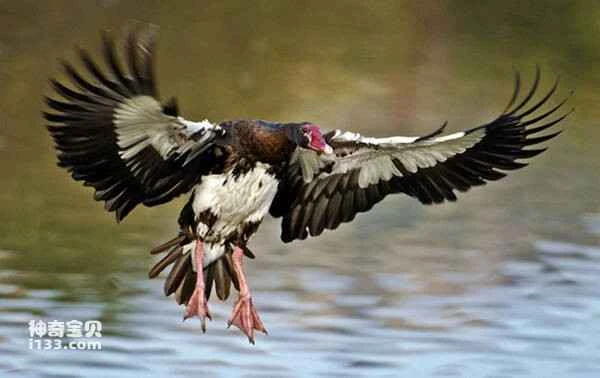
The spurred goose is an intermediate species between geese and ducks, measuring 75 to 100 centimeters in length. Males weigh 5400-5900 grams, while females weigh 4000-4500 grams. These geese, with their distinctive black and white plumage, are easily recognizable by their long, thick necks, broad wings, and slender legs. Males and females are similar, but males are slightly larger.
The adult goose has a peaked cap, and its lower body (except for the front neck), sides of the chest, and almost the entire lower body (including the wings and tail) are a bronze-green metallic color. The throat, lower neck, chest, lower sides, and bottom are the rest of the body.
The forehead is prominent, and the cheeks extend to the back of the eyes, revealing pinkish bare skin. The female goose has a less prominent hump, and relatively less bare skin on her cheeks. The legs and feet are rose-red, and the irises are black.
Detailed introduction
The gambensis goose (scientific name: Plectropterus gambensis) is a bird type between geese and ducks, and is considered the largest perched duck in other classification systems.
The diet of the spurred goose is mainly vegetarian, including plant seeds, fruits, tubers, aquatic plants and reeds, as well as small fish and invertebrates.
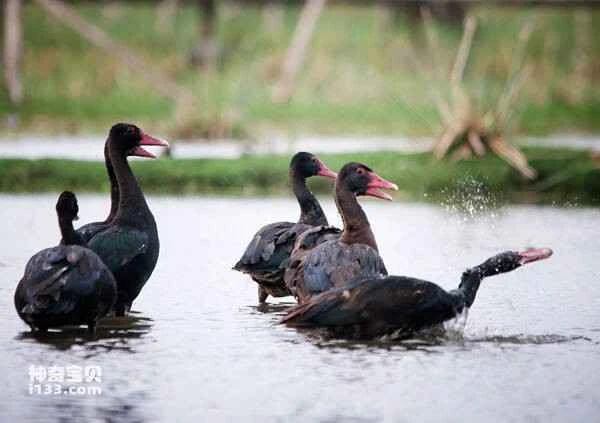
The breeding season for spurred geese varies by region and rainy season. In North Africa, it is from August to December, in the East from January to June, and in the South from August to May. Nests are large and usually hidden in riverside vegetation. They also use old nests, tree cavities, rock burrows, and termite mounds. During the breeding season, they are fearful and cautious, and the female will fiercely defend her nest site. Each female lays 6 to 15 ivory-colored eggs per nest, with an incubation period of 30 to 33 days. After hatching, the parents continue to guide and educate the goslings until they are independent at about 10 weeks old.
Listed as Least Concern (LC) on the IUCN Red List of Threatened Species 2012 ver 3.1.
Protect wild animals and ban the consumption of wild game.
Maintaining ecological balance is everyone's responsibility!