
Basic Information
Scientific classification
- Chinese name: Black-headed Duck
- Scientific name: Blue-winged Duck, *Pteronetta hartlaubii*, Hartlaub's Duck
- Classification: Waterfowl
- Family and genus: Anseriformes, Anatidae, Black-headed Duck
Vital signs data
- Body length: 48-60 cm
- Weight: 800-940g
- Lifespan: No verification data available.
Significant features
It has a round body, short wings, a black head and neck, a black and white patterned bill, black legs, and deep red irises.
Distribution and Habitat
It is distributed in West and Central Africa, including Guinea, Sierra Leone, Nigeria, Sudan, Gabon, the Republic of Congo, and Zaire.
The Blue-winged Perch is found in West and Central Africa. It is a dark chestnut-colored duck native to the African forests. Initially considered a perch, it was later reclassified as a burrowing duck. However, unlike the burrowing duck, it is classified as its own genus. The Blue-winged Perch is a gregarious duck that inhabits large lakes, shallow bays, and marshes. It can sleep in the wind and waves and nests in tree cavities.
Appearance
The Black-headed Duck is a species of duck found in the forests of Africa, with a dark chestnut-colored body. It measures 48-60 cm in length and weighs 800-940 grams. It has a rounded body, short wings, a black head and neck, a black and white patterned bill, black legs, and a deep red iris. It also has blue feathers on its wings, hence its other name, the Blue-winged Duck.
Detailed introduction
The black-headed duck (Pteronetta hartlaubii), also known as the Hartlaub's Duck, is a dark chestnut-colored duck found in the forests of Africa.
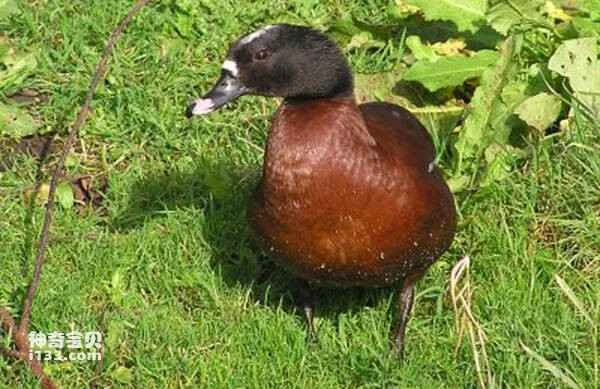
The black-headed dyke was initially thought to be a perch, but was later reclassified as belonging to the burrowing duck family. However, it has always been distinct from other ducks and is therefore classified in its own unique genus. Analysis of mitochondrial DNA cytochrome b and NADH dehydrogenase subunit 2 revealed that the black-headed dyke belongs to a distinct clade. The Latin name for the black-headed dyke is named in honor of the German naturalist Gustav Hartlaub.
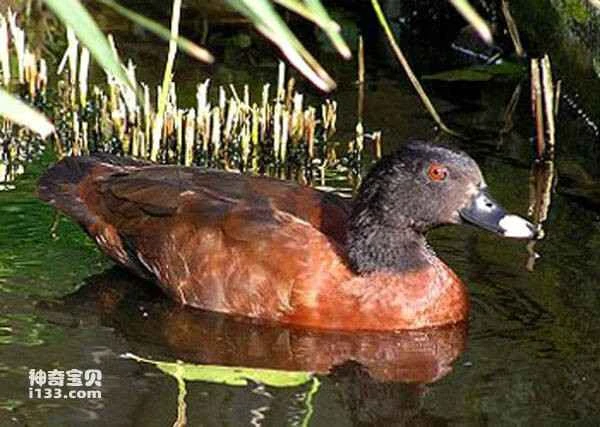
Black-headed dykes typically forage for larvae and pupae in rock crevices, feeding on aquatic animals, plants, seeds, small fish, snails, and crabs. The breeding season is from May to July. They nest in shrubs or grass near water, using floating nests. Each clutch contains 6-10 eggs. The incubation period is 25 days.
Listed in the International Union for Conservation of Nature (IUCN) Red List of Birds, 2009 ver 3.1.
Protect wild animals and ban the consumption of wild game.
Maintaining ecological balance is everyone's responsibility!


