
Basic Information
Scientific classification
- Chinese name: Peruvian Grebe
- Scientific name: Peruvian Grebe, Puna Grebe, Podocipes taczanowskii, Junin Grebe, Puna Grebe
- Classification: Waterfowl
- Genus and family: Grebe, order Grebe, family Grebe, genus Grebe
Vital signs data
- Body length: 33-38 cm
- Weight: No verification information available.
- Lifespan: No verification data available.
Significant features
The species' scientific name "taczanowskii" and its French name "Grèbe de Taczanowski" are both named in honor of the Polish zoologist Wladyslaw Taczanowski.
Distribution and Habitat
It is found only in Lake Junín, on the Junín Plateau in central and western Peru.
They inhabit freshwater lakes and marshes, spending almost their entire lives in water. Their habitat, Lake Junín, covers approximately 140 square kilometers and is quite shallow, with a depth of 5-10 meters. Located at an altitude of 4,080 meters, it is surrounded by extensive reed marshes.
Appearance
The Peruvian Grebe measures 33-38 cm in length. Males and females have similar plumage, but males are larger than females. In breeding plumage, the Peruvian Grebe is greyish-white, with white on the lower cheeks, throat, neck, and chest. The rest of the base color is greyish-white, with slate grey on the sides. The inner wing coverts are white, the outer coverts are grey, and the secondary coverts are mostly white. The crown, forehead, and area below the eyes are dark grey to black. The ear flaps have elongated feathers mixed with some fine silver feathers, forming tufts that hang back to the uppermost part of the neck. The nape is dark grey to black, narrowing in the upper center and widening towards the rest of the nape.
This species has a short beak, mostly blackish-grey, sometimes with a darker lower jaw and a paler tip. The iris is bright red, with a paler and more yellow inner ring. The legs and feet are pale greenish-grey, sometimes with a slight orange-yellow tinge. The non-breeding plumage is slightly pale. The ear flaps lack long, fine feathers. Juveniles resemble non-breeding adults, sometimes appearing brownish-gray.
Detailed introduction
The Peruvian Grebe (scientific name: Podiceps taczanowskii), also known as Junin Grebe, Junín Grebe, or Puna Grebe, has no subspecies.
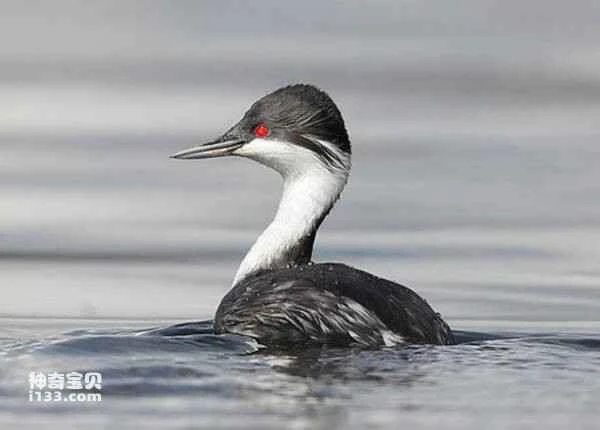
The Peruvian grebe primarily feeds on small fish of the genus *Pseudococcus*, which make up 90% of its diet. It also eats aquatic insects and larvae, crustaceans, mollusks, and small plants.
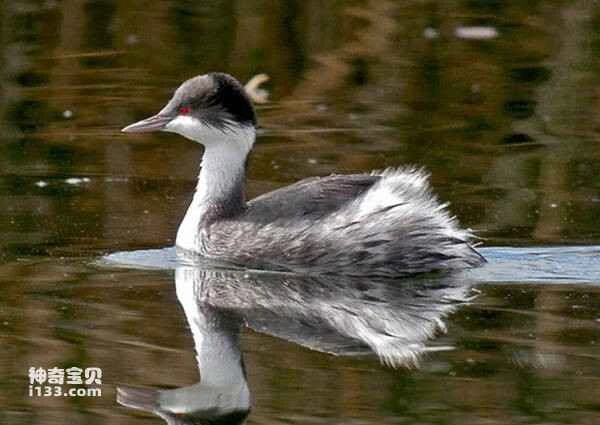
The Peruvian Grebe nests in the vast reed beds bordering Lake Junin during its breeding season. At the start of the breeding season, they engage in courtship displays. Two Peruvian Grebes face each other and simultaneously and rapidly turn their heads from side to side. This display, known as "head-swinging," is usually accompanied by calls. The breeding season occurs during the rainfall period from late November to March of the following year, peaking in December and January. Up to 20 pairs nest together in the breeding area, with nests spaced 2-4 meters apart. They build floating nests in the tall sedge and reed beds along the shore of Lake Junin, constructed from reeds, weeds, and some clay, attached to the reeds. Each clutch typically contains 2-7 eggs, with both parents taking turns incubating. The chicks hatch after about 25 days. The chicks are precocial, covered in dense downy feathers that are grey with light stripes, while their underparts are whitish. The chicks are able to move freely 2-3 weeks after hatching. The parents often carry the chicks on their backs, and if startled and diving, they tuck them under their wings. Breeding success depends on the water level; when the lake water is particularly low, the birds cannot breed.
The Peruvian grebe is found only in Lake Junin. Its habitat is affected by water pollution from mining activities, with extreme water level fluctuations leading to water quality deterioration. Water level regulations from hydroelectric power plants supplying power to nearby mines have dried up nesting and foraging areas, resulting in breeding failure. The northwest part of the lake has become lifeless due to iron oxide deposition. The lake is also polluted by sewage from nearby towns, leading to eutrophication and oxygen depletion, potentially reducing the number of fish available for the Peruvian grebe to feed on. Relatively unstable climatic conditions associated with the El Niño Southern Oscillation event may have caused significant fluctuations in species numbers, recovering somewhat in years with high water levels (e.g., 1997–1998), and in 1982, many Peruvian grebes died under extremely cold conditions. A similar situation in June 2007 drew attention.
Due to a significant population decline, only a very small adult population remains. A new estimate using different methods in early 1995 was 205 individuals. In August 1998, more than 250 individuals were found within a 4-square-kilometer area of the lake (estimated total at 350-400 birds). Statistical estimates using standardized survey methods in 2001, 2002, and 2007 were 304, 249, and 217 individuals, respectively (OECD, 2009). Species censuses in August 2014 and August 2015 counted 315 and 238 birds, respectively. The numbers remain in the 50-249 range and are still declining. Different survey methods make estimating the population difficult. However, surveys between 2007 and 2016 suggest a population between 217 and 468 individuals, roughly equivalent to 145-312 mature individuals.
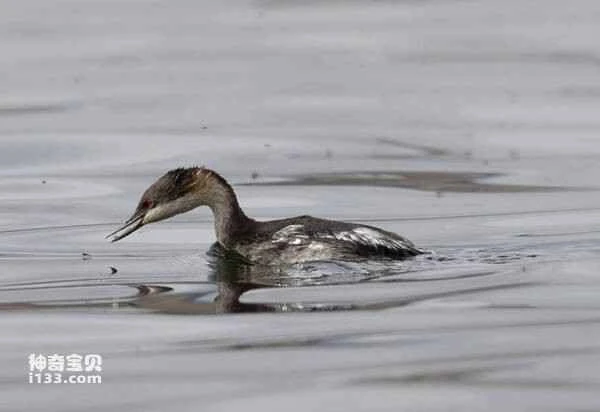
The Peruvian grebe is listed as critically endangered. Although Lake Junin has been declared a national nature reserve and hunting and fishing are managed, water level management is not well controlled.
Lake Junin has been declared a national nature reserve by Peru. Hunting and fishing are regulated, but little work has been done to disrupt water level management, which is controlled by mining companies. Attempts have been made to relocate the Peruvian grebe to a lake north of Junin. Fishing and relocation are feasible, but the chosen lake must be suitable and free from gillnets used for rainbow trout fishing. In 2002, the Peruvian government passed an emergency law to protect the lake, which mandated cleanup efforts and imposed stricter restrictions on water withdrawals. In 2009, the species was adopted as a symbol of Andean highland wetland conservation by organizations such as BirdLife International and BirdLife USA, who called for an independent environmental audit and ongoing environmental monitoring of the lake (BirdLife International 2009). ECOAN (Ecosystems of the Andes) has been actively involved in conservation efforts, including a series of educational and training programs with the local community, as well as research and monitoring of the species' population size and potential threats (ECOAN 2016).
Monitor species abundance and reproductive success. Study species needs throughout their life cycle. Protect clean waterways flowing into Lake Junin and improve legislation and enforcement to prevent lake pollution. Engage with local stakeholders to identify and reduce pollution sources. Reduce water level fluctuations caused by hydroelectric dam discharges, with the consent and participation of local mining companies. Identify a potential individual displacement lake and consider establishing captive breeding populations. Develop ecotourism in the area, including establishing a monitoring platform for the lake to aid in species abundance monitoring.
Listed as Critically Endangered (CR) in the IUCN Red List of Threatened Species 2019 ver 3.1.
Protect wild animals and ban the consumption of wild game.
Maintaining ecological balance is everyone's responsibility!


