Basic Information
Scientific classification
- Chinese name: Silver Grebe
- Scientific name: Silver Grebe, White Grebe, Podiceps occipitalis
- Classification: Waterfowl
- Genus and family: Grebe, order Grebe, family Grebe, genus Grebe
Vital signs data
- Body length: Approximately 29 centimeters
- Weight: 340-400g
- Lifespan: No verification data available.
Significant features
Adult birds have a dark brown and brownish-black ruff around the neck, dark brown upperparts, and white underparts.
Distribution and Habitat
It is distributed in South America, including Argentina, the Falkland Islands, Bolivia, Chile (Malvinas Islands), and Paraguay.
It is widely distributed in freshwater ponds and streams in Chile, Argentina, and the Falkland Islands. It inhabits vegetation in freshwater lakes and swamps.
Appearance
The Silver Grebe is a loon. It measures approximately 29 cm in length and weighs 340-400 grams. It has a dark brown crest on the nape; adults have a dark brown and brownish-black ruff on the upper neck; the upperparts are dark brown, and the underparts are white. The bill is narrow and pointed, black with a white tip, and yellowish-green near the cleft. The iris is red. The lores, chin, and upper throat are dark brown; the lower throat, ear coverts, and sides of the neck are reddish-chestnut; the upperparts are dark brown, with some feathers having pale tips; the primary and secondary flight feathers are grayish-brown, with grayish-black tips on the primary flight feathers and white tips on the secondary flight feathers; the greater and median coverts are dark grayish-black, and the lesser coverts are pale blackish-brown; the tail feathers are very short, a mixture of brown, tan, and white; the forechest, flanks, and vent are grayish-brown. The tips of the forechest feathers are pale or white, while the hindbreast and belly are silky white, slightly tinged with grayish-brown; the axillary feathers and underwing coverts are white. The legs, near the tail, are slate gray, with broad claws at the toes and webbed membranes on the sides.
The beak is straight, laterally compressed, and pointed; the nostrils are open and located near the base of the beak; the wings are short, with 12 primary flight feathers, the first one vestigial, and the fifth secondary flight feather missing. The tail has only some short, soft down feathers, or almost none. The feet are located near the rump. The tarsi are laterally compressed, adapted for diving; all four toes have broad, webbed flaps; the claws are blunt and broad, the inner edge of the middle toe is serrated, the hind toe is short and positioned higher than the other toes, or is absent. The body plumage is short and dense, providing excellent moisture resistance; the feathers have accessory feathers, and the preen gland is feathered; the sexes are similar. The skull is either cleft palate or fully nasal; both lack basal wing processes; the digestive system lacks a cecum; the chicks are precocial.
Detailed introduction
The Silver Grebe (scientific name: Podiceps occipitalis) has two subspecies.
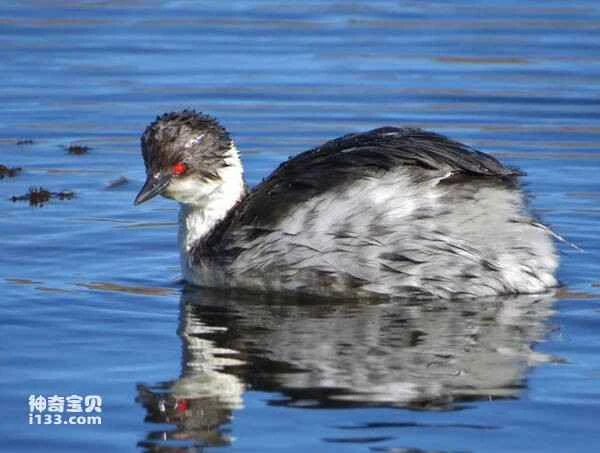
Silver grebes spend almost their entire lives in water and often live in groups. They are not good fliers. They swim using their legs instead of their wings and rarely walk on land. They can dive to forage, generally only diving to depths of 1-4 meters. Their diet mainly consists of aquatic insects and larvae, crustaceans, mollusks, invertebrates, small fish, and aquatic plants.
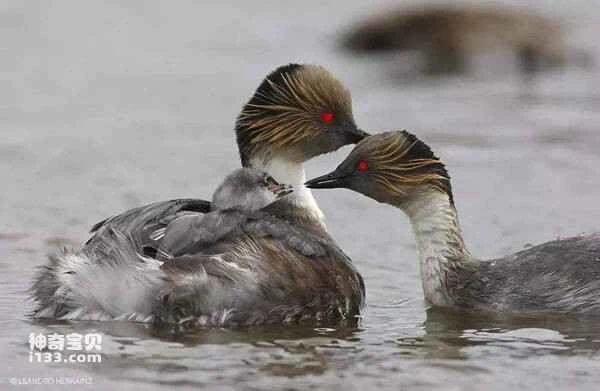
During the breeding season in October, silver grebes build floating nests concealed by aquatic plants, constructed from reeds, weeds, and some clay. They lay two eggs in November and December. Newly laid eggs are bluish-green, gradually turning rusty brown as they incubate. The eggs measure 51.5 × 35.8 mm. Incubation begins immediately after the first egg is laid, lasting 20-23 days. The chicks are precocial, covered in dense downy feathers, and capable of free movement. For the first 2-3 weeks after hatching, the parents often carry the chicks on their backs; if startled and diving, they tuck them under their wings.
Listed as Least Concern (LC) on the IUCN Red List of Threatened Species 2013 ver 3.1.
Protect wild animals and ban the consumption of wild game.
Maintaining ecological balance is everyone's responsibility!