Basic Information
Scientific classification
- Chinese name: Long-legged spider
- Scientific name: Pholcus phalangioides (and related long-legged spiders)
- Classification: Arthropoda
- Family: Pholcidae Pholcus Pholcus phalangioides
Vital signs data
- Body length: female 7–10 mm; male 6–8 mm; leg span 5–7 cm
- Weight: Small spider; extremely light, varies from individual to individual.
- Lifespan: Approximately 1–2 years (may be slightly longer under indoor conditions).
Significant features
Commonly found indoors; slender body with extremely long legs; loose, tangled webs; preys on mosquitoes and other small arthropods.
Distribution and Habitat
Widely distributed globally; commonly found in shady corners such as residences, basements, garages, underpasses, and cave entrances.
Appearance
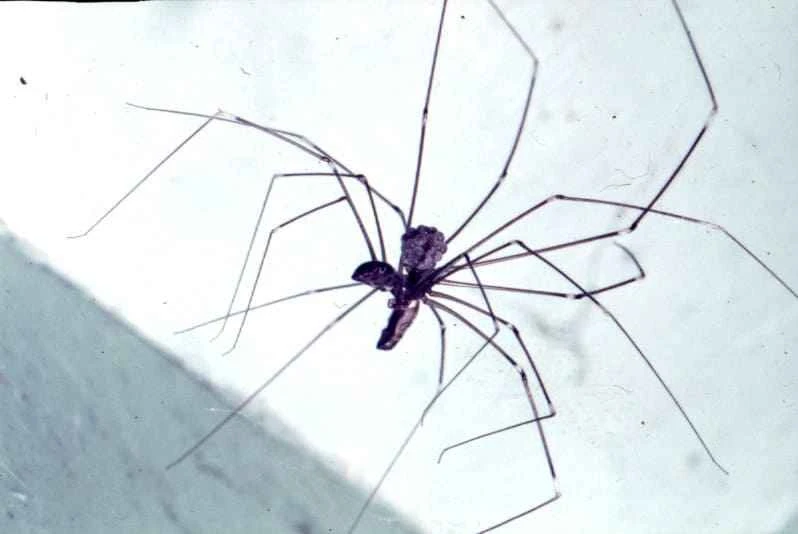
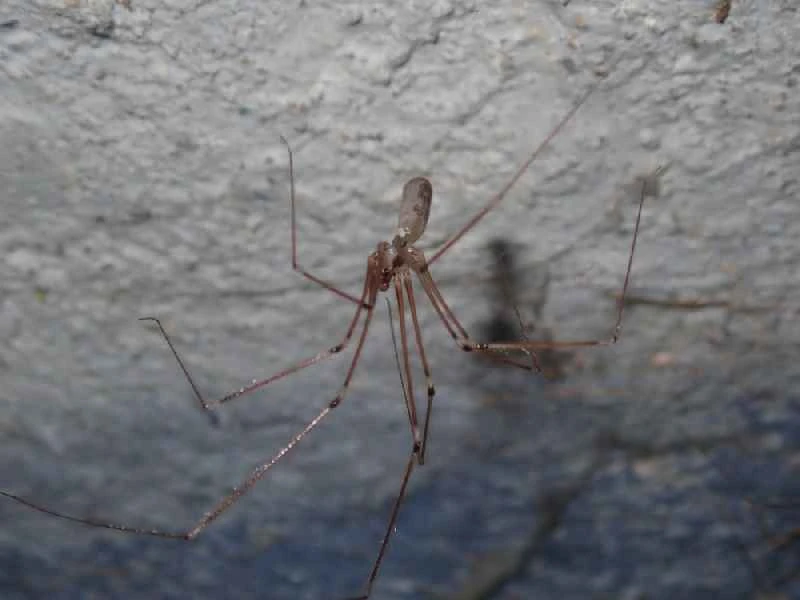
Light yellowish-brown to grayish-brown and translucent; slender body with a slightly oval abdomen; extremely long and delicate legs.
Detailed introduction
The term "daddy-long-legs spider " in the context of a home typically refers to the parent-legged spider ( Pholcus phalangioides ), belonging to the family Pholcidae . They are known for their small bodies, long, silken legs, and the loose, tangled webs they often weave on ceilings and in corners , making them one of the most common "roommate spiders" in homes and basements worldwide.
Ecology and Biology
Activity patterns: Predominantly nocturnal , spending most of the day lying still in the center of its web or hanging upside down in a corner; when disturbed, it will vibrate its body and web at high speed , creating a "fuzzy shaking" to confuse predators.
Diet: It preys on mosquitoes, midges, flies, small moths, and other spiders, and can even prey on animals larger than itself.
Reproduction: After laying eggs, the female spider directly holds the egg mass with her mouthparts and pedipalps , without making a typical egg sac; before hatching, the female spider can often be seen holding a small round ball of eggs in her mouth.
Morphology and Recognition
Body length: Female spiders are about 7–10 mm long, and male spiders are about 6–8 mm long; leg span can reach 5–7 cm .
Body shape: The body is slender, cylindrical or slightly oval , with extremely long and thin legs.
Body color: mostly light yellowish-brown to grayish-brown semi-transparent , with light-colored spots or cloud-like patterns visible on the head, chest and abdomen.
Spider web: A web is a loose, three-dimensional, tangled web that is usually attached to ceilings, beams, columns, corners, or the backs of furniture.
Distribution and Habitat
Pholcus phalangioides is a globally distributed species, widely found in cool, dry to slightly damp environments such as houses, basements, garages, underpasses, and cave entrances . In the wild, it can also be found in caves, tree hollows, and rock crevices.
Humanity and Safety
Medical significance: It has very little medical significance to humans. It is very difficult for it to bite people. Even if it does bite, it usually causes a mild local reaction.
Ecological role: By preying on mosquitoes and other small arthropods, it helps control the number of indoor pests .
Misconception: There is a common saying that "long-legged spiders are very venomous, but their teeth can't bite people," but there is no scientific evidence to support this.
IUCN: Pholcus phalangioides is currently not evaluated (NE) .
Frequently Asked Questions
Q1: Do long-legged spiders bite? They generally do not attack people unless provoked; theoretically, they may try to bite when forcibly grabbed, but there are very few records of this and the symptoms are mild.
Q2: Is it really "highly toxic"? There is a lack of scientific evidence to suggest that long-legged spiders are highly toxic to humans. Existing research and case studies support that its medical importance is very low .
Q3: Should I remove them from my home? If you don't mind, they can help reduce mosquitoes ; if you need to remove them, it is recommended to use a broom or vacuum cleaner to remove the webs and then gently move the spiders out.
Q4: How to distinguish it from "crown spider" or "crown garden spider"? The long-legged spider has a slender body, extremely long legs, and a loose web ; while the common garden spider weaves a regular round web and has a more robust body.