Basic Information
Scientific classification
- Chinese name: Hoopoe
- Scientific name: Common Hoopoe, also known as the Mountain Monk, Cockscomb Bird, Stinky Chicken, and Fragrant Chicken. English: Common Hoopoe, Hoopoe; French: Huppe fasciée; Arabic: الهدهد
- Classification: Climbing birds
- Family and genus: Hornbills, Hoopoeidae, and genus Hoopoe
Vital signs data
- Body length: 24.5-31.2 cm
- Weight: 53-90g
- Lifespan: Approximately 20 years
Significant features
It's the national bird of Israel, a bird that's a bit unhygienic.
Distribution and Habitat
It is mainly distributed in Europe, Asia and North Africa, and has a wide distribution in China.
They inhabit open areas such as mountains, plains, forests, forest edges, roadsides, river valleys, farmland, grasslands, villages, and orchards, with forest edges and cultivated land being particularly common. In winter, they mainly stay in low-altitude areas such as plains at the foot of mountains, while in summer they can reach altitudes of up to 3000 meters. They are commonly seen foraging alone or in pairs in open areas, cultivated land, and orchards in mountainous or plain areas. When startled, they may fly to nearby small trees or to a rock on a nearby hillside.
Appearance
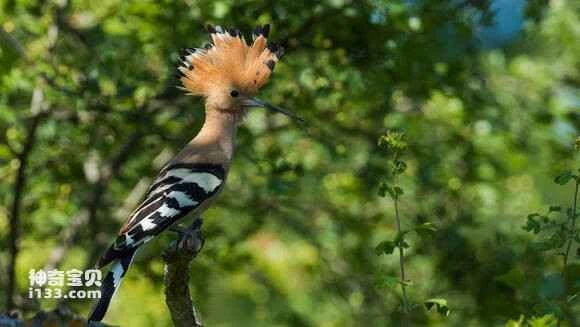
The hoopoe has a pale chestnut-brown head, neck, and chest. Its crest is slightly darker with black tips on each feather, and white spots precede the black tips on the hind feathers. The chest is tinged with pale wine color; the upper back and lesser wing coverts turn brownish-brown; the lower back and scapulars are blackish-brown with brownish-white tips and edges; there are three bands of black, brownish-white, and blackish-brown on the upper and lower back, along with an incomplete white band, forming a wide band that extends to the sides and below the wing bend; the rump is white; the upper tail coverts are white at the base and black at the tips, with some feathers having white edges; the tail feathers are black, each with a white spot extending from the middle to the sides and near the tip, forming an arc-shaped horizontal band. The outer wings are black, turning blackish-brown inwards; the median and greater coverts have brownish-white near-terminal bars; the primary flight feathers (except the first) have a row of white bars near the tip; the secondary flight feathers have four rows of white bars; and the tertiaries are mixed with brownish-white diagonal stripes and edges. The belly and flanks change from pale grape brown to white, with brown longitudinal streaks, until the undertail coverts are all white. The iris is brown to reddish-brown; the bill is black with a pale leaden purple base; the legs are leaden black.
Young birds have paler upper bodies and browner lower bodies.
Size measurements: Weight ♂ 53-81 g, ♀ 55-90 g; Body length ♂ 266-312 mm, ♀ 245-300 mm; Bill length ♂ 47-59 mm, ♀ 43-56 mm; Wing length ♂ 140-158 mm, ♀ 136-157 mm; Tail length ♂ 95-124 mm, ♀ 90-110 mm; Tarsus length ♂ 18-27 mm, ♀ 20-25 mm (Note: ♂ male; ♀ female) (common subspecies).
Detailed introduction
The hoopoe (scientific name: Upupa epops), also known as Common Hoopoe or Hoopoe, is called Huppe fasciée in French and الهدهد in Arabic. It has eight subspecies.
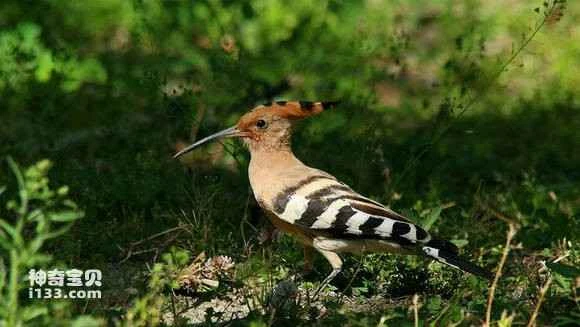
The hoopoe has a very unique appearance, with colorful feathers on its head, a long, narrow, pointed beak, and well-defined plumage. Its alert and straightforward nature, as well as its unwavering loyalty, have made it a symbol in religion and legend since ancient times. In China, the hoopoe symbolizes peace, happiness, and joy. Many ancient Chinese poems praise the hoopoe.
A Taoist robe adorned with star-studded flowers, a palace maid from Ziyang Palace transformed and soaring. She can spread the news of spring to the world; if she reaches Penglai Mountain, do not let her return.
The warm rain in the green forest satiates the mulberry insects, and the rain-soaked leaves are wet with verdant reds. Spring thoughts cannot be suppressed, and the hibiscus blossoms on the branches appeal to the spring breeze.
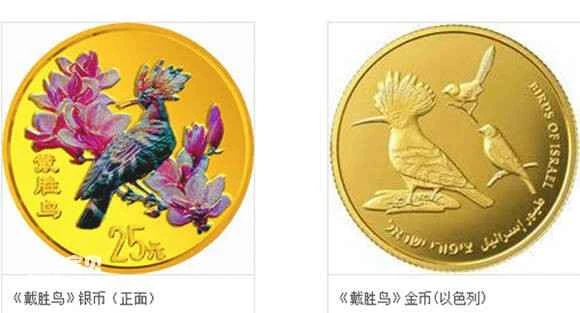
The Hoopoe One-Ounce Colorized Silver Coin, also known as the Rare Birds of China Colorized Silver Coin, is a single-piece colorized silver coin issued by China Gold Coin Corporation. It was launched by China Gold Coin Corporation during the Spring Festival of 2000 and is a very auspicious and meaningful commemorative silver coin symbolizing "the beginning of a new millennium, the hoopoe brings good fortune".
The hoopoe primarily feeds on insects and larvae of the orders Hymenoptera, Orthoptera, Coleoptera, and Lepidoptera, such as locusts, mole crickets, stoneflies, scarab beetles, nymphs, moths, and butterfly larvae and adults. It also eats worms and other small invertebrates. It forages mostly in forest edges, grasslands, or cultivated land, often inserting its long proboscis into the soil to feed.
During the breeding season, male hoopoes often fight to protect their territory. When they fight, they approach each other, first facing each other with their crests raised and their beaks pointing downwards as much as possible. Suddenly, they bite each other's beaks and pull each other in a straight line like a tug-of-war to maintain a certain safe distance. Then, they fall down together, flapping their wings and separating, continuing to collide with each other on the ground until one of them gives way.
The hoopoe's breeding season is from April to June. They nest and breed in pairs. Sometimes, competition for females can be observed between males. The female observes from the sidelines and eventually pairs with the winner. They typically nest in natural tree cavities at forest edges or along forest roads, or in abandoned woodpecker burrows. The size and diameter of the burrow entrance vary considerably depending on the environment. In farmland areas at the foot of mountains where tree cavities are scarce, they also nest in crevices in abandoned house walls and cliff faces, and sometimes even lay their eggs on piles of dry branches on the ground. The nest is constructed of plant stems and leaves, sometimes mixed with plant roots, feathers, and hair.
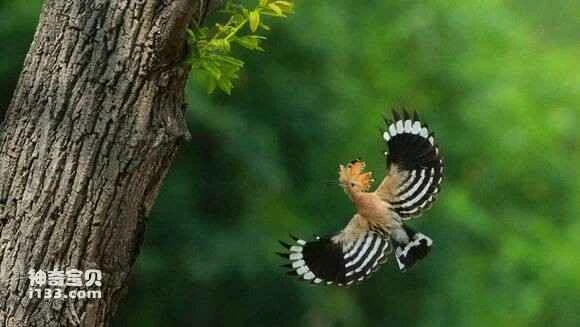
The hoopoe breeds once a year, typically laying 6-8 eggs per clutch, occasionally as few as 5, as many as 9, and even up to 12. The eggs are oblong-oval, pale duck-egg blue or light grayish-brown in color. The female begins incubation immediately after laying the first egg. Incubation is undertaken by the female and lasts for 18 days. The chicks are altricial. Newly hatched chicks weigh only 3.5 grams, are 45 mm long, and are entirely pinkish-red, with only white downy feathers on the crown, midback, groin, shoulders, and tail. Both parents participate in raising the chicks. After 26-29 days of feeding by the parents, the chicks are ready to fly and leave the nest. Because the parents do not clean up the chicks' droppings, and the female discharges a dark brown, oily liquid from glands in her tail during incubation, the nest becomes very dirty and smelly, hence the hoopoe's common nickname, "Stinky Auntie."
On May 29, 2008, Israeli President Shimon Peres declared the hoopoe the national bird of Israel in Jerusalem. This event, part of Israel's 60th anniversary celebrations, was initiated by the Israel Nature Conservation Society to raise public awareness of bird conservation. It was estimated that 150,000 Israelis voted on 10 local candidate bird species. Public opinion accounted for 75%, while the opinion of an expert panel composed of Israeli poets, politicians, and academic representatives accounted for 25%. The hoopoe was chosen because of its beauty, dutiful care, and ability to nurture its offspring.
Listed as Least Concern (LC) on the IUCN Red List of Threatened Species 2020 ver 3.1.
It is listed in the "List of Terrestrial Wild Animals of Beneficial or Important Economic and Scientific Research Value under State Protection" (Item 278) issued by the State Forestry Administration of China on August 1, 2000.
Protect wild animals and ban the consumption of wild game.
Maintaining ecological balance is everyone's responsibility!