Basic Information
Scientific classification
- Chinese name: Great Grebe
- Scientific name: Podiceps major, Great Grebe
- Classification: Waterfowl
- Genus and family: Grebe, order Grebe, family Grebe, genus Grebe
Vital signs data
- Body length: 67-80 cm
- Weight: 1.6-2kg
- Lifespan: No verification data available.
Significant features
It has a small tuft of black feathers on its head and reddish-brown eyes.
Distribution and Habitat
Origin: Argentina, Brazil, Chile (Malvinas Islands), Paraguay, Peru, South Georgia and South Sandwich Islands, Uruguay.
Migratory bird: Spain.
They primarily inhabit open waters, including low-altitude lakes, rivers surrounded by forests, and estuarine marshes. During the breeding season, they frequent large lakes and areas with dense vegetation. Outside of the breeding season, most Great Grebes migrate to estuaries and bays, and are usually active on the high seas. Outside of the breeding season, they live along the coast year-round.
Appearance
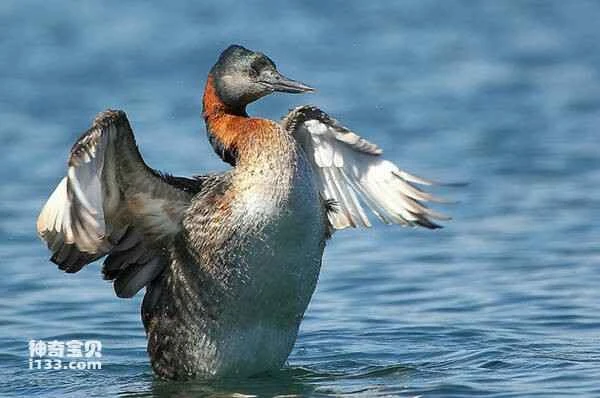
The Great Grebe is one of the larger loons in the Grebe family. It measures 67-80 cm in length and typically weighs around 1600 grams, but can reach up to 2 kg. Its back and wings are greyish-gray, its head is greyish-black, its neck and breast are brownish-yellow to reddish-brown, and its inner sides to belly are white. It has a small tuft of black feathers on its crown. Its eyes are reddish-brown. The bill is straight, laterally compressed, and pointed; the nostrils are open and located near the base of the bill; the wings are short, with 12 primary flight feathers, the first vestigial, and the fifth secondary flight feather missing. The tail has only some short, soft downy feathers, or almost none. The feet are located near the rump. The tarsi are laterally compressed, adapted for diving; all four toes have broad, webbed edges; the claws are blunt and broad, the inner edge of the middle toe is serrated, and the hind toe is short and positioned higher than the other toes, or may be absent. The plumage is short and dense, providing excellent moisture resistance; the feathers have secondary feathers, and the preen gland is feathered; the sexes are similar. The skull is of the split palate type and the whole nasal type; and lacks the basal wing process; the digestive system lacks the cecum; the chicks are precocial.
The Great Grebe is easily identifiable in the wild due to its size, distinctive coloration, and its ability to not mix with any other birds.
Detailed introduction
The Great Grebe (scientific name: Podiceps major) is a relatively large loon in the grebe family.
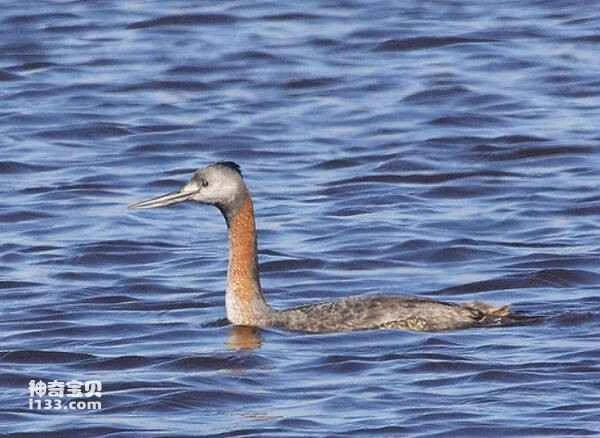
Great grebes typically live in small groups of three to five or even more than ten individuals. They are adept swimmers and divers, and can also walk on land, though their movements are slow and clumsy. Their flight is weak; they need to wade and run a short distance on the water to take off, and cannot take off from land at all. Their flight distance is short and they do not fly very high. During flight, their head and neck are stretched forward, their legs trail behind their tail, and their wings flap rapidly. They are active, frequently diving to forage when active, and often floating motionless on the surface when resting. When they encounter people, they swim into aquatic plants or dive underwater to hide, occasionally surfacing again nearby.
Great grebes are typically active and forage during the day, hunting by diving. Their diet mainly consists of various small fish, which they compete with cormorants for. They also eat shrimp, crustaceans, and mollusks. Living along the coast, nearly half of their diet consists of crabs during the winter.
The Great Grebe's breeding season is from September to October. A second brood may hatch in January and February of the following year. They nest in shallow water near the banks of lakes and ponds with aquatic plants, nested among the reeds. The nest is a floating nest, usually constructed by biting off a piece of reed as the base, placed among the reeds, and floating on the water's surface, rising and falling with the tides. The nest is truncated cone-shaped, narrower at the top and wider at the bottom. It is entirely constructed of reeds and aquatic plants, lined with moss or left empty. The portion above the waterline is 6.0-10.0 cm. Each clutch contains 3-5 eggs, sometimes 6 or more. The eggs are initially white or grayish-white, later turning dirty white or dirty brown. Both parents take turns incubating the eggs; when leaving the nest, the parents cover the eggs with aquatic plants around the edge. The incubation period is 19-24 days, though some reports indicate 23-28 days. The chicks are precocial, able to swim as early as the second day after hatching. Parent birds often carry their chicks on their backs, and when they are startled and dive, they tuck them under their wings.
Listed as Least Concern (LC) on the IUCN Red List of Threatened Species 2013 ver 3.1.
Protect wild animals and ban the consumption of wild game.
Maintaining ecological balance is everyone's responsibility!