Basic Information
Scientific classification
- Chinese name: Opossum
- Scientific name: Didelphidae
- Classification: Rodentia
- Family and genus: Opossumidae, genus Opossum
Vital signs data
- Body length: 38-51 cm
- Weight: 2-6 kg
- Lifespan: 3-7 years
Significant features
Survival Strategy: Opossums use a unique "playing dead" strategy to escape predators. When threatened, opossums exhibit very realistic signs of death, including stopping breathing, dropping body temperature, trembling, and expelling a foul-smelling liquid from their anal glands, making predators believe they are dead and thus avoiding being preyed upon.
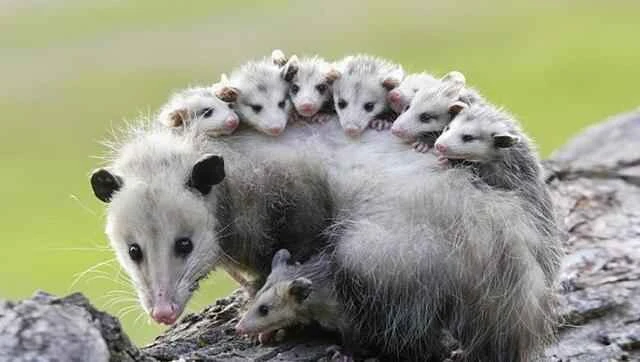
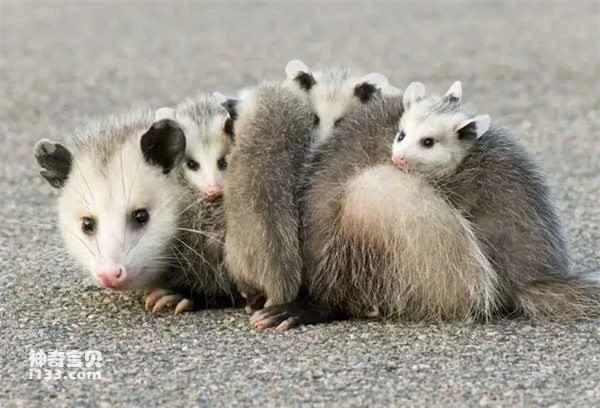
Reproductive capacity: Opossums are highly prolific, with females giving birth to multiple offspring per litter, up to 20 in total. The offspring live in their mother's pouch for a period after birth, then climb onto their mother's back until they are able to live independently.
Dietary range: Opossums are omnivorous, feeding on plants, insects, small animals, and more. They can eat almost anything, including garbage and rotting fruit, which allows them to survive in a variety of environments.
Body temperature and health: Opossums have a low body temperature, which makes it impossible for the rabies virus to survive in their bodies. Therefore, opossums neither contract nor transmit rabies.
Physical characteristics: Opossums have a pointed snout, hairless ears, and a long tail, which they use to grasp tree trunks and small objects. Their fur is dark grayish-brown, with white hair on their face.
Intelligence and Behavior: Although opossums have relatively low intelligence, their feigning death behavior is a survival skill acquired through learning and genetics. When playing dead, the opossum's brain remains active, rather than being truly frightened.
Distribution and Habitat
Distributed across a vast area from southeastern Canada to Argentina, they inhabit natural environments such as deciduous forests, woodlands, and wetlands, and are also common in urban areas.
Appearance
They have pointed snouts, hairless ears, and long tails that they use to grasp tree trunks and small objects. Their fur is dark grayish-brown, with white hair on their faces.
Detailed introduction
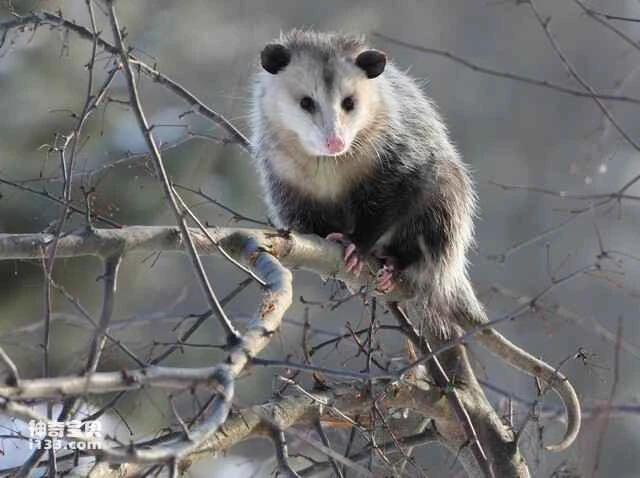
Opossums (scientific name Didelphinae , English name: Opossum ) are a general term for mammals in the family Opossumidae of the order Marsupialia, and are small to medium-sized mammals. They are named "oppossums" because the mother can carry her young with her wherever she goes. They possess remarkable reproductive abilities and are often described as "masters at raising babies." Their lifespan is 3-7 years. Their body length ranges from 38 to 51 centimeters, including the head and body length, but excluding the tail. They are small to medium-sized; plantigrade, with short limbs, each with five toes, the hind paws having a large thumb, no claws, and capable of grasping; a long, prehensile, hairless tail that can hook onto branches and function as a fifth limb, the tail and feet covered with scales; a long snout, a narrow skull, and a well-developed sagittal ridge; they possess the most teeth of any living land mammal, with small incisors, large canines, and tricuspid molars.
Opossums are mainly found in the Americas, primarily in southeastern Canada, extending south through the eastern United States and Mexico to Argentina. They are solitary and nomadic, temporarily residing in existing burrows or beneath human dwellings. Nocturnal and docile, they are primarily nocturnal, preying on insects, snails, and other small invertebrates, and also consume some plant matter. Their average estrous cycle is 28 days, gestation period is 12-14 days , and they can have multiple litters, up to 13 offspring. The lactation period is 70-125 days; their lifespan is 2-4 years .
Opossums growl when threatened or injured (especially males), play dead, and mimic the appearance and smell of sick or dead animals. They are known as "brake makers" because they can suddenly stop mid-run to confuse predators, then leap away unexpectedly. Their fine, soft hair is used to produce high-quality fur and textiles.
History of Species
The American opossum is one of the few marsupials that live outside of Australia and its neighboring islands (along with the southern pisciformis of South America). Thanks to its diversity and remarkable adaptability, the American opossum has survived for 70 million years.
The Australian marsupial, possum, is often mistakenly translated as " opossum " by Chinese Australians (the two English names are similar), but its Chinese name is actually "袋貂" (dàidāo). Although both opossums and possums belong to the metathalli, opossums belong to the order American marsupials, while possums belong to the order Australoidea. They diverged earlier and are less closely related.
Fossils remarkably similar to modern American opossums were first found in Late Cretaceous strata, indicating that the opossum family is a fairly ancient group among marsupials. During the Late Cretaceous, 65 to 90 million years ago, North and South America were still closely connected. Soon after, North and South America were separated, and at that time, only a very small number of herbivorous eutherians (mainly Xenopterygii and Australopithecus) were distributed in South America. Without carnivorous predators, the marsupials of South America ( and not just opossums ) lived carefree lives. Unfortunately, this peaceful period was short-lived. Two to three million years ago, North and South America reunited through the Panama-Pacific International Expansion (PPIE), allowing carnivorous eutherians to invade South America from North America. Most of the marsupials in South America (such as the saber-toothed cat) became extinct, with only the opossum surviving.
Mammals are divided into three major groups: monotremes, marsupials, and placentals. Monotremes reproduce by laying eggs and are also known as prototheria, such as echidnas. Marsupials belong to the metathalli, while placentals belong to the eutherians.
Morphological characteristics
Opossums range in size from as small as a mouse to much larger than a cat. Despite their vastly different sizes, they share many common characteristics: a long snout, like a mouse's; small, hairless, almost translucent ears; a long, whip-like tail that can grip branches; five toes on each foot, with the big toe on each hind foot folding up close to the sole; and 50 fully functional teeth, allowing them to eat both meat and plants. These commonalities are only general; short-tailed opossums live on the ground and rarely climb trees, their short tails serving a balancing function.
Habitat
Of all known marsupial mammal habitats, the prairie opossum has the southernmost range. It is highly adaptable, inhabiting plains, forests, swamps, and farmlands. It does not hibernate, lives solitary lives, is nocturnal, and prefers to roost in trees. This species is also one of the least known marsupial mammals. The prairie opossum lives in the arid and cold Patagonia and Monte Desert regions of Argentina. It is an omnivore, primarily feeding on mice and arthropods, but also preying on insects, snails, earthworms, small birds, frogs, lizards, and other rodents, as well as some fruits and vegetables.
Fewer than 10 populations have been found in the region between 33 and 48 degrees south latitude, but the remains of prairie opossums found in local owl droppings suggest that the population could number over 90. The main threat to prairie opossums is habitat loss caused by increasing desertification in Patagonia.
The grassland opossum has several protected areas within its habitat. Because little is known about its exact geographical distribution, habits, and natural history, further research is needed to determine the species' precise current status.
In January 2016 , animal service workers in California found an opossum riddled with arrows in the mountains near Los Angeles. The opossum had been hit in the head and torso by crossbow bolts.
Lifestyle
feeding habits
Opossums are docile creatures that eat small invertebrates and plants. They are nocturnal, hunting insects, snails, and other small invertebrates, and also consume some plants. Opossums typically live in trees. They move very cautiously, often hooking their hind legs onto branches to secure themselves before considering their next move. If they spot an intruder below, they don't immediately flee. Instead, they grip the branch tightly with their forelimbs, widen their eyes, and watch the intruder's every move before deciding on their course of action.
They rely on their keen sense of smell and agile bodies to quickly locate food sources. Opossums are usually nocturnal to avoid daytime predators. They leap between branches, using their tails for balance, and nimbly traverse the rainforest in search of food.
The Survival Challenge of the Opossum
Despite their remarkable reproductive capacity and adaptability, opossums still face many survival challenges. They have many natural predators, such as wolves and dogs, but they possess certain skills when threatened, otherwise they wouldn't have survived to this day. When opossums are unable to escape predators, they often feign death. Some have believed that this "feigning death" is not a trick, but rather that they are genuinely frightened into unconsciousness by a ferocious beast. Scientists, using principles of electrophysiology, conducted in vivo brain tests on opossums, revealing the truth. Analysis of bioelectrical data recorded under different conditions showed that even when opossums are "feigning death," their brains never cease activity. This is significantly different from the bioelectrical activity observed in animals under anesthesia or deep sleep; in fact, the opossum brain is even more efficient when "feigning death."
Playing dead feature
Opossums have a remarkable and effective trick for evading predators: feigning death. When about to be captured, they immediately lie down, their face suddenly turning pale, mouth open, tongue lolling out, eyes tightly closed, long tail curled between their jaws, belly bulging, breathing and heartbeat ceasing, and body trembling violently. This exaggerated display of pain feigns death, instilling fear in the pursuer and causing them to abandon their prey. If this dramatic fall isn't enough to deceive their predator, the opossum will release a foul-smelling yellow liquid from its scent glands near its anus. This liquid further convinces the predator that it is dead and rotting. At this point, it will remain motionless when touched by the pursuer. Most predators prefer fresh meat; once dead, the body decomposes and becomes riddled with germs, at which point the predator will leave. Therefore, many carnivores, seeing that the opossum is indeed "dead"—with no breath coming out of its nostrils and its body temperature significantly lowered—leave it alone. Once the predator is away, within minutes to hours, the opossum recovers. Seeing that there is no danger around, it immediately gets up and runs away, thus saving its life.
Scientists discovered the secret behind opossums' feigned death by using an instrument to test them. Because animal brain cells constantly emit impulses, forming a bioelectric current, the characteristics of this current can be used to determine whether an animal is sleeping, numb, unconscious, or awake. Instrumental tests on opossums feigning death revealed that their brain cells never stopped active, and were even more active than usual. Clearly, the opossum was anxiously waiting for an opportunity to escape; it was neither unconscious nor in shock—it was genuinely playing dead.
The way opossums "play dead" is strikingly similar to the behavior of epileptic patients. However, while epilepsy in humans is extremely painful and accompanied by the fear of relapse, the opossum's "epilepsy" is different. It's not only painless and itch-free, but also a life-saving tactic. At the first sign of danger, the "epilepsy" immediately strikes.
So why do opossums' "epilepsy" attacks happen so quickly? It turns out that when opossums are threatened or attacked, their bodies quickly secrete a paralyzing substance. This substance rapidly enters the brain, causing them to immediately lose consciousness, collapse to the ground, and appear to be dead. This "feigned death" method is a special self-defense instinct endowed upon opossums by nature.
Opossums can suddenly stop mid-run, a braking ability perhaps unmatched by any other animal in the world, which is precisely what confuses their predators. Animals hunting them are often startled by this sudden movement, also abruptly "braking," remaining frozen in place for a while, completely bewildered. Then, the opossum, which had been standing still, suddenly leaps up and runs away again. This abrupt change leaves its pursuers terrified, often standing there dumbfounded, watching helplessly as their prey escapes. By the time the pursuers realize what's happening and try to catch the opossum again, it has already vanished without a trace. This ability has earned opossums the title of "brake master" in the animal kingdom.
Reproduction methods
Opossums are among the most prolific mammals on Earth. They reproduce 2 to 3 times a year, with each reproduction lasting approximately 122 days, primarily between January/February and June/July . Marsupials generally have short gestation periods and long lactation periods . This is because their placentas are particularly primitive, hence the name "primitive placenta." The embryo has a large yolk sac to provide nutrition. Once the yolk sac is depleted, the fetus must be expelled from the mother's body and crawl into her pouch to nurse. Surprisingly, the gestation period for females is only about 12-13 days , and the offspring are quite small, only about the size of a small worm. Opossums give birth to 6-15 pups per litter , with the entire pregnancy and delivery process taking only a few weeks. Newborn opossums are less than 2 centimeters long and can crawl into the pouch to continue developing. The lactation period lasts about 102 days, and the pups reach sexual maturity in about six months. This is much shorter than that of many other mammals. This rapid reproduction rate has led to a surge in the number of opossums in the rainforest, making them common inhabitants.
Males bear the primary responsibility for raising their young. After giving birth, female opossums place their pouches in the male's brood pouch. This pouch, located on the male's abdomen, is specifically designed to protect and nurture the young. A male opossum's brood pouch can hold up to 12 young. When opossums go out to forage for food, their brood pouches are always bulging, as if filled with small balls, and they appear to waddle as they walk.
Distribution range
Opossums are mainly found in Latin America. They are distributed in southeastern Canada, extending south through the eastern United States and Mexico to a region at 47 ° south latitude in Argentina.
Scientific research
Scientists use computer calculations to estimate the intelligence of mammals. An IQ greater than 1.0 indicates that the species has a larger brain than average, while an IQ less than 1.0 indicates that the species has a smaller brain. Humans ( from an evolutionary perspective, the most advanced mammals ) have an IQ of approximately 7.5 ; raccoons, found in North and Central America, have an IQ of approximately 1.4. So, what is the IQ of an opossum? It's approximately between 0.35 and 0.57 , making the opossum one of the least intelligent mammals.
Among mammals, the more complex their social relationships, the more developed their intelligence. Scientists use a scale of 2 to 20 to assess the social relationships of animals: 2 points represents the most complex animal, and 20 points represents the most complex. Opossums, except for the approximately three- month mother-child bond, live a solitary life and exhibit only limited behavioral patterns, lacking any complex social relationships, thus receiving only 2 points ( the lowest score ) . The highest scores are naturally achieved by higher primates such as apes and monkeys, receiving 20 points ( the maximum score ) .