Basic Information
Scientific classification
- Chinese name: Northern Red-billed Hornbill
- Scientific name: Red-billed Hornbill, *Tockus erythrorhynchus*, Northern red-billed hornbill
- Classification: Climbing birds
- Genus and species: Order Coraciiformes, Family Hornbills, Genus *Bruguiera*
Vital signs data
- Body length: 28-32 cm
- Weight: No verification information available.
- Lifespan: No verification data available.
Significant features
Distribution and Habitat
The Northern Red-billed Hornbill is distributed in south-central Africa (including the southern Arabian Peninsula and the entire African continent south of the Sahara Desert (Tropic of Cancer)).
Appearance
Like most small hornbills, the Northern Red-billed Hornbill lacks the distinctive bony casque of other hornbills. Adults, both males and females, possess a large, curved, red bill that accounts for one-third of their body length. Despite its size, the bill is not clumsy. Its internal structure resembles a honeycomb, filled with gaps, which reduces weight, making the bill both light and very strong. The Northern Red-billed Hornbill's cheeks, chin, and throat are creamy white, while the crown of its head is black and the feathers below the neck are black and white. The female's plumage is similar to the male's, only smaller in size. Like other hornbills, they have long, beautiful eyelashes, a rare feature among birds.
Detailed introduction
The Northern Red-billed Hornbill, scientifically known as *Tockus erythrorhynchus*, is one of 14 species of small hornbills.
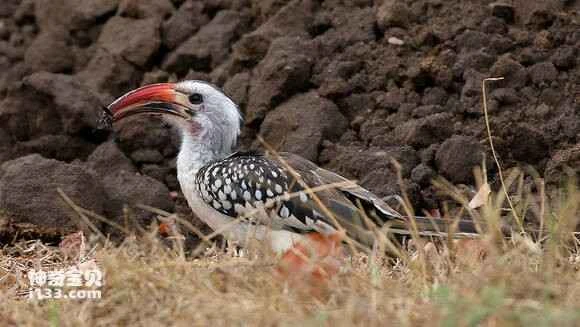
Northern red-billed hornbills nest in tree cavities and primarily feed on fruits and insects.
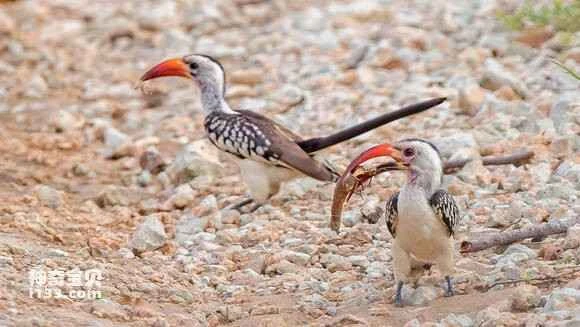
During the breeding season, male Northern Red-billed Hornbills perch atop the highest branches, spread their wings, stand upright, and call loudly, bobbing their bodies up and down in sync with their calls. Males then compete to see who can call the loudest, and females reciprocate in kind, expressing their affection. Their nests are primarily natural tree cavities or holes formed by termites or the decay of trees over time. These cavities are comfortable and safe. Like other hornbills, the Northern Red-billed Hornbill seals the entrance to the cavity with mud, leaving only a small opening for the female's beak to protrude. This allows the female to incubate and feed her chicks safely and comfortably, protected from wind and sun, and shielding the chicks from threats and harm from snakes, monkeys, and birds of prey.
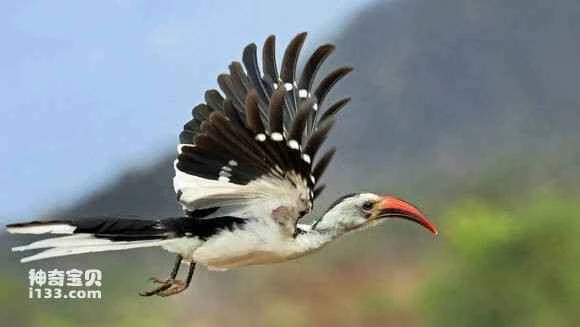
The sealing of the nest is primarily the responsibility of the female, while the male guards the entrance to prevent other males from damaging it. Northern Red-billed Hornbills lay 1-3 eggs per clutch. Incubation is the female's job. Northern Red-billed Hornbills are very clean birds; the female and chicks will directly defecate at the nest entrance, and the male helps clean up the droppings to keep the nest clean. The male provides all the food during incubation and chick raising. He must repeatedly fly outside to forage. If the female doesn't greet him with her beak, he will gently tap the tree trunk to signal her to come and eat. After the chicks hatch, the female undergoes a complete molt, at which point she is almost unable to fly. After molting, she pecks open the nest entrance and flies out with her grown chicks. Therefore, by the end of the breeding season, the female and chicks are very plump, while the male is exhausted and thin—truly a model father among birds. If the male hornbill dies during the breeding season, the female hornbill and the chicks living in the tree hole will also starve to death. Therefore, the hornbill is also known as the "love bird".
Protect wild animals and ban the consumption of wild game.
Maintaining ecological balance is everyone's responsibility!