Basic Information
Scientific classification
- Chinese name: Bottlenose dolphin
- Scientific name: Tursiops truncatus
- Order: Cetacea
- Family and genus: Dolphinidae, genus *Dolphinus*
Vital signs data
- Body length: Adults are typically 2–4 meters long, with most nearshore populations between 2.3–3 meters.
- Weight: The weight is generally about 150–300 kg, and large offshore individuals can exceed 400 kg.
- Lifespan: In the wild, lifespan is typically 30–40 years, with some individuals living to over 50 years old, and sometimes even longer under captive conditions.
Significant features
One of the world's most famous dolphins, intelligent, curious, and social, with highly developed echolocation abilities and complex group behaviors, it is an important medium-sized predator in many temperate and tropical seas.
Distribution and Habitat
Widely distributed in temperate and tropical seas worldwide, from shallow continental shelf seas, bays, and estuaries to offshore slopes and waters. There are populations that live year-round in nearshore shallow seas, as well as offshore populations that migrate to wider sea areas depending on the season and prey.
Appearance
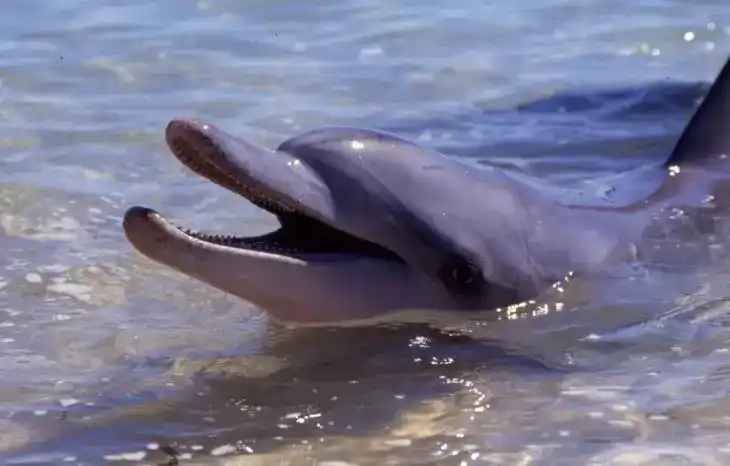
The body is streamlined and torpedo-shaped, with a rounded forehead and a short, thick snout resembling a "bottleneck". The back is dark gray or bluish-gray, and the abdomen is light gray to milky white. The dorsal fin is sickle-shaped and located in the middle and rear of the body. The pectoral fins are relatively short and wide, and the caudal fin is large with a distinct central notch. Scratches and wounds left during interactions with companions or during hunting are commonly seen on the body surface.
Detailed introduction
The bottlenose dolphin (commonly referring to the common bottlenose dolphin, scientific name *Tursiops truncatus *) is one of the most familiar dolphins to humans, belonging to the genus *Tursiops* in the family Delphinidae. Intelligent, curious, and social, they are widely distributed in temperate and tropical waters worldwide, serving as important medium-sized predators in nearshore and coastal ecosystems, and are considered a "representative species" for human understanding of dolphin behavior and intelligence.
Classification and nomenclature
Bottlenose dolphins belong to the class Mammalia, order Cetacea, suborder Odontoceti, family Delphinidae, and genus Tursiops. Currently, the genus Tursiops includes at least the common bottlenose dolphin ( Tursiops truncatus ) and the Indo-Pacific bottlenose dolphin ( Tursiops aduncus ), which are similar in appearance but differ in size, distribution, and genetics. In everyday language, "Bottlenose Dolphin" usually refers to the common bottlenose dolphin or a general term for this type of bottlenose dolphin.
Appearance features
Bottlenose dolphins have a streamlined, torpedo-shaped body, perfectly suited for high-speed swimming. Adults typically reach 2–4 meters in length, with most nearshore populations between 2.3–3 meters; their weight generally ranges from 150–300 kilograms, though larger nearshore or offshore individuals can exceed 400 kilograms. They have a smooth, rounded melon on their forehead, connected to a short, thick, bottle-shaped snout, resembling the neck of a rounded neck—hence their English name, "bottlenose."
The body color gradually changes from back to belly: the back is mostly dark gray or bluish-gray, gradually lightening towards the sides, while the belly is light gray, milky white, or slightly pink. Newborn juveniles often have light-colored gravid markings, which gradually disappear as they grow. The corners of their mouths often have a smiling curve, leading to the common perception that bottlenose dolphins have a "smiling expression." Their pectoral fins are relatively short and broad, their dorsal fin is sickle-shaped and located slightly behind the middle of the body, and their tail fin is broad with a distinct central notch, used for powerful propulsion. Scratches and wounds from interactions with companions, parasite attachment, or attacks by predators are frequently visible on their bodies.
Distribution range and habitat
Bottlenose dolphins are widely distributed in temperate and tropical seas worldwide, including the Atlantic, Pacific, and Indian Oceans, as well as coastal and offshore waters of some enclosed seas. They can be found in shallow seas, bays, estuaries, and lagoons near the continental shelf, as well as on offshore slopes and in offshore waters. Different populations differ in their water depth preferences and migration patterns.
Coastal populations typically inhabit continental shelves and waters surrounding islands at depths ranging from tens to hundreds of meters, often associated with highly productive habitats such as harbors, estuaries, seagrass beds, and coral reefs. Offshore populations are more prevalent in fish-rich waters such as ocean basin edges, current confluences, and upwelling zones. Some areas have "sedentary" populations with limited year-round ranges, while others are "migratory" populations that move seasonally according to changes in water temperature and prey distribution.
Lifestyle Habits and Behaviors
Bottlenose dolphins are highly social animals, typically living in small or medium-sized groups of 2 to several dozen individuals. They may also form temporary large groups in abundant waters or migration routes. Their group structure is relatively complex, consisting of stable "matrilineal groups" composed of closely related females and their calves, while males often form pairs or small groups and move between different groups.
They communicate through a variety of sounds (whistles, clicks, pops, etc.) and body language (leaping out of the water, tail slapping, slapping, etc.). Each bottlenose dolphin typically possesses a unique vocal pattern, similar to a "signature whistle," used to identify each other within the group. Bottlenose dolphins also have a sophisticated echolocation system, using "sonar imaging"—emitting and receiving high-frequency sound waves—to locate prey or obstacles in murky or dark waters.
feeding habits
Bottlenose dolphins are carnivorous predators, primarily hunting small to medium-sized fish, squid, and cephalopods, and sometimes crustaceans or other small marine animals. Their hunting methods are diverse, including chasing and encircling, driving schools of fish to shallow waters or the surface, hunting in coordination with other fish, and even opportunistic foraging by using fishing boats to startle schools of fish.
Some nearshore populations develop local "predation cultures" for specific prey, such as driving fish to the shallows near the shore and then rushing up to catch them, or using a sponge to cover their snouts and search for lurking prey on the seabed. These behaviors are passed down from generation to generation within the group through social learning.
Reproduction and life cycle
Bottlenose dolphins do not breed at a fixed time, but in certain sea areas, there is a breeding peak during the season when food is plentiful and the water temperature is suitable. Females usually give birth to one calf per litter, with a gestation period of about 12 months. Newborn calves are about 1–1.3 meters long and weigh about 15–30 kilograms. They swim close to their mothers, are breastfed, and rely on their mothers and the group for protection.
Calves are typically weaned around 3–6 years of age, before which they learn group migration routes, hunting techniques, and social rules. The age of sexual maturity for bottlenose dolphins varies slightly by region and sex, generally around 5–12 years for females and 8–13 years for males. Commonly recorded lifespans in the wild are 30–40 years, with some females living to over 50 years in favorable conditions; captive individuals sometimes live even longer.
Relationship with humans
Bottlenose dolphins have an extremely close relationship with humans. On the one hand, they are "star species" in whale watching, dolphin shows, and science education, driving ecotourism and raising awareness of marine conservation in many coastal areas; their exceptional learning abilities and complex behaviors have also made them important subjects of cognitive research and ethology.
On the other hand, bottlenose dolphins also face a variety of threats from human activities, including bycatch by fishing gear, by-fishing, nearshore habitat degradation, marine pollution, ship collisions, and underwater noise pollution. In a few areas, bottlenose dolphins may also be directly hunted or engage in resource conflicts with fishermen.
Protecting the status quo and threats
In the IUCN Red List, the common bottlenose dolphin is classified as "Least Concern (LC)," reflecting its widespread distribution and still considerable overall population. However, the status of local subpopulations varies significantly across different sea areas. Some small populations in enclosed bays or along the coast are declining due to pollution, overexploitation, and fisheries pressure, and even face regional endangerment risks.
Key threats include: bycatch via fishing nets and longline fishing, plastic and chemical pollution, nearshore habitat destruction by land reclamation and engineering projects, ship noise and high-speed collisions, and climate change leading to warming seawater and changes in food resources. Conservation measures include establishing marine protected areas and buffer zones for important habitats, improving fishing gear design to reduce bycatch, controlling pollution and vessel speed, strengthening population monitoring and acoustic research, and raising public awareness of bottlenose dolphins and their marine environment through public education and responsible tourism.
Frequently Asked Questions
Q1: Are bottlenose dolphins the same species as the "dolphins" that ordinary people talk about?
The most common "dolphin" in the public's impression and in aquarium performances is usually the bottlenose dolphin or a closely related species that are very similar to it. Therefore, many people's image of "dolphin" is basically that of the bottlenose dolphin.
Q2: Are bottlenose dolphins really intelligent?
Bottlenose dolphins possess highly developed brains, enabling them to engage in complex behaviors such as social learning, cooperative hunting, tool use, and self-recognition. They are considered to be among the most cognitively capable non-human animals, but there is still much scientific discussion regarding the comparison of their "intelligence."
Q3: What precautions should be taken when observing bottlenose dolphins?
When engaging in whale and dolphin watching activities in the wild, maintain an appropriate distance from the dolphins, avoid high-speed chasing, surrounding, or feeding them, do not throw trash into the sea, and follow local whale and dolphin watching guidelines to minimize disturbance to dolphin behavior and habitat.
Q4: What is the biggest threat currently facing bottlenose dolphins?
Key threats include bycatch and overcrowding by fishing gear, nearshore habitat degradation and pollution, ship noise and impacts, plastic debris ingestion, and changes in the marine environment and food web due to climate change. Continued pollution and engineering development are particularly dangerous for small, localized populations.