Basic Information
Scientific classification
- Chinese name: Bryde's beaked whale
- Scientific name: Mesoplodon densirostris
- Order: Cetacea
- Family and genus: Beaked whale (family Beaked whales)
Vital signs data
- Body length: Adults typically measure about 4.5–5.4 meters in length, with females being slightly larger than males.
- Weight: Weight is generally around 800–1200 kg, but varies depending on the individual and the sea area.
- Lifespan: Based on studies of dental plates and bones, lifespan is estimated to be around 30–40 years.
Significant features
A typical deep-diving beaked whale, the male has a pair of prominent triangular teeth on its lower jaw, and its body is covered with scratches and scars. It can dive to depths of thousands of meters to prey on deep-sea squid and fish. It is secretive in its activities but widely distributed.
Distribution and Habitat
Widely distributed in the deep waters of tropical and warm temperate oceans worldwide, they are often found in waters deeper than 200–1500 meters, such as continental slopes, steep island slopes, and trench edges. They usually dive and forage in small groups in deep waters far from the coast, and rarely venture into shallow waters near the shore.
Appearance
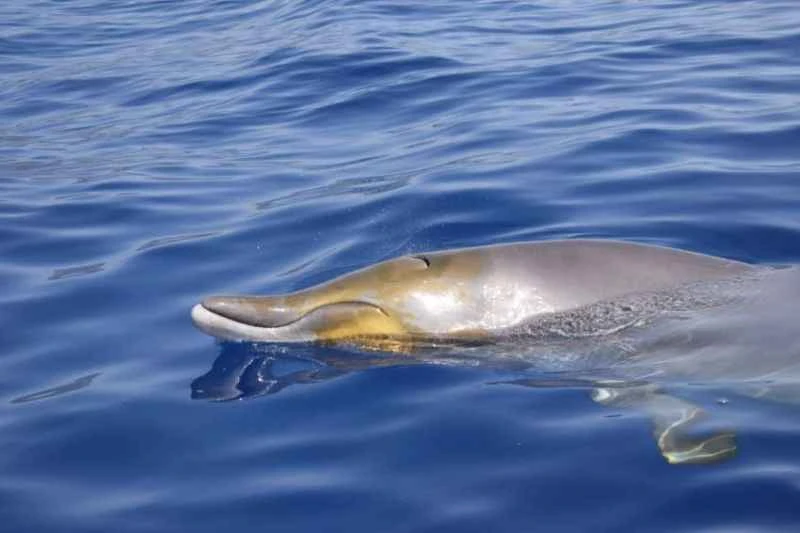
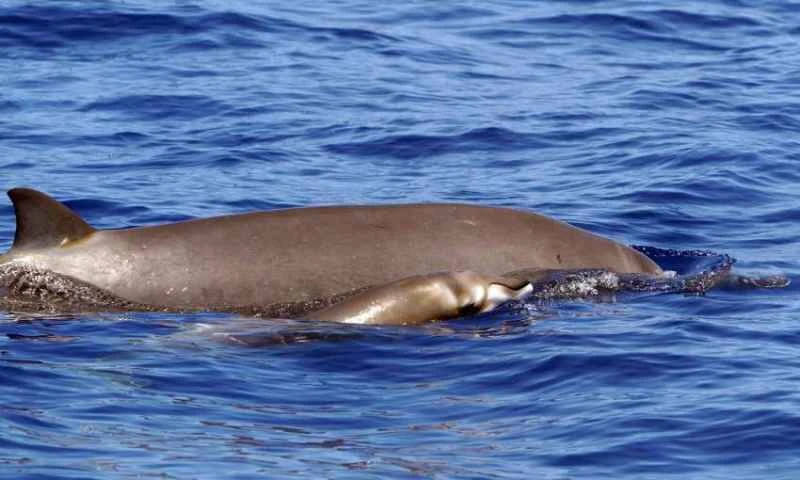
The body is slender and spindle-shaped, with a small head, pointed snout, and indistinct forehead. The body color is mostly lead gray to brownish gray, with a slightly lighter belly. The body surface often shows circular white spots caused by biscuit shark bites and long stripes caused by fighting among the same species. Adult male whales have a pair of distinct triangular teeth growing in the middle of their lower jaw, which is a key feature for identifying this species.
Detailed introduction
Blainville's beaked whale (scientific name *Mesoplodon densirostris *) is a medium-sized deep-diving toothed whale belonging to the genus *Mesoplodon* in the family Beaked Whales. It is one of the most studied and documented beaked whales, renowned for its ability to dive to extremely deep and for extended periods, and for the prominent "tusk-like" teeth on the lower jaw of males. Blainville's beaked whales are widely distributed in the tropical and subtropical oceans of the world and are typical deep-sea predators, primarily feeding on deep-sea squid and fish.
Classification and nomenclature
Bryde's beaked whales belong to the class Mammalia, order Cetacea, suborder Odontoceti, family Ziphiidae, and genus Mesoplodon . This genus contains more than ten morphologically similar medium-sized beaked whales, often differing slightly in body size and tooth morphology, making identification somewhat difficult. The scientific name *Mesoplodon densirostris * refers to its "dense bony rostrum," with the male's upper jaw being particularly thick; in Chinese, it is often referred to as "Bryde's beaked whale" or "Bryde's medium-beaked whale."
Appearance features
Bryde's beaked whales have a slender, spindle-shaped body with a relatively small head, a slightly pointed snout, and an indistinct forehead. The transition between the snout and forehead is gentle, unlike the prominent "square head" of sperm whales. Adults typically reach a length of 4.5–5.4 meters, with females slightly larger than males; their weight generally ranges from 800 to 1200 kilograms. The dorsal fin is positioned towards the rear, small and curved, located in the posterior half of the body; the pectoral fins are relatively short, and the tail fin is broad with no central notch or only a slight concave shape.
The body color is mostly lead-gray, dark gray, or brownish-gray, with a slightly lighter belly. The body surface is often covered with irregular spots, scratches, and circular white scars, some of which are scratches from fights with other Bryce's whales, while others are from bites by small sharks such as biscuit sharks. Adult males have a pair of prominent triangular teeth protruding from both sides of the lower jaw, located near the middle of the corners of the mouth, which is one of the important characteristics for identifying Bryce's beaked whales; the teeth of females and juveniles are not exposed, and their appearance is smoother. A light-colored arc-shaped stripe often runs from behind the corners of the mouth to in front of the eyes, which is a typical feature of this species.
Distribution range and habitat
Bryde's beaked whales are widely distributed in tropical and warm temperate oceans worldwide, including the outer waters of the Atlantic, Indian, and Pacific Oceans, and have been recorded in deep waters around many island nations and ocean chains. They typically inhabit deep-sea areas at depths of 200–1500 meters or even deeper, such as continental slopes, steep island slopes, and trench edges, and rarely approach shallow, nearshore waters.
Because Bryde's beaked whales spend most of their time diving in the deep sea far from the coast and rarely stay on the surface for extended periods, observing them in the wild is not easy. For many years, their distribution and numbers have been primarily known through stranded individuals, acoustic monitoring, and occasional shipboard observations. Deep-sea valleys and island arc channels surrounding some tropical island nations are considered important habitats for them.
Lifestyle Habits and Behaviors
Bryde's beaked whales are typical deep-diving predators with exceptional diving abilities. Scientific records show that they can dive to depths exceeding 1,000 meters or even deeper to hunt, with single dives often lasting over 45–60 minutes, followed by shallower dives of several minutes to a dozen minutes to recover. They typically live in small groups of 3–10 individuals, and sometimes appear in the same areas as other beaked whales or dolphins.
On the surface, Bryde's beaked whales are cautious, unlike dolphins that actively approach boats. They typically surface briefly to breathe before diving back down. Males often compete for mates by colliding and scratching each other with their exposed teeth, resulting in adult males having crisscrossing white scars on their bodies. They also use sonar (echolocation) to locate prey and companions in the dark depths, making them typical acoustically adapted deep-sea toothed whales.
feeding habits
Bryde's beaked whales primarily feed on small to medium-sized squid and deep-sea fish, classifying them as mesotrophic to high-trophic-level predators. They inhabit waters hundreds to thousands of meters deep, using sonar to locate prey before swooping down, chasing, or "sucking" their prey into the water. Studies of their stomach contents have revealed that many of their prey species inhabit the mid- or deep-sea layers, including various squid, cuttlefish, and some deep-sea fish.
Because they inhabit deep-sea environments, their direct competition with human fishery resources is relatively limited. However, in waters where longline fishing and deep-sea netting operations are intensive, they are sometimes injured or killed by accidental catches.
Reproduction and life cycle
Detailed reproductive biology information about Bryde's beaked whales is relatively limited, but it is generally assumed that their reproductive pattern is similar to that of other medium-sized toothed whales. Females typically give birth to one calf per litter, with a gestation period of about one year. Newborn calves are about 2–2.5 meters long and stay with their mothers for a long time after birth, being breastfed and gradually learning to dive and hunt.
Based on studies of their teeth and skeletons, it is estimated that Bryde's beaked whales may have a lifespan of 30–40 years. They mature relatively late, have a long reproductive cycle, and are typical K-selective species. Once a large number of adult individuals die due to human activities, the population recovers slowly.
Relationship with humans
Bryde's beaked whales are not a primary target species in traditional whaling, but they may be hunted on a small scale or killed by accident in certain areas. In modern whale watching tourism, Bryde's beaked whales are occasionally observed surfacing at a distance near deep trenches and steep island slopes, but due to their elusive nature, deep dives, and long periods of time, opportunities for observation are relatively limited.
The potential impacts of human activities on Bryde's beaked whales mainly stem from underwater noise (especially mid-frequency military sonar and high-intensity acoustic seismic exploration), accidental catches using longline fishing and deep-sea fishing gear, ingestion of plastic and fishing gear debris, and changes in deep-sea food webs caused by climate change. Some beaked whale strandings are believed to be related to high-intensity sonar interference, raising concerns about the relationship between military sonar and deep-sea cetacean conservation.
Protecting the status quo and threats
Currently, Bryde's beaked whales are assessed as Least Concern (LC) on the IUCN Red List, reflecting their wide distribution and the lack of evidence of a rapid global decline. However, due to their habitat in deep ocean environments, monitoring is challenging, and population numbers and trends in many areas remain unclear, leading to their classification as one of the deep-sea cetaceans with "relatively insufficient data."
The key to protecting Bryde's beaked whales in the future lies in: strengthening deep-sea acoustic and visual monitoring to assess the population status in different sea areas; minimizing interference from military and industrial sonar in their main habitats; reducing accidental catches from deep-sea fishing gear and plastic pollution; and promoting long-term conservation and research of beaked whale species in the high seas and exclusive economic zones through international cooperation.
Frequently Asked Questions
Q1: How can Bryde's beaked whale be distinguished from other beaked whales?
The most distinctive feature of Bryde's beaked whales is that adult males have a pair of exposed triangular teeth growing from the middle of their lower jaw, along with light-colored stripes around the corners of their mouths and numerous scars on their bodies. In contrast, many other medium-beaked whales have teeth in different positions, shapes, and head outlines, requiring a combination of tooth morphology and head features for identification.
Q2: How deep and how long can Bryde's beaked whales dive?
Research records show that Bryde's beaked whales can dive to depths of over 1,000 meters or even deeper to hunt, with single deep dives often lasting 45–60 minutes or more, interspersed with short shallow dives for recovery. They are among the deep-sea toothed whales with the most powerful diving abilities.
Q3: How do human activities at sea affect Bryde's beaked whales?
Underwater noise (especially mid-frequency military sonar and seismic exploration sound sources) may interfere with echolocation and behavior, and in extreme cases may be associated with some mass stranding incidents; deep-water longline fishing and nets may also lead to accidental catches or entanglement; ingestion of plastic waste and discarded fishing gear may cause intestinal obstruction or poisoning.
Q4: Is there a chance to see Bryde's beaked whales when whale watching at sea?
Compared to dolphins and some large whales that prefer to approach ships, Bryde's beaked whales are more secretive and tend to stay in deep waters, making them difficult to observe. Generally, only on open-ocean whale-watching routes near deep-sea trenches and steep island slopes are there opportunities to briefly spot them surfacing to breathe.