Basic Information
Scientific classification
- Chinese name: Black-striped Wallaby
- Scientific name: Notamacropus dorsalis
- Classification: Mammals
- Family and genus: Wallabieidae, Genus: Wallabie
Vital signs data
- Body length: Adults typically have a head and body length of about 60–70 cm, and the tail length is close to or slightly shorter than the body length.
- Weight: The weight is generally about 6–12 kg, with males being slightly larger than females.
- Lifespan: 7–10 years in the wild, possibly slightly longer in captivity.
Significant features
The medium-sized wallaby, with a distinctive black stripe down its back, mainly inhabits the arid and semi-arid scrub and woodlands of eastern Australia and is an important member of the local herbivorous marsupial fauna.
Distribution and Habitat
They are mainly distributed in arid and semi-arid habitats in parts of Queensland and New South Wales in eastern Australia, including eucalyptus forests, shrublands, rocky hills, and grassland-shrub transition zones. They usually rely on areas with complex terrain or high vegetation to avoid predators and come out to open grasslands to forage at dusk and night.
Appearance
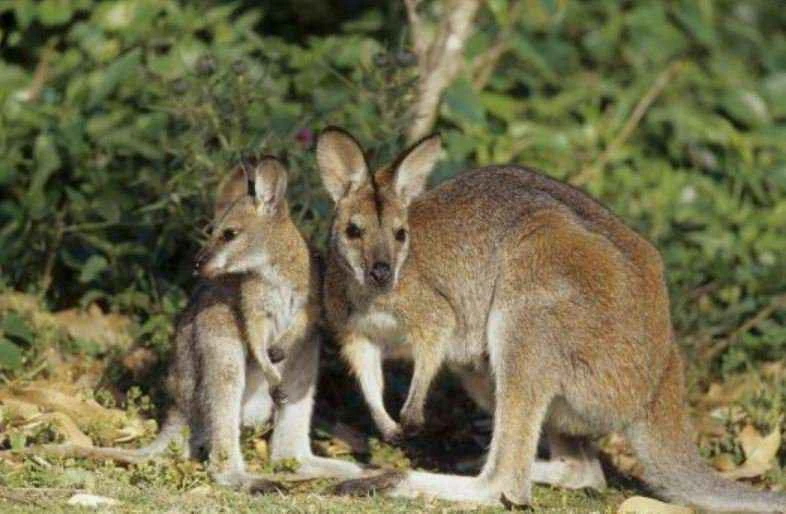
It has a light and strong body, well-developed hind legs, and a long and thick tail, which are suitable for jumping and balancing. Its body color is mainly grayish-brown to yellowish-brown, with a white belly. There is a dark stripe on the back that extends from the shoulder to the tail root. Light-colored spots and "eyeliner" are commonly seen on the face. The ears are erect and light-colored on the inside.
Detailed introduction
The black-striped wallaby (scientific name *Notamacropus dorsalis* , formerly * Macropus dorsalis* ) is a medium-sized marsupial herbivore belonging to the family Macropodidae and the genus *Notamacropus*. It is named for the distinctive black stripe along its back and is one of the most representative small to medium-sized kangaroos in the dry woodland and scrub ecosystems of eastern Australia. Due to habitat loss and fragmentation, populations in some areas have experienced significant declines over the past century.
Classification and nomenclature
The black-striped wallaby belongs to the class Mammalia, order Diprotodontia, family Macropodidae, and genus Notamacropus . Traditional literature often classifies it under the genus Macropus , hence the older scientific name Macropus dorsalis is still used. Its common English names are Black-striped Wallaby or Black-striped Rock-wallaby, while the Chinese names "黑纹沙袋鼠" (black-striped wallaby) or "黑纹岩袋鼠" (black-striped rock-wallaby) emphasize the striking black stripes on its back.
Appearance features
The black-striped wallaby is medium-sized, with a lithe yet robust build. Adults typically have a head-to-body length of about 60–70 cm, with a tail length close to or slightly shorter than their body length; they generally weigh about 6–12 kg, with males slightly larger than females. Like other wallabies, it has well-developed hind limbs and a long, powerful tail for jumping and maintaining balance; its forelimbs are relatively short, primarily used for feeding and simple support.
The coat color is primarily grayish-brown to yellowish-brown, slightly lighter on the sides and whitish on the belly. The most distinctive feature is a dark longitudinal stripe running down the back from the shoulder area to the base of the tail, hence the name "Black Stripe." Lighter stripes or patches are usually present around the eyes and on the sides of the face, contrasting with the dark eyeliner and making the facial expression more pronounced. The ears are erect, with light-colored fur on the inside, aiding in sound detection in open bushes. The tail is covered with short hair, thick at the base, and slightly darker at the tip.
Distribution range and habitat
Black-striped wallabies are mainly distributed in the arid and semi-arid regions of eastern Australia, with their core distribution area located in south-central Queensland and parts of New South Wales. Historically, their distribution was more extensive, but it has shrunk significantly in many areas. They mostly live in open dry woodlands, eucalyptus forests, shrublands, rocky hills, and grassland-shrub transition zones, usually relying on areas with complex terrain or high vegetation to avoid predators.
In drier habitats, black-striped wallabies are often found near stream valleys, rocky slopes, and the edges of savannahs. During the day, they retreat to the shade of bushes or rocks, and in the evening and at night, they venture into open grasslands to graze on tender grasses and herbs. Human activities such as clearing bushes, overgrazing, and land reclamation reduce their available shelter and food resources, leading to local population declines.
Lifestyle Habits and Behaviors
Black-striped wallabies are mostly nocturnal and twilight animals, preferring to rest in bushes or under the cover of rocks during the day. They generally live in small groups or family groups, which are smaller than those of large kangaroos and usually consist of one or more adult females and their young. Adult males may join intermittently during the breeding season.
Their primary mode of locomotion is hopping, with strong hind limbs enabling them to leap rapidly and continuously, adapting them to traverse undulating terrain. When threatened, they quickly jump into rock crevices, dense bushes, or under slopes for cover. Black-striped wallabies have relatively fixed ranges, repeatedly using familiar paths to travel between resting and foraging areas.
feeding habits
Black-striped wallabies are herbivores, primarily feeding on the leaves and buds of various grasses and sedges, and also nibbling on some new shoots and fallen leaves of shrubs. During rainy seasons, they prefer nutrient-rich grasses and herbaceous plants; in dry periods, they rely more on drought-resistant plants and some succulent leaves or stem segments to supplement their water intake.
Their diet varies with the seasons and habitat conditions, and they are somewhat flexible in utilizing different plant species, but overall their diet still mainly consists of grasses and low vegetation. Overgrazing and the invasion of alien plants may alter the vegetation structure, indirectly affecting the quality and quantity of food for black-striped wallabies.
Reproduction and life cycle
Black-striped wallabies can typically breed multiple times a year, with the specific breeding season depending on local climate and food availability. Females usually give birth to only one offspring at a time, with a gestation period of about one month. Newborn pups are extremely small and immediately crawl into the pouch located on the front of the female's abdomen, where they attach nipples and continue to develop for several months.
After about 6–7 months in the pouch, the young begin to frequently peek out and briefly leave the pouch, gradually moving around the mother and attempting to feed on plants. Even after leaving the pouch, the young will return to nurse for a period of time until they are fully weaned and can live independently. In the wild, the lifespan of the black-striped wallaby is generally about 7–10 years, and may be slightly longer in captivity.
Relationship with humans
In some areas, the black-striped wallaby's habitat overlaps with agricultural and pastoral land, and it may be considered a pest by farmers because it grazes on pasture or crops. At the same time, it may also be affected by dog predation, fencing, and vehicle collisions. Due to its small size and sensitivity to environmental changes, continuous land reclamation, scrub clearing, and overgrazing will put pressure on its long-term survival.
On the other hand, the black-striped wallaby, a wild marsupial endemic to Australia, is of great importance to the local ecosystem and biodiversity, and is a representative species frequently mentioned in ecotourism and science education. Protecting its habitat, controlling invasive predators, and rationally planning agriculture and animal husbandry are key to achieving coexistence between humans and wildlife.
Protecting the status quo and threats
On the IUCN Red List, the black-striped wallaby is generally assessed as near threatened (e.g., Near Threatened, NT) or regionally concerned, with its overall population declining in some areas. Major threats include habitat loss and fragmentation (particularly scrub clearing and land conversion to pasture or farmland), predation by invasive carnivores such as foxes and wild dogs, road accidents, and the impacts of prolonged drought and climate change on vegetation and water resources.
Conservation measures include: establishing and managing nature reserves and reserves in important distribution areas; preserving shrublands and rock shelters near farmland and pastures; controlling invasive predators; and understanding the trends of individual populations through ecological surveys and long-term monitoring to provide a basis for future conservation planning.
Frequently Asked Questions
Q1: What is the difference between the black-striped wallaby and the common large kangaroo?
Black-striped wallabies are relatively small and belong to the wallabies family. They have distinct black stripes on their backs and mostly live in shrublands and rocky slopes. In contrast, common species such as the Eastern Grey Wallabies are larger and have a wider range of activities, usually appearing in large grasslands and pastures.
Q2: When are black-striped wallabies most active?
They are mostly nocturnal and twilight animals, resting in bushes or rocky shelters during the day and foraging from dusk to dawn. Compared to large kangaroos, they are more elusive and less likely to be spotted during the day.
Q3: What are the main threats facing the black-striped wallaby?
The main threats include habitat clearing and reclamation, vegetation degradation due to overgrazing, predation by invasive predators such as foxes and wild dogs, road traffic accidents, and the impacts of prolonged drought and climate change on water resources and vegetation.
Q4: What are some effective measures to protect black-striped wallabies?
This includes preserving and restoring shrub and rock shelters, establishing protected areas or reserves in key distribution areas, controlling the number of invasive predators, setting up wildlife warning signs and access roads near roads, and monitoring and studying population changes in various locations to develop more precise conservation strategies.