Basic Information
Scientific classification
- Chinese name: Boston
- Scientific name: Boston Terrier
- Classification: Rodentia
- Genus and species: Canis
Vital signs data
- Body length: approximately 30 cm
- Weight: 3-11kg
- Lifespan: 11-13 years
Significant features
Compact and well-proportioned, with a short tail that typically does not exceed two inches (approximately 5 cm) in length. Coat colors are diverse, primarily white, black, spotted, and seal (a dark brown) or combinations of these. The ideal Boston Terrier is white, covering its chest, muzzle, neck, forelegs, hind legs, and between (but not above) the eyes. A more symmetrical appearance is considered more authentic for the Boston Terrier. Large, prominent eyes are a distinctive feature; the wide-set, round eyes contribute to its unique look. Gentle and easily trained, the Boston Terrier is often regarded as an "American gentleman."
Distribution and Habitat
Primarily found in the United States. This breed originated in Boston, USA, and is now widely distributed and kept around the world.
Appearance
Compact and well-proportioned, with a short tail that typically does not exceed two inches (approximately 5 cm) in length. Coat colors are diverse, primarily white, black, spotted, and seal (a dark brown) or combinations of these. The ideal Boston Terrier is white, covering its chest, muzzle, neck, forelegs, hind legs, and between (but not above) the eyes. A more symmetrical appearance is considered more authentic for the Boston Terrier. Large, prominent eyes are a striking feature; the wide-set, round eyes contribute to its distinctive look.
Detailed introduction
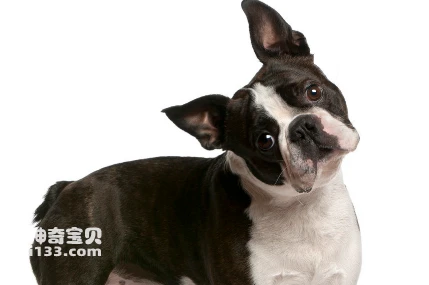
The Boston Terrier ( scientific name: Boston Terrier , also known as Boston Bull , Boston Bull Terrier , Boxwood, American Gentlemen ) is a breed of Terrier with a lifespan of 11-13 years. Originating in Boston, USA, it is a non-sporting dog. It is an active and highly intelligent breed, ranking approximately 54th in canine intelligence . It has a smooth coat, short head, compact build, short tail, and is a very well-proportioned dog. Its coat color is brindle, seal, or black with evenly distributed white markings. The head size is in proportion to the body, and its expression reflects its high intelligence. While not particularly unique, it makes an excellent guard or companion dog. Early Boston Terriers were a modified breed resulting from crossbreeding with Bulldogs and Bull Terriers. Later, extensive improvements were made through selective breeding with other Boston Terriers and French Bulldogs.
Color and markings are prerequisites for distinguishing the breed and identifying it according to the AKC standard. Their coat color should be black, seal-colored, or with white markings. Boston Terriers are medium-sized dogs with a short tail and erect ears. They are very intelligent and easily trained. Friendly but sometimes stubborn. Although a few live into their teens, the average lifespan is 11 to 13 years. Originally bred as ratters and companion dogs, Boston Terriers are now primarily kept as toy dogs. In biological classification, they belong to the Canidae family.
The Boston Terrier was listed as one of the 21 most popular dog breeds in 2016 .
In the early days, the Boston Terrier's color and markings were not important. However, since the early 20th century, its distinctive markings and colors have been written into the AKC standard, becoming its fundamental characteristics. The Boston Terrier has lost much of its aggression and prefers human companionship; although some males may still provoke other dogs, this is usually based on a feeling of territorial intrusion. The Boston Terrier has become the mascot of Boston University and Wofford College in Spartanburg, SC .
Appearance description
[Habits] This breed is lively, intelligent, playful, and affectionate . The traditional aggressiveness is no longer present. Suitable as a lovely family pet. They like to run around the house and have a strong personality.
[Body Shape] The Boston Terrier is a compact, well-proportioned dog. It generally has no wrinkles. A Boston Terrier typically measures 15-17 inches when standing, and has a relatively broad chest.
Height: 30-50 cm; Weight: not exceeding 11 kg; Lightweight: 7 kg; Middleweight: 7-9 kg ; Heavyweight : 9-11 kg ( males 3.5-11 kg , females 3-10 kg ).
[Body] Muscular and firm, with a deep and broad chest. Short back and a slightly sloping loin.
[Head] A square head with angular skull, a flat top, a slightly arched neck, a short muzzle, but with a uniform or slightly protruding lower jaw and bite . The size of the head must be proportionate to the body.
[Ears] The ears are erect, thin and upright, located at both ends of the skull.
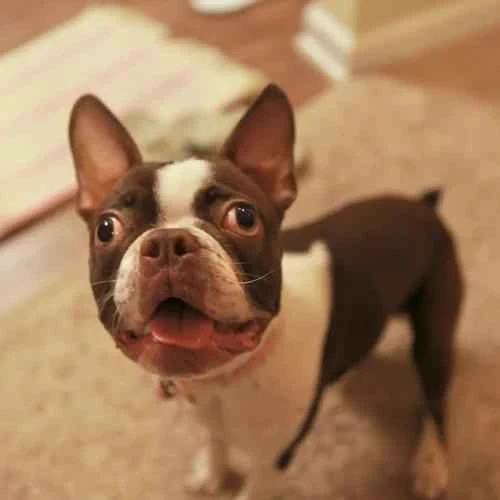
[Eyes] Round, large, and protruding eyes are a distinctive feature of this breed. The round eyes of this breed are set far apart.
[Nose] A wide, black nose
[Chin] The upper lip is large and droopy, and the mouth is tightly closed, completely covering the teeth . The lower jaw is wide and square.
[Limbs] The thigh muscles are well-developed, the forelimbs are straight, and the hindlimbs are strong.
[Foot sole] Speech and demeanor: firm, with a noticeably raised toe.
[ Tail ] The tail is relatively short and straight, and slightly crooked . The tail is set low and usually hangs down.
[Fur] Short and fine, smooth and glossy, with a more popular appearance resembling a small jacket pattern.
[Coat Color] 1. Gray with white markings; 2. Gray should be clearly visible throughout the entire body; 3. Black with white markings. However, gray with white markings is preferred.
[Gait] The footwork is stable, the steps are synchronized, and the forelimbs and hind legs move forward in a straight line with perfect rhythm, each step appearing powerful and graceful. Gait defects: swaying, paddling posture, and crossing steps. Horse stance. Serious gait defect: Crossing steps appearing on both forelimbs and hind limbs.
[Nursing] Puppies have large heads, and most of them require a cesarean section to give birth . Due to the high cost of the surgery, the breed is limited to those with breeding value.
According to international breed standards, a dog's weight should not exceed 25 pounds ( 11 kilograms). Therefore, the AKC classifies this breed into five categories: under 15 pounds, 15 pounds, under 20 pounds, 20 pounds, and not exceeding 25 pounds.
fur color
The Boston Terrier's coat color is primarily white, black, brindle, and seal (a wet seal color, similar to dark brown, appearing almost black in the spring sunshine) or a combination of all four. Any other color is not recognized by the AKC because their offspring are typically bred through crossbreeding with other breeds, thus losing their distinctive " tuxedo " appearance.
According to the AKC , the ideal Boston Terrier should be white, covering its chest, muzzle, neck, forelegs, hind legs, and between its eyes (but not over them). Its symmetrical appearance, as indicated by its conformation, clearly indicates a purer breed. Because its appearance resembles that of a human in formal attire, in addition to its elegant and pleasing characteristics, the breed is often referred to as the "American Gentleman ."
Its genetic variation results in a short tail. These short tails may be spiral, curled, or straight. But generally, the Boston Terrier's tail will not exceed two inches in length.
Lifestyle
The Boston Terrier is gentle, patient, and gets along well with other pets, dogs, and children. They are sociable, have a great sense of humor, and typically exhibit a strong, helpful nature. They are very sensitive to their owner's voice, eager to please, highly adaptable, and easy to train. They are quiet dogs, rarely barking, but their protective nature can sometimes lead to aggressive behavior towards other pets and strangers. This breed sheds very little and usually requires very little grooming.
health issues
A bowed back may be caused by a problem with the patella in the hind legs, which in turn causes the dog's center of gravity to shift forward onto the front legs. This could also simply be a structural defect with little practical impact on the dog. Due to their short muzzles, many Boston Terriers cannot tolerate hot or cold weather, and forcing them to exercise in such conditions can be harmful. An overly sensitive digestive system is also typical of Boston Terriers, and their bloating is often associated with poor dietary habits.
Their large, protruding eyes make them highly susceptible to corneal ulcers. Because of the breed's short muzzle and large eyes, their eyes are also easily injured when exposed to sand, dust, debris, or sharp objects (such as thorny plants).
The Boston Terrier is a brachycephalic breed. The word comes from the Greek root " brachy ." This structure can result in small nostrils and a narrow trachea. Boston Terriers may snore and sneeze frequently as a way to clean mucus from their palate, which is harmless to the dog. Brachycephalic dogs may experience complications under general anesthesia. Boston Terriers are frequently given birth via cesarean section, and a survey by the UK Kennel Club showed that over 90% of births were performed this way.
fur grooming
Boston Terriers have short, smooth fur that requires very little brushing. They do experience slight shedding; brushing their fine hairs weekly can effectively remove loose fur . Brushing promotes healthy fur growth because it secretes oils from the skin and encourages new hair growth. Boston Terriers' nails need regular trimming. Unmanaged nails can cause them pain, make walking difficult, or fall out after tripping over something.
Brushing your teeth regularly is also essential for maintaining good oral health. By brushing regularly, plaque and other bacteria can be removed, reducing the risk of mouth pain, gum infections, or bad breath.
Feeding methods
In their daily feed, medium and small-sized animals need 200-250 grams of meat, while large-sized animals need 300-350 grams of meat, along with an equal amount of dry feed or biscuits.
Meat should be cooked for 15-20 minutes, chopped, and then mixed with cooked dry vegetables and an appropriate amount of warm water before feeding.
The amount of food to provide each day should be adjusted according to the dog's size, aiming for just the right amount. Too little food will result in insufficient nutrition, causing the dog to lose its lively and adorable appearance; too much food will lead to obesity, thus diminishing its charming appeal. Feeding should be done at fixed times, in fixed quantities, and at fixed locations, and the dog should finish eating within 15-25 minutes. If the time is exceeded, the food and bowl should be removed to prevent the dog from developing a bad habit of irregular eating.
Take it for a walk every morning or evening, but do not let it run fast or do strenuous exercise, otherwise it will experience shortness of breath.
Its coat needs to be combed or brushed daily to keep it clean and shiny. It also needs regular bathing; every 20-30 days in cool weather and every 3-5 days in hot weather. Excessively long hair on the head (forehead), bridge of the nose, and abdomen should be trimmed regularly to reveal the short white hairs, making it look more beautiful and endearing. Its toenails should also be trimmed every 10-15 days .
If you apply a little olive oil to the fur after it has been bathed and dried, and then rub it with a soft material such as wool or silk, its appearance will become even more beautiful and attractive.
During the breeding process, the dog should be trained regularly to develop good hygiene habits, such as relieving itself in a designated spot and not scratching sofas or clothes. Earwax and tartar should also be cleaned every few days. Because of its large eyes, dust and foreign objects can easily enter and cause eye diseases, the eyes and eye sockets should be cleaned regularly with a 2% boric acid solution to prevent bacterial infection.
Because Boston Terriers are brachycephalic dogs with short respiratory tracts, they are prone to heatstroke. Therefore, they should not be allowed to go for walks or engage in other strenuous activities during the midday heat in summer. Additionally, their noses are prone to cracking. In the dry winter and autumn seasons, small amounts of glycerin or petroleum jelly should be applied to their noses regularly to prevent dryness and cracking. Regularly monitor the dog's mental state, appetite, stool consistency, and the dryness, moisture, and temperature of its nose pads. If any signs of illness are detected, seek medical attention promptly.
Due to their large heads, Boston Terriers often require a cesarean section for delivery . Because of the high cost of the surgery, the breed is limited to pedigrees with breeding value.
Value of existence
Historically, Boston Terriers were primarily used for dogfighting, but their friendly and cheerful nature has made them popular companion dogs. Today, in addition to being excellent partners, Boston Terriers excel in various canine sports. They are increasingly popular in agility competitions, obedience training, relay races, tracking, dock diving, fly ball, weightlifting, barn hunting, and chase games. A versatile breed with an outgoing personality and a strong desire to make new friends, they are highly sought-after therapy dogs.
A Brilliant Journey
In 1921 , at a ceremony commemorating the 102nd Infantry Regiment, the U.S. Army awarded a gold medal to a distinguished war dog: Sergeant Stubby . This bulldog, adorned with three service patches and one wounded soldier patch, was granted a U.S. Army rank—making him the first dog in history to earn a rank. This gratifying war dog also received a medal from France. Sergeant Stubby , adorned with numerous medals, died in 1926 , but became known as America's "greatest war dog."
In 2012 , a high school student named Victoria Reed took her veterinarian's advice and submitted a photo of her Boston Terrier ( Bruschi ) to the Guinness World Records. Because each of Bruschi 's eyes was 1.1 inches ( 2.8 centimeters) in diameter, it was recognized by the Guinness World Records as "the dog with the largest eyes".
FCI Standards
FCI Number: 140
FCI Classification: Group 9: Companion and Toy Dogs
Height: Male Boston Terriers stand 16.9-15.0 inches ( 43.0-38.1 cm) at the shoulder; female Boston Terriers stand 0.0-0.0 inches ( 0.0-0.0 cm) at the shoulder.
Weight range: Male Boston Terriers weigh 24.9-9.9 lbs ( 11.3-4.5 kg); Female Boston Terriers weigh 0.0-0.0 lbs ( 0.0-0.0 kg).
Head (head, face, eyes, ears, nose, mouth, muzzle, jaw, teeth)
Skull: Square, flat at the top, without wrinkles, with a prominent frontal bone. Nose: Black and broad, with open and clearly defined nostrils. Muzzle: Short, square, broad, deep, and wrinkled, not exceeding one-third the length of the head. Lips: Well-developed but not drooping, completely covering the teeth. Jaw / Teeth: Wide but not protruding jaws, with even teeth, a scissor bite or underbite. Face: Flat. Eyes: Broad, large, and round, black, indicating alertness and intelligence. Ears: Small, erect, naturally or manicured, well-proportioned to the head shape, and placed as close to the skull as possible.
Trunk (neck, chest, ribs, waist and back, front of body, skin)
Neck: The neck must be of proportionate length to the body, slightly arched, and then curve gracefully to the head. Body: The body should appear short. Back: Short and broad enough. Croup: The croup curve should be slightly fixed at the tail. Chest: Deep and of moderate width, with well-sprung ribs.
Limbs (forequarters, shoulders, upper limbs, pastern joints, pasterns, feet, hindquarters, thighs, hocks, joints, and hock nails)
Forequarters: Forelegs set moderately and widely spaced. Shoulders: Slightly sloping back. Pasterns: Short, strong, neither turned in nor out. Forefeet: Small, round, compact, not turned out. Thighs: Strong, muscular. Stifles: Moderately bent. Hindfeet: Small, round, and compact, neither turned in nor out. Toes slightly arched.
Tail: low-set, short, thin and pointed, straight or spiral.
Gait / Movement: Confident stride, with perfect movement of the front and back legs, displaying grace and power.
Disqualifying conditions:
Faults: Any deviation from the above points is considered a fault, and any dog that exhibits obvious physical or behavioral abnormalities is disqualified.
AKC Official Standard ( Approved on February 11 , 2011 , and effective March 30 , 2011 )
General Appearance: The Boston Terrier is a lively, highly intelligent dog with a smooth coat, short head, compact build, short tail, and good balance. Its color is brindle, seal, or black, evenly marked with white patches. The head is proportionate to the dog's size, and its expression indicates high intelligence.
Overall Appearance : The body is rather short and sturdy, with strong limbs that turn smoothly, and a short tail. There are no prominent features that would make the dog appear disproportionate. The dog gives an impression of determination, strength, and activity, with a noble style and elegant manners.
The proportion of “color and white markings” is a particularly striking feature of the representative sample.
When determining the relative value of the overall appearance to other points, special consideration should be given to "balance, expression, color, and white markings".
Size, proportion, and physique:
Weight : Classified as follows: Under 15 pounds; 15 to under 20 pounds; 20 pounds to no more than 25 pounds.
The length of the legs must be in proportion to the length of the body, giving the Boston Terrier a striking, square appearance. The Boston Terrier is a sturdy dog and should not appear thin or coarse. The bone structure and muscles must be proportionate, enhancing the dog's weight and build.
Defect - Blocky or coarse appearance.
The effect of sex. When comparing samples of each sex, the only significant difference was that the female dogs showed a slight improvement in body size.
Expression : The skull is square, flat on top, without wrinkles, with flat cheeks, prominent eyebrows, and a well-defined forehead.
The ideal expression for a Boston Terrier is alert and docile, indicating a high level of intelligence. This is the most important characteristic of the breed.
Eyes : Wide-set, large and round, dark in color. The eyes are located in a square position on the skull, and when viewed from the front, the outer corners are in line with the cheeks.
Disqualification - Eyes are blue or have any blue tinge. Ears are small, erect, natural or cropped to fit the shape of the head, and placed as close as possible to the corners of the skull.
Head : The muzzle is short, square, wide, and deep, in proportion to the skull. It is wrinkleless and shorter than its width or depth; its length does not exceed approximately one-third of the skull's length. The muzzle runs parallel to the top of the skull from tip to tip of the nose. The nose is black and broad, with a clear line between the nostrils.
Disqualification - Dudley nose. A broad, square jaw with short, even teeth. Even bite or overbite resulting in a square muzzle. Adequate jaw depth, but not drooping, completely covering the teeth when the mouth is closed. Serious fault - Crooked mouth. Head fault - Excessive white or blue showing in the eyes. Narrow or wide nostrils. Ears disproportionate to head size. Serious head fault - Tongue or teeth protruding when the mouth is closed.
Body: Neck, Topline, and Body: The length of the neck must contribute to the dog's overall balanced appearance. The neck is slightly arched, the head is carried gracefully, and lies neatly against the shoulders. The back is short enough to give the body a square shape. The topline is level, with the croup slightly arched to the tail root. The chest is deep and broad, with well-developed ribs extending towards the loin. The body should appear short. The tail is set low, short, thin, and pointed, straight or spiraled, and should not rise above the level line. (Note: Ideally, the tail length should not exceed one-quarter of the distance from the tail root to the hock.)
Disqualification - Docked tail. Physical defect - Tail carried merrily. Serious physical defect - Hunchback, swaying back, flat sides.
Forequarters : The shoulders are sloping and tilted back, allowing the Boston Terrier to move gracefully. The elbows are neither turned in nor out. The forelegs are moderately spaced and aligned with the upper part of the shoulder blades. The foreleg bones are straight, and the pasterns are short and strong. Dewclaws may be removed. The feet are small, round, and compact, neither turned in nor out, with arched toes and short nails.
Defects - Lack of muscle in the legs; feet are splayed.
Hindquarters: Thighs are strong and muscular, with well-bent and correctly positioned stifles. Hocks are short, neither turning in nor out, with clearly defined hock joints. Feet are small and compact, with short nails. Fault - Straight stifles. Gait: The Boston Terrier has a steady, straight gait, with both forelegs and hind legs moving forward in perfect rhythm, each step displaying elegance and power.
Gait defects - the gait does not involve rolling, paddling, or swaying. Hackney gait.
Severe gait defect - any cross movement, whether front or back.
Coat: The coat is short, smooth, shiny, and fine in texture.
Color and markings: Striped, seal, or black with white markings. Striped is preferred only if all other qualities are equal. (Note: Seal definition. Seal appears black but appears reddish in sunlight or strong light.) Disqualification - Solid black, solid striped, or solid seal, without the required white markings. Any color not described in the standard. Required markings: White muzzle band, white patch between the eyes, white breast. Ideal markings:
A white muzzle stripe, even white markings between the eyes and above the head, a white collar, a white chest, and white forelegs and hind legs below the hocks, or entirely white. (Note: Representative specimens should not be penalized for not possessing the "ideal markings.") Dogs with more white on their head or body must have sufficient merits to offset any shortcomings.
Temperament : The Boston Terrier is a friendly and lively dog. The breed has a good temperament and high intelligence, making it an unparalleled companion dog.
summary:
The Boston Terrier's clean, short back, combined with its distinctive square head and chin, and striking markings, makes it one of the most stylish and charming native American dog breeds.
Scoring Criteria
Overall appearance 10
Emoji 10
Head (muzzle, mandible, occlusion, skull, and stop) 15
Eyes 5
Ear 5
Neck, topline, body and tail 15
Forequarters 10
Hindquarters 10
Foot 5
Color, coat, and markings 5
Gait 10
Total 100
Disqualification: Eyes blue or with any blue tinge. Dudley nose. Docked tail. Solid black, solid spotted, or solid seal-colored, without the required white markings. Any color not described in the standard.