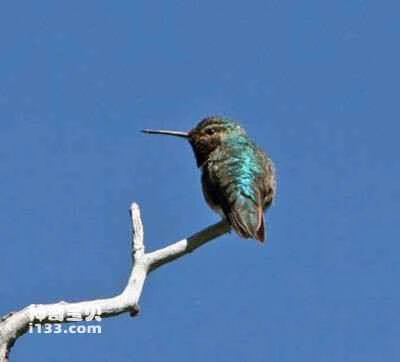
Basic Information
Scientific classification
- Chinese name: Brown-backed Flycatcher
- Scientific name: Brown-backed Shrike, Brown-backed Flowery Shrike
- Classification: Songbirds
- Family and genus: Brown-backed Flycatcher
Vital signs data
- Body length: 13-15 cm
- weight:
- life:
Significant features
A small bird, 13-15 cm in length. Upperparts: head and sides black with a blue metallic sheen. Back blackish-brown, rump white. Wings blackish-brown, with white edges on the median coverts, innermost greater coverts, and inner flight feathers, forming distinctive white patches on the wings. Tail black with white tips. Underparts: chin, lower cheeks, and sides of neck white; the rest of the underparts pale grape-brown.
Distribution and Habitat
It is distributed from India and Sri Lanka, eastward along the Himalayas to the Indochina Peninsula, the Malay Peninsula, Indonesia, and in southeastern Tibet, western, southern and southeastern Yunnan, central and southern Guizhou, and southwestern Guangxi in mainland China. It inhabits broad-leaved forests, rainforests, and mixed coniferous and broad-leaved forests at altitudes of around 2000 meters and below, and is also found in sparse forests and sparse shrublands on forest edges and grassy slopes. Especially during the breeding season, it mostly inhabits dense mountain forests, while in winter it is more active in sparse forests in low hills and plains at the foot of mountains, and sometimes appears in roadside bushes and trees along farmland edges. Outside the breeding season, it is often found in groups in the upper and middle layers of the forest.
Appearance
The male's upperparts are black with a blue metallic sheen, extending from the forehead, crown, nape, hindneck, and sides of the head. The back, shoulders, and rump are dirty brown or blackish-brown, with broad white tips on the lower back and rump feathers, making the rump appear white. The uppertail coverts are black, as is the tail, with white tips on the outer tail feathers, increasing in size towards the outer edges. The tips of the blackish-brown median coverts are white, as are the outer edges of the greater inner coverts and inner flight feathers, forming a distinctive white wing patch. The chin, lower cheek, sides of the neck, and front of the shoulders are white, forming a semi-ringed pattern. The remaining underparts are semi-grape-brown or smoky-brown, turning white towards the undertail coverts.
The female and male birds are generally similar, but the forehead, crown, nape, and nape are not black but are dark brown or dirty brown like the back. The wings and tail are also dark brown with less black, and the underparts are slightly lighter than those of the male.
The iris is brown or reddish-brown, and the mouth and feet are black.
Size measurements: Weight: ♂ 7-13 g, ♀ 7-14 g; Body length: ♂ 132-148 mm, ♀ 136-152 mm; Bill length: ♂ 11-13 mm, ♀ 11-13 mm; Wing length: ♂ 59-67 mm, ♀ 60-67 mm; Tail length: ♂ 58-69 mm, ♀ 61-69 mm; Tarsus length: ♂ 13-15 mm, ♀ 13-14 mm. (Note: ♂ male; ♀ female)
Detailed introduction
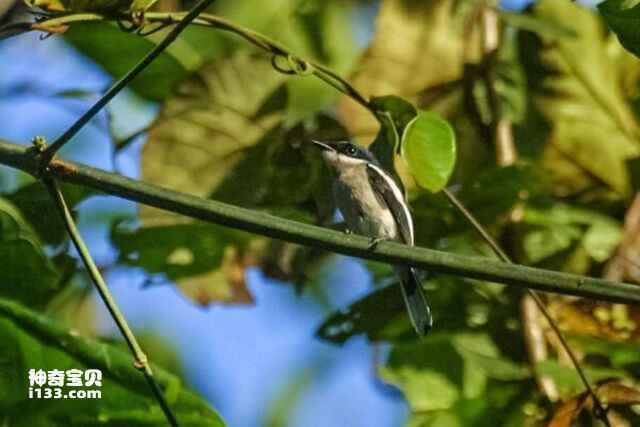
The Brown-backed Shrike (scientific name: *Hemipus picatus*), also known as the Brown-backed Magpie Shrike, is a bird belonging to the genus *Hemipus* in the family Minivetidae. It primarily breeds in mountain forests at altitudes of 800-2100 meters, with a breeding season from March to June. It nests in trees, typically on the outermost horizontal branches of the canopy. The nest is constructed from twigs, grass leaves, stems, and roots, with an outer layer of spider silk, moss, and lichen. The nest is shallowly cup-shaped and has a relatively delicate and sturdy structure. The nest is located 3-10 meters above the ground, and each clutch contains 2-3 eggs. There are two types of egg color: one is pale greenish-white with dark brown spots, and the other is pinkish-white with dark brown and reddish-brown spots. The eggs measure 15-17 mm × 12.4-13.7 mm.
It primarily inhabits secondary broad-leaved forests, rainforests, monsoon forests, evergreen broad-leaved forests, and mixed coniferous and broad-leaved forests in mountainous areas below 2100 meters in altitude. It is also found in sparse forest edges and sparse shrublands on grassy slopes, along roadsides or in thickets in dam areas, and in rainforests. It is gregarious, often mixed with other species, and moves among trees. It carefully searches for hidden or startled insects, then pounces on them like a shrike . Outside the breeding season, it often lives in groups in the upper and middle layers of the forest floor. Especially during the breeding season, it inhabits dense mountain forests, while in winter it is mostly active in sparse forests in low hills and plains at the foot of mountains, sometimes also appearing in roadside thickets and trees along farmland edges.
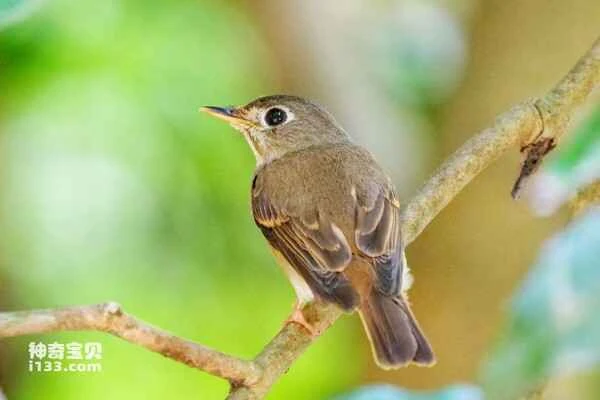
It is a resident bird in China and does not migrate . Except during the breeding season when they are active in pairs, they are usually active in flocks during other seasons. They are mostly active in the canopy of trees, and sometimes also in small trees and shrubs. They forage among the branches and leaves in the canopy, mostly by flying, but occasionally they also forage on the ground.
They primarily feed on insects, including beetles, stink bugs, bees, moths, dragonflies, flies, leafhoppers, and other insects and insect larvae belonging to the orders Coleoptera, Hemiptera, Hymenoptera, Lepidoptera, and Odonata.
This species has a wide distribution range and does not approach the threshold for vulnerable or endangered status (distribution area or fluctuation range less than 20,000 square kilometers, habitat quality, population size, fragmentation of distribution area), and its population trend is stable. Therefore, it is assessed as a species with no survival crisis.