Basic Information
Scientific classification
- Chinese name: Huangdao Long-snouted Beetle
- Scientific name: Saccoglossus hwangtauensis (also known as Huangdao long-snouted stigmata, jade hook worm)
- Classification: Hemichordates
- Family and genus: Acorniformes, Haematopoda, Acerolae
Vital signs data
- Body length: 210-420 mm
- weight:
- life:
Significant features
A species endemic to China.
Distribution and Habitat
It is distributed in Jiaozhou Bay, Shandong Province. It inhabits the intertidal zone and lives burrowing in sandy or muddy bottoms.
Appearance
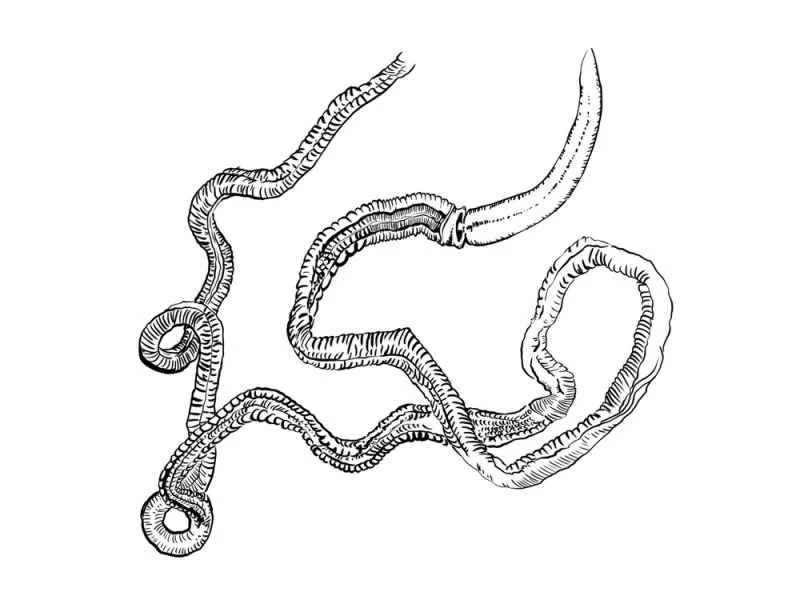
The snout is flattened and conical, with a longitudinal groove running along the central line on both the dorsal and ventral sides. The collar is smooth, with a ring-shaped groove in the middle and posterior parts, and a ring-shaped white raised edge on the posterior margin. The gonads are well-developed. The snout is light orange-yellow, the collar is dark orange-yellow, the gill genital area is pale yellowish-brown in females and pale yellowish-brown or orange-yellow in males, the liver area is dark green, and the posterior tail area is white. The anal margin often has a darker brown pigment.
Detailed introduction
Saccoglossus hwangtauensis is a type of gill worm distributed in the intertidal and subtidal zones of Jiaozhou Bay, Qingdao City, Shandong Province, China.[1] It belongs to the genus Saccoglossus of the family Saccoglossidae.
The Huangdao long-snouted beetle has a soft, worm-like body. It measures 290 mm in total length, with an average snout length of 15.6 mm and an average width of 5.6 mm. The collar is broad and short, averaging 2.85 mm in length and 5 mm in width. The gill genitals, located on the anterior dorsal side of the trunk, are well-developed, connecting anteriorly to the posterior edge of the collar, and are approximately 200 mm long. Two pale-colored ridges extend between the genital wings, gradually approaching each other until they are close together. The snout, collar, and anterior half of the gill genital wings are pale orange-yellow, while the posterior half of the gill genital wings and the hepatic cecum are greenish-brown. The brown pigment gradually decreases and the yellow pigment gradually increases towards the rear, culminating in a completely yellow color at the posterior part of the tail.
Reasons for endangerment: habitat loss and environmental pollution.