Basic Information
Scientific classification
- Chinese name: Deep Blue Jade
- Scientific name: Ultramarine Jadeite, Todirhamphus leucopygius, Ultramarine Kingfisher
- Classification: Climbing birds
- Genus and species: Order Coraciiformes, Family Kingfisher, Genus Aldebaran
Vital signs data
- Body length: Approximately 21 centimeters
- Weight: 35-61g
- Lifespan: No verification data available.
Significant features
Distribution and Habitat
Deep blue emeralds are found in Papua New Guinea and the Solomon Islands. The Greater Solomon Islands extend from Buka and Bougainville, through Shortlands, Choisel, Saint Isabel, and Flori to Guadalcanal.
The Deep Blue Emerald inhabits the rainforests and lowlands of Bougainville and the Solomon Islands. Its range extends eastward to Guadalcanal and the Florida Keys. It can reach altitudes of up to 2000 meters. It is found in forest edges, wooded gardens, and naturally growing and regenerating shrublands. It can also be found in valleys at the foot of mountains and along the coast.
Appearance
The Deep Blue Kingfisher is 21 cm in length, with females weighing 35-52 grams and males 44-61 grams. Adult males have a bluish-purple forehead and crown, slightly lighter on the sides. A narrow black band runs from the lores, below the eyes, across the cheeks, and down to the neck. A broad white band runs along the sides of the neck to the back of the head, forming a white collar. The crown and scapula are deep bluish-purple. The lower crown and back are white. The middle of the tail is bluish-purple. The tail is bluish-black. The wings are bluish-purple with black feather edges. The wing coverts are white. The chin, throat, chest, abdomen, and sides are pure white, with a prominent bright red tail. The beak is black or dark gray.
The iris is dark brown and surrounded by a black eye ring. The legs are black. Adult females differ from males primarily in that their backs and undersides are covered in a bluish-purple coat instead of white. Juveniles differ from adults in that their breasts and necks are black, and their plumage is darker.
The beak is thick and long, resembling a chisel, with a relatively wide base, a straight beak peak, a rounded ridge, and no nasal grooves on either side; the wings are rounded, with the first primary flight feather being the same length as or slightly shorter than the seventh primary flight feather, and the second, third, and fourth primary flight feathers being nearly the same length; the base of the primary flight feathers has white spots; the tail is rounded.
Detailed introduction
The scientific name of the deep blue jade is *Todirhamphus leucopygius*, *Ultramarine Kingfisher*. It is a single species with no subspecies.
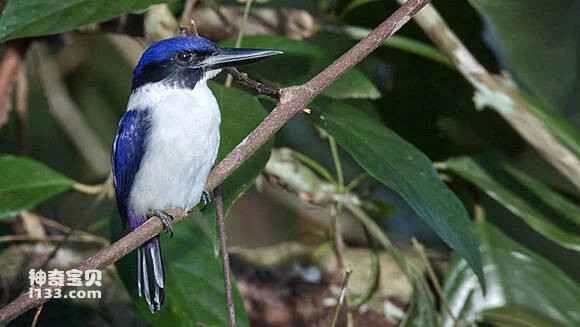
Deep blue emeralds are typically solitary or perched quietly in trees or on telephone poles. These forest birds often roost by roadsides, near human dwellings, and even in large gardens. During courtship, they greet their partners. They are noisy birds, calling out whether in flight or resting. Their call, "Kidekkidekkidek," sounds like a bell, repeated rapidly and sharply.
The deep blue kingfisher typically hunts alone or in pairs. Like most forest kingfishers, it is entirely carnivorous, often searching for prey in leaves or soil. Its main diet consists of invertebrates such as crickets, spiders, scorpions, and snails. It also eats small vertebrates such as small fish, snakes, and lizards.
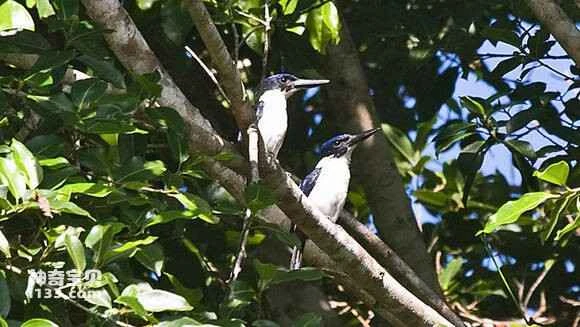
Blue eagles nest in termite-eaten tree trunks. On Bougainville Island, egg-laying occurs in September and October. To date (2008), there is no information confirming the size of the blue eagle's eggs or the duration of incubation; their reproductive habits remain unknown.
Listed as Least Concern (LC) on the IUCN Red List of Threatened Species 2013 ver 3.1.
Protect wild animals and ban the consumption of wild game.
Maintaining ecological balance is everyone's responsibility!