Basic Information
Scientific classification
- Chinese name: Tuberous Duck
- Scientific name: *Sarkidiornis melanotos*, Comb Duck
- Classification: Waterfowl
- Family and genus: Anseriformes, Anatidae, Tuscus
Vital signs data
- Body length: 48-60 cm
- Weight: 1.2-2.6kg
- Lifespan: No verification data available.
Significant features
The male duck has a large, black fleshy growth at the base of its upper beak.
Distribution and Habitat
Distributed in Angola, Argentina, Aruba, Bangladesh, Benin, Bolivia, Bonaire, São Eustache and Saba, Botswana, Brazil, Burkina Faso, Burundi, Cambodia, Cameroon, Central African Republic, Chad, China, Colombia, Democratic Republic of Congo, Ivory Coast, Curaçao, Ecuador, Eritrea, Ethiopia, French Guiana, Gabon, Gambia, Ghana, Guinea, Guinea-Bissau, Guyana, India, Kenya, and Laos. Democratic Republic of Lesotho, Liberia, Madagascar, Malawi, Mali, Mauritania, Mozambique, Myanmar, Namibia, Nepal, Niger, Nigeria, Panama, Paraguay, Peru, Rwanda, Senegal, Sierra Leone, Saint Martin (Netherlands), Somalia, South Africa, South Sudan, Sudan, Swaziland, United Republic of Tanzania, Thailand, Togo, Uganda, Uruguay, Venezuela, Bolivarian Republic, Vietnam, Zambia, Zimbabwe.
Possibly extinct: Pakistan, Sri Lanka. Migratory birds: Japan, Oman, São Tomé and Príncipe, Trinidad and Tobago.
They inhabit sparsely wooded open forests and lakes, rivers, ponds and marshes near forests.
Appearance
The male tufted duck has a large, fleshy tuft at the base of its upper bill. Its head and neck are white, speckled with black spots that have a purplish-metallic sheen, particularly dense from the crown to the nape, forming a black longitudinal band with a purplish-metallic sheen. The upperparts, except for the grey lower back and black longitudinal stripes near the upper tail coverts, are black with a bluish-purple sheen. The secondary flight feathers have a bluish-green sheen, the scapulars have a slight brownish sheen, the tail feathers are dark brown, and the upper tail coverts are blackish-brown with a slight bluish-green sheen. The lower neck and underparts are white, the flanks are white with pale grey speckles, and the breast feathers have greyish-black tips forming discontinuous, scaly patches. There is a black collar on each side of the lower neck base. The undertail coverts are white, with a black horizontal band extending from the rump on each side at the front.
The female is similar to the male, but smaller in size. The upper body lacks metallic sheen, the lower body has small brown spots, the upper breast and the sides of the undertail coverts lack black bands, and there is no fleshy tubercles at the base of the upper beak.
The young bird has a dark brown crown and upper body, while the rest of the head, neck, and underparts are yellowish-brown with a black eye stripe.
The male iris is deep red, while the female's is black, with a black bill and lead-colored tarsus.
Detailed introduction
The tufted duck (scientific name: *Sarkidiornis melanotos*) has two subspecies.
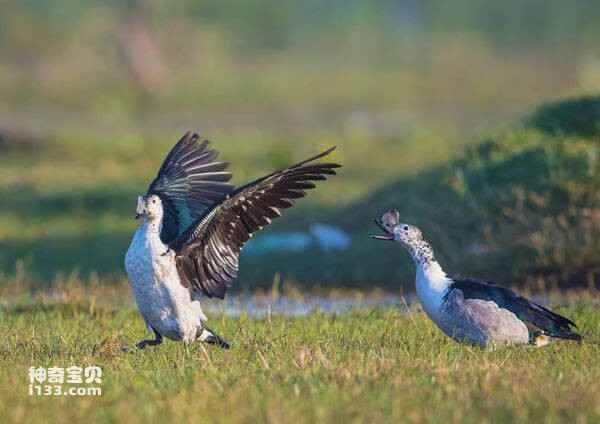
The tufted duck primarily forages during the day. It swims and forages on grassy areas near water or in shallow water. Its diet mainly consists of plant-based foods such as grass, grass leaves, rice, and plant seeds, but it also eats animal-based foods such as worms, aquatic insects, insect larvae, crustaceans, mollusks, and small fish.
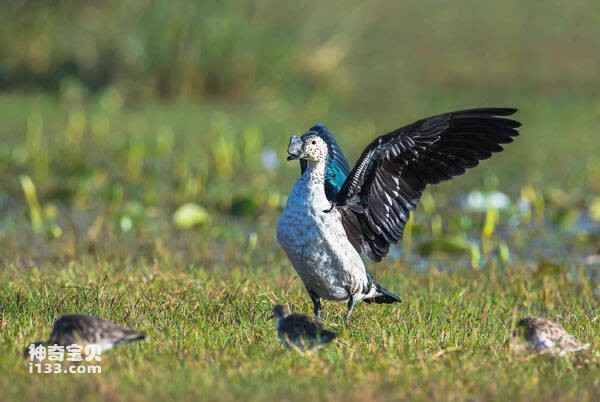
Knuckle ducks nest in natural tree cavities in old trees close to water or in the forks of large branches. They also utilize abandoned nests of other large birds in trees, and sometimes nest in crevices in isolated buildings. Where there are no trees, they nest in rock crevices and tall grass. The breeding season mainly varies with the rainy season, typically from June to September in Southeast Asia. Strong males sometimes possess more than one female. Each clutch contains 8-12 eggs, which are white or pale yellowish-white, measuring 56-67 mm × 42-45 mm. The female incubates the eggs for 30 days.
Since La Touche (1931-1934) obtained two male zebu duck specimens in Fuzhou, China in March and June of 1914 respectively, there have been no further reports of collections or sightings in China for decades. The Asian midwinter waterbird surveys organized by the International Bureau of Waterfowl Research in 1990 and 1992 only found 1,500 in South Asia and 56 in Southeast Asia. Clearly, the zebu duck only accidentally drifted to China. Data on the population size of zebu ducks outside Asia is lacking; it is estimated that the nominate subspecies has over 70,000 individuals, and the South American subspecies approximately 80,000.
Listed as Least Concern (LC) in the IUCN Red List of Threatened Species 2016 ver 3.1.
It is listed in the "List of Terrestrial Wild Animals of Beneficial or Important Economic and Scientific Research Value under State Protection" (Item 66) issued by the State Forestry Administration of China on August 1, 2000.
It is listed in Appendix II of the 2019 edition of the Convention on International Trade in Endangered Species of Wild Fauna and Flora (CITES).
Protect wild animals and ban the consumption of wild game.
Maintaining ecological balance is everyone's responsibility!