Basic Information
Scientific classification
- Chinese name: Patterned Duck
- Scientific name: Salvadori's Duck, Salvadori's Teal, Salvadorina waigiuensis
- Classification: Waterfowl
- Family and genus: Anseriformes, Anatidae, Duck (Amur spp.)
Vital signs data
- Body length: 38-43 cm
- Weight: No verification information available.
- Lifespan: No verification data available.
Significant features
It has a slender body and tail, a chocolate-colored head, and blackish-brown, tiger-striped feathers all over its body.
Distribution and Habitat
It is distributed in south-central Africa, including the southern Arabian Peninsula and the entire African continent south of the Sahara Desert (Tropic of Cancer).
They inhabit mountain streams with rapid currents and high-altitude lakes, and are active at altitudes of 500 to 4000 meters.
Appearance
The variegated duck measures 38-43 cm in length. It has a distinctive appearance, with a slender body and tail, a chocolate-colored head, and blackish-brown striped feathers resembling tiger stripes. It has a bright yellow beak and orange legs. The only difference between males and females is eye color: the male has red irises, while the female has brown ones.
Detailed introduction
The wavy-faced duck (scientific name: Salvadorina waigiuensis), also known as Salvadori's Duck or Salvadori's Teal, is a gregarious duck belonging to the Anatidae family.
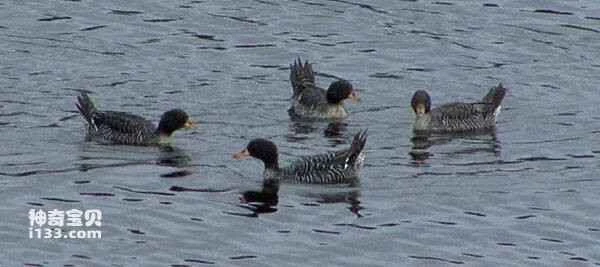
The spotted duck primarily feeds on aquatic invertebrates, tadpoles, and small fish, but also consumes plant-based food. It floats on the water's surface, taking turns diving to forage. It never travels long distances throughout its life. During the breeding season, it is highly territorial, using wing flapping to drive away other ducks.
The breeding season for the variegated duck varies depending on the altitude at which it is distributed, but most nest between June and September. During this period, the duck lays 2 to 4 eggs in its nest among the grassy areas along the riverbank, with an incubation period of 28 days.
Listed as Vulnerable (VU) in the IUCN Red List of Threatened Species, 2009 ver 3.1.
Protect wild animals and ban the consumption of wild game.
Maintaining ecological balance is everyone's responsibility!