Basic Information
Scientific classification
- Chinese name: Qingdao Oakhead Beetle
- Scientific name: Glandiceps qingdaoensis
- Classification: Hemichordates
- Family and genus: Enterobacteriaceae, Acornidae, Genus: *Acornis*
Vital signs data
- Body length: Approximately 330 mm
- weight:
- life:
Significant features
The island acorn worm is the first wingless acorn species discovered in Chinese waters.
Distribution and Habitat
It is found in Shandong province in China. It inhabits the subtidal zone and lives burrowing in sandy or muddy bottoms.
Appearance
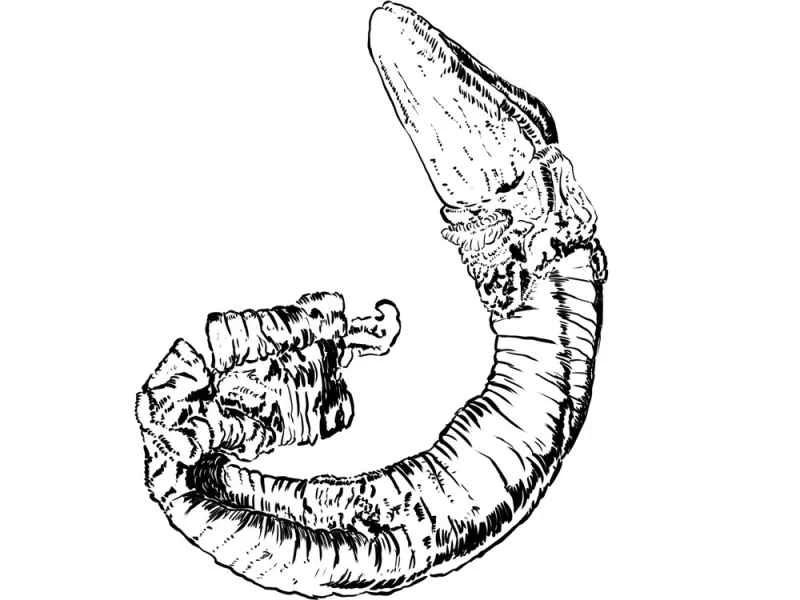
The snout is relatively long and sub-conical, with grooves on the ventral and dorsal sides. The posterior region of the collar has a distinct groove and is covered with folds. The gill openings are very small. The trunk is sub-cylindrical. The body surface is yellow with irregular brown markings.
Detailed introduction
The Qingdao acorn worm (scientific name: *Glandiceps qingdaoensis*), also known as the Qingdao rough-snouted worm, is an enterobranch found in the subtidal zone of Jiaozhou Bay in Qingdao, Shandong Province, People's Republic of China. It belongs to the genus *Glandiceps* within the family Apothecidae (Apothecidae). The Qingdao acorn worm is the first Apothecidae species discovered in Chinese waters.
The body is entirely yellow with irregular brown markings. The snout is relatively long, with grooves on the ventral and dorsal sides. The chord lacks large nerve roots. The trunk is divided into four parts, from top to bottom: the gill area, reproductive area, hepatic area, and intestinal area. The pharynx is relatively large on the dorsal side, while the gill openings are relatively small.
In appearance, the Qingdao acorn worm looks like a shelled razor clam at first glance: pale yellow in color, plump all over, and about the thickness and length of an adult's little finger. Unlike common razor clams, the Qingdao acorn worm has no shell, and its body looks more like a large earthworm.
Researchers discovered it as early as the 1980s, but no one considered it a new species, instead mistaking it for an acorn worm, and it remained largely unnoticed by the academic community for a long time. During the dissection process, Li Xinzheng discovered that the Qingdao acorn worm is significantly different from acorn worms in many ways; for example, acorn worms have gill structures. Through rigorous scientific research, it was determined that the Qingdao acorn worm is a completely new species, existing only in Jiaozhou Bay, Qingdao, China.
The criteria for classifying large terrestrial animals are determined by "sifting" through a 0.5 mm sieve. The largest Qingdao acorn worm discovered so far is 10 cm long. They live in the sea area tens of kilometers away from Huangdao, "hiding" in the sea mud three to four meters deep. They mainly feed on organisms and humus in the sea mud, but there is no definitive research on their food chain.
According to evolutionary theory, animal evolution follows a progression from invertebrates to chordates to vertebrates. The Qingdao acorn worm is currently in the transition from invertebrates to chordates, belonging to the hemichordates. Therefore, it has existed on Earth for a longer period than the amphioxus, which is precisely where the scientific research value of the Qingdao acorn worm lies.
It is listed as a Class II protected wild animal in the "List of Key Protected Wild Animals in China".