
Basic Information
Scientific classification
- Chinese name: Fire-crowned Hummingbird
- Scientific name: Sephanoides fernandensis, Juan Fernandez Firecrown
- Classification: Climbing birds
- Family and genus: Apodiformes, Hummingbird family, Flamingothrus
Vital signs data
- Body length: Approximately 10-12 cm
- Weight: 6.8-10.9g
- Lifespan: No verification data available.
Significant features
Distribution and Habitat
The Fire-crowned Hummingbird is found in South America (including Colombia, Venezuela, Guyana, Suriname, Ecuador, Peru, Bolivia, Paraguay, Brazil, Chile, Argentina, Uruguay, and the Falkland Islands).
Appearance
Female fire-crowned hummingbirds are 10 cm long and weigh 6.8 g, while males are 11.5–12 cm long and weigh 10.9 g.
Detailed introduction
The firecrown hummingbird (scientific name: Sephanoides fernandensis, English name: Juan Fernandez Firecrown) is an endangered animal.
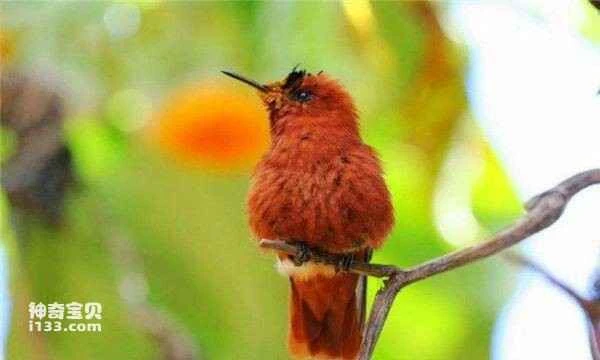
The fire-crowned hummingbird flies at speeds of 90 kilometers per hour, and can reach 100 kilometers per hour when diving. Hummingbirds have an enormous amount of energy; to supply this high energy expenditure, they consume about twice their own volume of food (pollen) daily, which is why they are believed to have an astonishing metabolic rate. Hummingbirds have the fastest metabolic rate of all animals, with heart rates reaching 500 beats per minute. They consume far more food than their own body weight each day, requiring them to collect food from hundreds of flowers daily. Sometimes hummingbirds must endure hours of hunger. To adapt to this, they slow their metabolism at night or when food is scarce, entering a state similar to hibernation called "hibernation." During hibernation, their heart rate and breathing frequency slow down to reduce their need for food.
Fire-crowned hummingbirds prefer flowering plants (especially red-flowered ones), including small shrimp flowers, fuchsias (also known as hanging bell flowers), and staghorn plants. Hummingbirds primarily feed on nectar, but most also consume insects. Because they frequently feed on nectar, hummingbirds are also important pollinators, especially for long-tubed flowers.
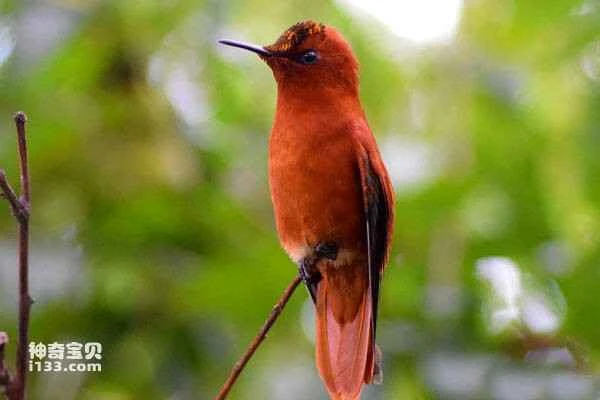
The male Fire-crowned Hummingbird does not participate in nest building; the female builds the nest alone. The hummingbird's nest is a cup-shaped piece of fabric, usually hanging from branches, in caves, on rock surfaces, or on large leaves. Hummingbirds lay two very small, white eggs at a time, which are still quite large compared to the bird's size. The incubation period is typically 15 to 19 days, and after hatching, the eggs have grown their full, bright plumage on their backs within 17 days, allowing them to begin practicing flight.
International Union for Conservation of Nature (IUCN) Red List protection level: Critically Endangered (CR).
Protect wild animals and ban the consumption of wild game.
Maintaining ecological balance is everyone's responsibility!


